Dial scale
Levers under the platform of a round-dial bathroom scale pass a small, fixed share of the load to a steel spring, wherever the load stands. The spring stretches in step with the load, and a toothed rack turns the stretch into a turn of the pointer.
A spring under the levers
A dial scale’s platform rests on levers inside its base. In the scale Andrew Turnbull patented, they are what he calls “the usual system of levers”. The principal lever, which he marks C, has two arms that rest in bearings at the far end and one arm that reaches out past the platform. A second lever, E, hangs from it. The platform stands on four points. Two are on each lever.
A frame stands at the near end. In it a spring hangs by its top, and its lower end is joined to the end of lever C, so the load on the platform is “resisted by the said spring”. The levers cut the load down so far, he wrote, that “a very light spring forms a great resistance”. The spring follows Hooke’s law, so the heavier the load, the more it stretches. On Physics Stack Exchange one reader wrote a bathroom scale’s working the same way, with the weight equal to the spring’s stiffness times its stretch.
Fig. 1 draws his scale cut open, side on, and its dial as you would see it from above. Guess which will move further as a load goes on, the platform or the spring.
What the drawing shows
The spring travels almost nine times further. With 250 lb on the platform, the spring in the drawing stretches 9.0 mm while the platform sinks 1.0 mm. The platform stands on lever C 25 mm from its bearings, and the spring hangs from it 216 mm out. The spring feels only 28.8 lb.
From a stretch to a turn
Turnbull turns that stretch into a turn with two more levers. They stand upright in the frame, marked K and L, and a bar, M, joins their tops. As they swing, the bar moves along “in substantially a horizontal plane”. An arm, N, reaches from lever L to the joint between the spring and lever C. When the spring stretches, L swings and the bar slides. A toothed rack, S, rides with the bar and turns a pinion, R, on an upright shaft through the middle of the dial. The pointer rides on top.
His dial lies flat. It is in “a plane parallel with the platform”. A beam on a scale standing on the floor would be too low to read with ease, he wrote. The flat dial is open to view, and the scale shows the weight “the instant” a load goes on. He did not claim the flat dial itself, which he knew was not new.
In Fig. 1 one turn of the pointer stands for 250 lb, as in a patent of 1917 below. Its marks are set where the pointer stops for each 10 lb. They come out a little uneven. They lie from 13.97 to 14.52 degrees apart. The patent of 1921 calls fitting the marks to such unevenness “objectionable”. It shapes a bell crank to even the movement out instead.
Where the load stands
A load can stand anywhere on a platform scale, and its levers still pass it whole to the weighing part. Turnbull’s levers manage it by their lengths. A pound on lever E’s points pulls down on lever C where E hangs from it, and lever C passes that to the spring. For that pound to pull the spring as hard as a pound on C’s own points, E’s short arm must be to its long arm as C’s short arm is to its arm out to E. In the drawing those are 21.1 mm against 75, and 25 mm against 89.
The platform and its two levers stand alone in Fig. 2, drawn larger, with 80 lb on it. Before you slide the load from one end to the other, guess what the dial will do. Then make lever E’s short arm a tenth too long, and slide it again.
What the drawing shows
The reading holds at 80 lb from one end to the other, while lever E’s share runs from the whole 80 lb down to nothing. With E’s short arm a tenth too long, the reading climbs to 88 lb as the load moves over lever E. NIST Handbook 44, which many states adopt for scales used in trade, tests this with a shift test. On a scale of up to 500 kg, a load of about a third of its capacity goes on the centre of each quarter of the platform in turn.
By law, scales kept out of trade must be labelled “Not Legal for Trade”, and bathroom scales are among them. Those words are printed on the instructions for Health o meter’s 142KL floor scale, which ask you to stand with your weight equally on both feet. A reader in Japan on Physics Stack Exchange got a reading 2.5 kg higher in the tiled bath area than in the bathroom, in a house whose wooden floors give under weight. A reply said the floor’s give does not matter while the scale stands level. A slope does.
Bringing the pointer to zero
Turnbull’s, Weber’s and Health o meter’s scales can all be set to zero. Turnbull hangs his spring from a bell crank, a lever bent at a right angle, and a screw through the frame pushes its lower arm in or lets it out. That raises or lowers the top of the spring, “correspondingly extending or contracting” it, until the pointer stands at zero.
Weber’s scale of 1917 hangs its springs from a beam on a bell crank too. There the screw lifts the beam, the frame and the platform together. The springs’ tension stays as it was, he wrote. So does the accuracy. Health o meter’s 142KL has a zero adjust knob at the bottom. Its instructions say the pointer may drift a little from zero over time. The best time to check is just after you step off.
Handbook 44 asks every scale it covers for a way to adjust its zero. The 1921 patent closes the holes to its spring screws with seals. An inspector of weights and measures puts them on once the scale has been tested.
Reading it standing up
A dial on the front of a box is hard to read from on top of it. Andrew Turnbull, of New Britain, Connecticut, had laid his dial flat in the scale he patented on 21 February 1888, the one drawn in Figs. 1 and 2. Health o meter’s own history says the first bathroom scale was the Juraso, from Germany in the early 1910s. A small mirror at 45 degrees let the user read the dial while standing on it. Marshall Field’s store in Chicago began selling it in 1913. When the First World War cut off supplies, the history says, the store turned to American kitchen scale makers for another.
Mathias J. Weber designed one. He was the superintendent of the Chicago Scale Company. His patent for a scale “especially designed for automatically taking the weight of humans” was filed in January 1917. It was granted that December. Its dial is a light dish whose rim slopes at about 45 degrees, marked in 250 divisions for a capacity of 250 lb. One row of numbers reads right from the front, the other for someone looking down from the platform. A push button in the platform lights a small lamp beside the window, because there is often not enough light to read by.
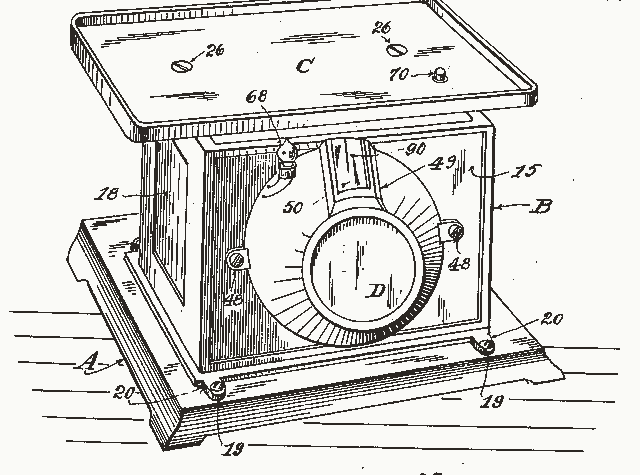
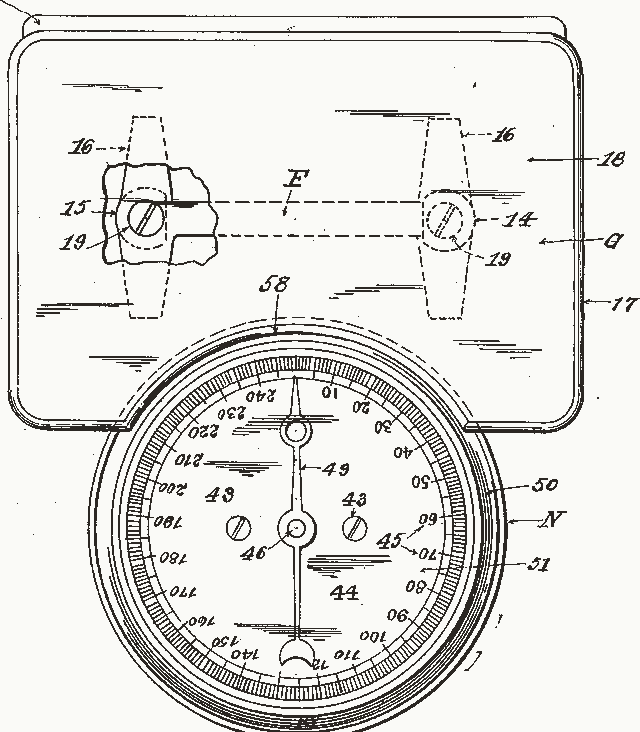
In 1919 Weber and two brothers, Irving and Alfred Hutchinson, formed the Continental Scale Works to make his design, the Health-O-Meter. The maker’s history gives its Model No. 100 a cast-iron frame and a rack and pinion with hardened bearings. It weighed 20 lb, stood eight inches tall and cost $16, with its accuracy guaranteed to within a pound. Its drum-type dial was still hard to read standing up. His patent of 1921 lays a flat dial in front of a low platform, with a hand that turns above it (Fig. 3). It says scales like these were coming into “very extensive use in bath rooms”. The maker’s history calls this his horizontal clock-face dial.
What the drawings leave out
The sizes are the drawing’s own. Turnbull’s patent gives none, and the dial’s one turn for 250 lb is the only number in Figs. 1 and 2 that follows a source, Weber’s patent of 1917. In the model the levers, the bar and the pointer weigh nothing. Nothing rubs. The spring follows Hooke’s law exactly. It hangs straight. Lever C’s two arms run outside lever E, so in the side view E’s post passes behind C. The model also shows only where the parts come to rest. One question on Physics Stack Exchange starts from a 5 kg weight dropped onto a bathroom scale, which reads more than 5 kg as it lands.
A bathroom scale taken apart in 2000 had four levers inside that work as one, with a ratio of 1 to 12, so a load of 120 lb puts about 10 lb on the spring. A pivot turns the spring plate’s up-and-down movement into the rack’s sideways one. Health o meter’s 142KL weighs up to 330 lb, or 150 kg, in steps of 1 lb. A spring scale also reads a little differently from place to place, by as much as 0.5% across the Earth, because the pull of gravity differs.
Sources
Read in November 2026.
- Andrew Turnbull, US Patent 378,382, “Weighing-scale”, 21 February 1888: the scale of Figs. 1 and 2.
- Mathias J. Weber, US Patent 1,249,262, “Weighing-scale”, 4 December 1917, and US Patent 1,382,699, “Weighing-scale”, 28 June 1921: the dials, the zero screws and Fig. 3.
- Rick Crandall, Pelstar LLC, “History of Pelstar, LLC and Evolution of the ‘Doctors’ Beam Scale”, 2010, revised 2021: the maker’s history.
- Health o meter Professional Scales, 142KL mechanical floor scale and its instructions.
- NIST, Handbook 44 (2026), section 2.20, Scales: zero and the shift test.
- International Society of Antique Scale Collectors, “Scale Types”, after M. A. Crawforth’s handbook.
- Marshall Brain, HowStuffWorks, “Inside a Bathroom Scale”, 1 April 2000, in the Internet Archive’s copy of 10 December 2019.
- Physics Stack Exchange, a scale on two floors, August 2014. User report.
- Physics Stack Exchange, a weight dropped on a scale, April 2015. User report.
- Wikipedia, “Weighing scale”: Hooke’s law and gravity from place to place.
The type is Playpen Sans by TypeTogether, under the SIL Open Font License 1.1.