Tape measure
Free of its case, the steel blade of a pocket tape measure stands out straight in the air, and when you let go it winds back in. A spring inside does the winding, a lock holds the blade out, and the loose hook on its end lets it measure from an edge or from a wall.
The hook on the end
Pull a little blade out of a tape and you can wiggle the hook on its end. The hook is a small steel plate bent at a right angle and riveted to the blade. Its rivet holes are oval on purpose, so that it slides along the blade by its own thickness.
Hook it over the end of a board and pull, and the hook slides out, so its inside face, the one touching the board, sits at the start of the scale. Push it against a wall and the hook slides in, so now its outside face sits there. Either way the scale starts where the tape touches the work.
Hooks differ in thickness from one model to the next. The hook on REEKON’s T1 tape is about 1 mm thick, and the hook in a 1991 patent slides 0.033 inch (0.84 mm). The hook in Fig. 1 is 1 mm thick.
Make the hook slide out in Fig. 1, press “Rivet it tight”, then switch to the wall, and guess first whether the tape will read long or short.
What the drawing shows
It reads short. A hook stuck in its slid-out place keeps its inside face at the start of the scale, so against a wall the hook’s own millimetre comes first and the 10 mm mark sits 11 mm from the wall. Stuck in the slid-in place, it makes every hooked reading long by the same millimetre.
On a woodworking forum, in a user report, one member remembered a newly hired engineer who took his new tape to the model shop to have the loose rivet tightened. Years later, as an engineering manager, he was still hearing about it.
Under EU rules, a Class II tape read from its hook may be out by 0.7 mm at 1 m and 0.9 mm at 2 m, so a 1 mm hook that could not slide would put one kind of reading outside the class at every length up to 2 m.
The spring inside
The case holds the blade wound in a coil on a drum, and inside the drum is a spiral spring, like a watch spring. The inner end of the spring is fixed to a post that stays still in the case. Its outer end passes through a slot in the drum and is joined to the inner end of the blade there.
William H. Bangs Jr. of West Meriden, Connecticut, described tapes built this way in 1864, as they were then “generally constructed”. Drawing the tape out winds the spring “more tightly” round the post, and when the pull stops, the spring turns the drum backward and winds the tape on.
Before you drag the hook out in Fig. 2, guess where the coils of the spring will gather.
What the drawing shows
The coils crowd in round the post. Each turn of the drum winds the spring one more turn, so the further the blade comes out, the tighter the spring is wound.
That winding is why a blade comes back fast. Stanley’s springs are “machine wound with very high tension”, and the maker warns against trying to wind one back up by hand. Letting a blade shoot back uncontrolled wears the mechanism and can hurt fingers and eyes. Each rewind ends with the hook striking the mouth of the case, and the blow falls on its rivets; woodworkers say the holes stretch and the tape grows less accurate. Guide the blade in with your hand.
The lock
The lock holds the blade out at any length, against the pull of the spring. Bangs’s tape of 1864 already had one: a ratchet wheel on the drum and a click on the case that caught its teeth, until the user moved a stud on the outside to free the click and let the tape wind in. He called that click the kind “in general use”.
Later locks grip the blade itself. In a design Robert F. West filed for The Stanley Works on 1 April 1963, a thumb button on the front of the case slides a brake down, and its shoe presses the blade against the floor of the case “in a wedge-like manner”. West let the lock slip under a hard push along the blade, a load that could otherwise buckle and damage it.
Press “Lock” in Fig. 3 and then “Let go”, and work out which part is holding the spring back.
What the drawing shows
The shoe holds the spring back. The spring still pulls on the blade through the drum, but the blade cannot slide under the shoe, so the drum cannot turn.
Why the blade stands out
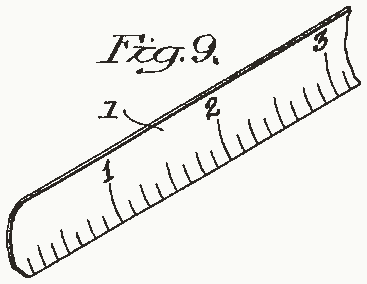
In the case the blade lies flat in its coil. As it leaves the mouth it springs back into a shallow curve across its width, and the curve keeps it straight. Hiram A. Farrand of Merchantville, New Jersey, patented this kind of tape on 3 January 1922. He wrote that in the coil its turns “temporarily lose their concavo-convex section and flatten out” but always tend to regain it, and that straightened out, it has the strength “to prevent it from buckling”. A woodworker on the same forum called a flat tape with no curve “limp”, like a piece of string.
Even a curved blade has a limit. Stanley’s FatMax tapes have 11 feet (3.35 m) of blade “standout”. On its wide blades Stanley deepens the curve where standout needs it, and flattens the first 5 inches or so for marking and for a better grip of the hook.
Slide the blade out in Fig. 4 until it folds. Then turn it over and guess where it will fold this time.
What the drawing shows
Turned over, the blade folds much closer to the case, because the curve helps only one way up. The blade’s weight bends it down, which stretches its top face and squeezes its bottom face. With the curve up, the stretched part is the two raised edges and the squeezed part is the middle, which the curve holds in shape. Turned over, the edges are squeezed instead, the curve flattens, and the blade gives way after a short length.
Older tapes
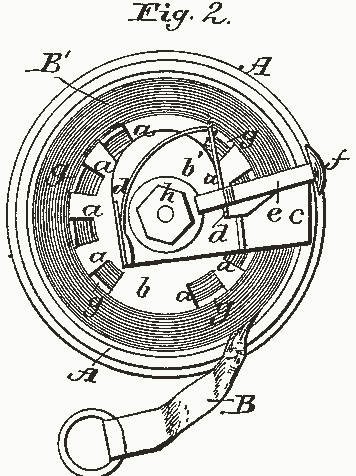
Spring tapes were common enough in 1864 for Bangs to say how they were “generally constructed”. On 14 July 1868 Alvin J. Fellows of New Haven, Connecticut, patented his way of fitting the click (Fig. 5). NIST lists the locking mechanism among Fellows’s improvements, and tape enthusiasts keep 14 July as National Tape Measure Day.
His patent claims less. Fellows wrote that metal cases with this kind of spring and a click were already in use, and he did not claim them. He claimed the manner of fitting the click at the centre of the drum, “so as to hold the tape at any desired position”, with a knob to free it. His spring is fixed to the post at its inner end and to the rim of the drum at its outer end, “as is done in watches”. The case is made “of gum-lac and saw-dust” and coloured with ivory-black, and the tape ends in a ring.
Farrand filed for his patent on 23 October 1919, and it was granted in 1922. His curved tape carries its scale “preferably on its concave surface”.
What the drawings leave out
The sizes are the drawing’s own. No source gives a blade’s thickness, the size of the drum or the case, the length and turns of the spring, or how often the drum turns over a full pull, so Figs. 2 and 3 draw them plausibly. The hook in Fig. 1 is much enlarged, and its blade is drawn far thicker than a real one. No source gives the lengths at which a blade folds, so Fig. 4 shows only that it folds sooner turned over.
Real tapes vary, too. Hooks are held by one, two or three rivets. A woodworker on that forum had a tape that stays out when pulled and winds in only when a button is pressed. None of the drawings shows the blade’s steel, which on Stanley’s tapes is C1095, hardened to about Rc 38 to 45, or the kinks and twists that fast rewinds can put in a blade.
Sources
Read in November 2026.
- A. J. Fellows, US Patent 79,965, “Improvement in Tape Measures”, 14 July 1868, for his click and case; Fig. 5 shows his Fig. 2.
- W. H. Bangs Jr., US Patent 45,372, “Improvement in Spring Tape-Measures”, 6 December 1864.
- H. A. Farrand, US Patent 1,402,589, “Rule”, 3 January 1922, for the curved blade; Fig. 5 shows his Fig. 9.
- R. F. West, US Patent 3,214,836, “Coilable rule”, 2 November 1965, for the lock.
- J. E. Edgell, US Patent 3,443,316, “Tape rule lock”, 13 May 1969, for the spring, the post and the drum.
- R. E. Knapp, US Patent 5,010,657, “Tape measure end hook”, 30 April 1991, for the hook and its rivets.
- Stanley Tools help pages on why the hook moves, standout, selective flattening and the spring.
- REEKON Tools, “[T1] Why the Hook Moves at the Tip”, for the hook’s thickness.
- NIST, D. Sawyer, “Going the Distance on National Tape Measure Day”.
- Directive 2014/32/EU, Annex X, “Material measures of length”, for the accuracy classes.
- The Tape Store, “Taking Care of Your Tape Measure”, for rewinding.
- Sawmill Creek Woodworking Community, “Tape Measure Question”, September 2010: woodworkers on the hook, its rivets and flat tapes. User report.
- Physics Stack Exchange, “How does the bistable spring tape in a slap bracelet (or retractable tape measure) work?”, September 2026, for which way up the curve must face. User report.
The type is Playpen Sans by TypeTogether, under the SIL Open Font License 1.1.