Odometer
Ten figures run round each index ring of a mechanical odometer, and a window in its case shows one figure from each ring. The first ring is turned by the wheel. Each ring after it stands still until the ring before it passes from 9 to 0, and then it moves one tenth of a turn.
A row of figures in a window
A mechanical odometer shows its count as a row of figures behind a small window. Each figure is printed round the edge of a ring. The rings sit side by side on one axle, so the figures line up and read like a number. Curtis H. Veeder’s cyclometer patent calls the rings index rings and the window a sight-opening, which may be closed by a piece of glass, and those names are kept here. A cyclometer is the same counter made for a bicycle. A hub odometer sits on the hub of a wheel.
An odometer that sets the charge for a hired car or truck in the United States must read in miles or kilometres. Its smallest step is a tenth. The tenths figure must stand apart from the rest, by its colour or a decimal point. Only one figure of each ring may be in view, except while that ring is moving on to its next figure. The tenths ring may turn all the time. Every other ring moves in steps.
Four rings and the last 9
Veeder’s cyclometer has four index rings, so its window reads from 000.0 to 999.9 miles. Its gears turn the first ring, the tenths, once for each mile. Each of the other three rings moves only while the ring on its right passes from 9 to 0, and then it moves one figure. So the miles ring turns once for every ten turns of the tenths ring.
Fig. 1 can start from 999.5 as well as from noughts. Guess how many rings move as the window passes 999.9.
What the drawing shows
All four rings move at once. At 999.9 every ring stands at 9, so as the tenths ring passes to 0 it carries the miles ring, which is passing from 9 to 0 as well and so carries the tens ring, and the tens ring carries the hundreds. The window then reads 000.0 again, and the count itself keeps no record of how often this has happened. In October 2026 the owner of a 1979 pickup whose odometer read 70,000 asked on r/MechanicAdvice whether it had gone 70,000 miles or 170,000, a user report of that doubt. Veeder gave his last ring the same locking ring as the others. It has no work to do except to hold the ring on its bearing.
The notch and the pinion
A small gear, the pinion, sits between each ring and the next. In counters of this kind the driving ring has only two teeth, and the pinion has every other tooth cut short on the side that faces it. The long teeth that are left rest on the driving ring’s rim. While two of them rest there, the pinion cannot turn. Its full set of teeth meshes with the next ring, so that ring is held still too. A gear with teeth taken away needs such a holding surface: without one, the teeth would sooner or later meet tip to tip.
Once a turn, a notch in the rim comes round to the pinion, with the two teeth on either side of it. One long tooth falls into the notch and is carried round with the ring until the notch has passed. In Fig. 2 that turns the pinion a third of a turn, and the miles ring two of its 20 teeth, which is a tenth of a turn. Before trying it, guess what the miles ring does while the tenths ring goes on from 8 to 9.
What the drawing shows
The miles ring does not move from 8 to 9. It stays at 3 until the tenths ring is past 9, because only then does the notch reach the pinion. While the pinion waits, its long teeth on the rim hold it still, and it holds the miles ring through its other teeth.
From the spoke to the first ring
On a bicycle the count starts at a spoke. A pin clamped to one spoke strikes the cyclometer’s star wheel at each turn of the wheel and turns it one step. A spring presses the star wheel’s shaft against a disk, so friction stops it jarring out of place or turning too far after a strike. Inside the case, an eccentric on that shaft rolls two gears, fixed together, inside two internal gears. One internal gear is fixed and the other is on the first ring, and their tooth counts differ by one, so the ring turns very slowly. Veeder called this a well-known form of differential gearing, and he chose the gears so that the ring turns once a mile.
Suppose the wheel is 28 inches across. It then rolls about 88 inches at each turn, and turns 720 times in a mile, or 72 times for each tenth. Fig. 1’s readout counts those turns.
A car’s odometer sits on the dash, a long way from any wheel. Veeder’s drive of 1906 carried the turning there through a flexible shaft inside a flexible sheath, with bevel gears at each end. Two more bevel wheels with pawls turned the shaft one way, whichever way the vehicle’s wheel turned, so the register added in both. A car’s mechanical odometer is turned by a flexible cable, a tightly wound spring inside a tube, from a gear on the transmission’s output shaft. In one that was taken apart and photographed, the cable turned three worm gears in a row, each moving its gear by one tooth a turn. Its input shaft turned 1,690 times for every mile.
A wheel of another size
The cyclometer in Fig. 3 is made for a 28-inch wheel. Before you turn the smaller wheel, guess whether the rings will count more road than it rolls, or less.
What the drawing shows
The rings count more road than the smaller wheel rolls. The counter counts turns, and it gives every turn the roll of a 28-inch wheel. A 26-inch wheel rolls 26/28 of that, so the rings count 7.7% too much, and a mile of road reads 1.08 miles. A counter set for one wheel reads high on a smaller wheel, and low on a larger one.
Drivers report gaps of this kind. In 2019 a driver whose car had been brought to the UK from Japan saw the trip meter show 20.4 miles where a GPS app showed 19.8, and one reply on Stack Exchange named tyres of another circumference as the largest cause. A cyclist was told in 2016 to measure the wheel’s roll by rolling the bicycle along, since a tyre’s printed size and its real circumference differ. Both are user reports.
The United States code for hired cars allows an odometer to be 4% out either way. Its tests run 2 miles with the tyres at the pressure posted in the vehicle, and one test works the road out from the wheel’s rolling circumference and its turns.
Veeder’s patent and the law
Curtis H. Veeder of Hartford, Connecticut, applied for his cyclometer patent on 27 April 1895. The patent is dated 22 October 1895. He drew its carry in two forms. In the first, springs bear on flats on each pinion’s sleeve, which he wrote made it easier to set the rings back to zero. In the second (Fig. 4), each ring carries a locking ring with a single notch. Two points of a star wheel on the sleeve bear on it until the notch, in line with the ring’s driving pin, comes round.
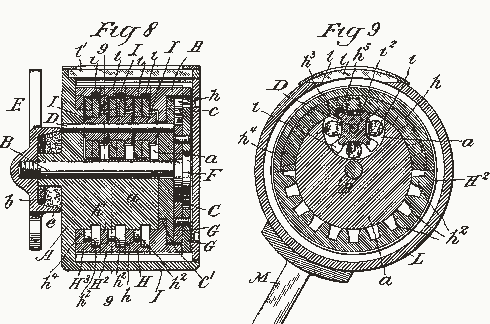
His spoke pin, on a slide so it could be set beside the star wheel, was patented in 1899, and the flexible-shaft drive in 1906. The Smithsonian keeps a Veeder odometer made around 1900, stamped with the patent’s date. The US Geological Survey tested distance measurers, and this is one of those it sent on to the Smithsonian in 1907 after they failed. US law now forbids anyone to disconnect, reset or alter a motor vehicle’s odometer intending to change the mileage it registers. A trip meter, which the driver resets, is not an odometer in that law.
What the drawings leave out
The sizes are the drawing’s own. So are the tooth counts, which Veeder’s patent never gives in words: the miles ring’s 20 teeth, the pinion’s six, the star wheel’s six points and the notch’s shape. The 28-inch wheel is a supposition as well.
Fig. 2 follows the counters whose driving ring has two teeth, and not Veeder’s pin and star wheel. Its two teeth are the two sides of the notch, cut to the path of the long tooth that drops in, which the model works out. It shows one pair of rings out of four. Fig. 1 has no gears at all, and Fig. 3 has none of the gearing inside the cyclometer’s case, nor its spring. No drawing has friction, wear or slack between teeth. Moving a drawing back runs it backwards. A real counter may not, since Veeder’s drive of 1906 adds whichever way its wheel turns.
Sources
Read in November 2026.
- C. H. Veeder, US Patent 548,482, “Cyclometer”, 22 October 1895, for Fig. 4, the index rings, the sight-opening, the star wheel, the gearing and both carries. (US Patent 548,482, 1895, Figs. 8 and 9. Public domain.)
- C. H. Veeder, US Patent 629,731, “Spoke-pin”, 25 July 1899.
- C. H. Veeder, US Patent 833,355, “Driving mechanism for odometers, &c.”, 16 October 1906, for the flexible shaft.
- National Institute of Standards and Technology, “NIST Handbook 44”, 2026, section 5.53, Odometers, for the display, the tests and the 4%.
- United States Code, title 49, section 32702 and section 32703, read in Cornell’s Legal Information Institute copy.
- Smithsonian Institution, “Odometer”, PH.247958, first published at americanhistory.si.edu, read in the archived copy of 6 December 2025.
- Roymech, “Indexing Mechanisms”, for counters’ cut pinions and holding surfaces.
- HowStuffWorks, “How Odometers Work”, first published at howstuffworks.com, read in the archived copy of 27 December 2024, for the pegs, the worm gears and the 1,690 turns.
- Motor Vehicle Maintenance and Repair Stack Exchange, “Speed and odometer differences between dash and GPS”, June 2019. User report.
- Bicycles Stack Exchange, “Possible cause for Google Maps / bicycle odometer divergence”, June 2016. User report.
- r/MechanicAdvice, “How do I know if my odometer rolled over?”, October 2026, via the Arctic Shift archive. User report.
The type is Playpen Sans by TypeTogether, under the SIL Open Font License 1.1.