Spinning top
Gravity tips a leaning top over when it stands still. Set spinning, the same top keeps its lean while its axis goes slowly round a circle. The faster it spins, the slower that circle. Below a certain spin the top can hold no steady circle, and it wobbles and falls.
A disk on a pointed rod
A spinning top stands on one point. The top in the drawings is a disk on a rod, built by Rod Cross of the University of Sydney to film for a paper of 2013. Its aluminium disk is 76 mm across and 8 mm thick. A threaded steel rod 4 mm thick and 60 mm long runs through its middle, held by a nut above and below. The rod’s lower end, 17 mm under the disk, is ground to a sharp point. Cross calls the whole thing essentially a gyroscope without its gimbals.
He spun it on a smooth, level surface, slowly by hand or faster with a string wrapped round the rod, and filmed it at 300 frames a second. It weighs 105 g. That is a little more than two tops sold as toys. The Trompo grande, a plastic top with a metal point, is 2.5 inches (64 mm) across and weighs 2.6 oz (74 g). The Rookie, a wooden top from Mr. Kumamoto’s woodshop in Yame City, Japan, is 70 mm across and weighs 77 g. Spiral grooves on its body guide its cotton string.
Toy tops are set going in other ways too. Pulling away a string wound round its body spins a peg top. A short stem is twirled between two fingers, and a long one between the palms, which keeps the top going much longer. Pump tops are made of tin, metal or plastic. Some tops are for games of chance. The teetotum is a carved wooden top with four or eight sides, and the dreidel that Jewish children use in games during Chanukah is a teetotum.
Where the weight pushes
A still top’s weight acts at its centre of mass, 21.5 mm up the axis from the point. Upright, the weight pulls straight down through the point, so it turns nothing. Leaning 8°, the top holds that centre 3.0 mm sideways from the point. The weight of 1.04 N, pulling down there, gives a turning push about the point, which physicists call a torque.
In Fig. 1 that top is let go at a lean of 8°, either still or spinning 20 turns a second, about as fast as Cross’s first spin. For each, guess where the upper end of the rod will go.
What the drawing shows
Still, the top falls over in the plane it leans in, and its disk hits the floor after 0.11 s, at a lean of 24°. Spinning, the upper end of the rod moves sideways, at right angles to the push. Its lean stays at 8°. In the time the still top takes to fall, the spinning one’s axis goes 16° round.
The sideways move comes from the rim of the disk. Each part of a fast-spinning rim keeps moving along its path. As the weight starts to tip the top, the rim’s front edge lifts and its back edge drops. That tilts the top a little to the side, along the circle. Going round at one lean, the top does not fall at all.
Once round the circle
With its axis going round, the top keeps one lean, and the upper end of its rod draws a circle round the upright line through the point (Fig. 2). The rod’s end goes round the same way as the top spins. Fig. 2 times each circle with the equation for a heavy top circling at one lean on a fixed point, worked with this top’s mass and shape. Guess first whether 7 turns a second gives a faster circle than 20, or a slower one.
What the drawing shows
At 7 turns a second the circle goes almost three times as fast as at 20. The same push swings a smaller spin round faster. One circle takes 2.5 s at 20 turns a second and 0.86 s at 7. The lean hardly changes it. At 21° the circles take 2.5 s and 0.87 s. At 2 turns a second no circle is possible at either lean, and the top falls onto its disk.
In Cross’s film the first circle took 2.32 s, at a spin of 126 rad/s, which is about 20 turns a second, and a lean of 8°. For that spin the equation gives 2.55 s, a tenth longer. Fig. 2 follows the equation.
The shortcut and the full equation
A shortcut gives the circle’s speed. Multiply the weight by the distance from the point to the centre of mass, then divide by the spin times the top’s moment of inertia about its axis. So the faster the spin, the slower the circle. The lean drops out, since the push and the sideways share of the spin both grow with it. The shortcut holds only while the spin is much faster than the circle.
The full equation also counts the turning of the whole top as its axis goes round. It has two answers, a fast circle and a slow one. The slow one is usually seen. Fig. 3 plots both ways of working it for this top at a lean of 8°. Guess how slow the spin must get before the shortcut is a tenth out.
What the drawing shows
The shortcut’s circle is more than a tenth too long once the spin drops below 4.5 turns a second. From 15 to 20 turns a second the two agree to within 1%, and at 10 the shortcut is 1.7% long. At 7 turns a second, a lean of 21° changes the full equation’s circle by 0.2%. Under 2.6 turns a second, or 16 rad/s, the full equation has no answer at all. There the top cannot circle at one lean, though the shortcut still gives a circle. Cross saw his top fall when its spin dropped below about 15 rad/s.
His last filmed circle, at 44 rad/s and a lean of 21°, took 0.73 s. The full equation gives 0.87 s there, nearly a fifth longer.
Covert’s peg-top
Henry C. Covert of New Haven, Connecticut, filed his patent for an improved peg-top in June 1901, and it was dated 1 April 1902 (Fig. 4). Tops were old by then. Clay ones 5,000 years old have been found in Iraq. In Covert’s day, spinning competitions were held in city streets and parks, and in 2022 the top went into the Toy Hall of Fame at The Strong.
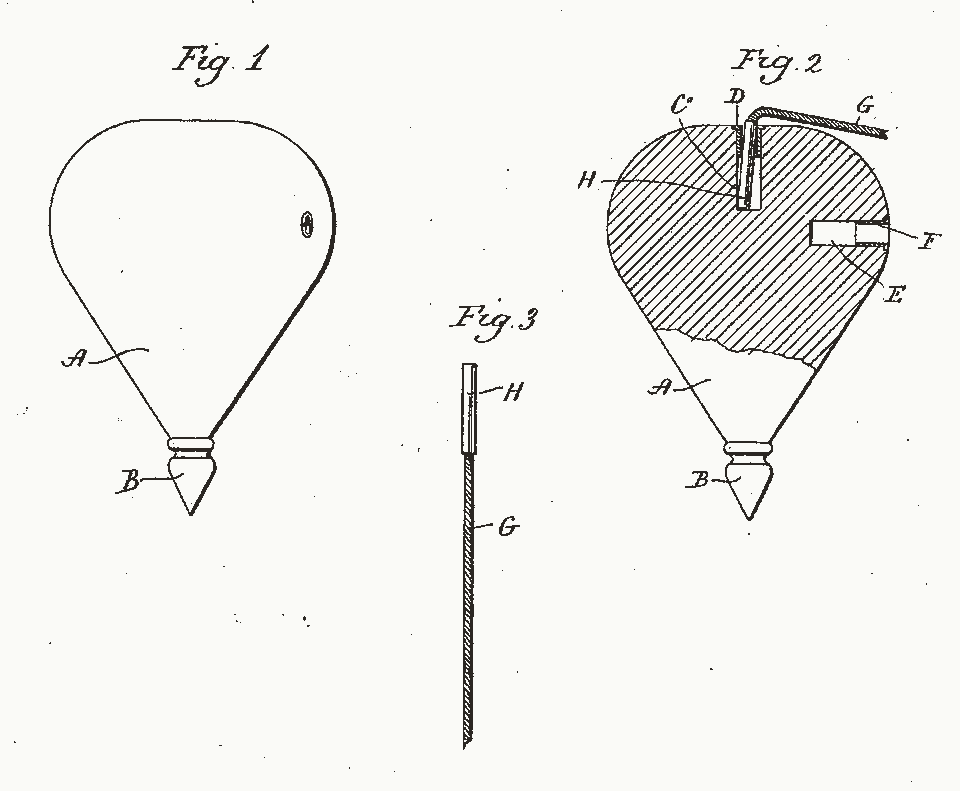
His top A is “of the usual form of peg-top”, rounded at its upper end and tapering to the usual peg B. Such a top, he writes, usually had a head at its upper end, “which is most generally removed by the user”. In its place he made a small recess, lined with a metal bushing, for the end of the string.
His string G has a stiffened end H, wrapped with metal or wire like the end of a shoelace, or dipped in paint. The end sits in the recess while the string is carried down to the peg and wound on the body, and it slips out when the top is thrown. Without it, boys often used a string with no knot and kept wetting its end. Dragged on the ground, Covert wrote, such a string “soon becomes soiled and is a very unclean practice”. A knotted one could tangle at the peg and pull the top back.
What the drawings leave out
The model holds the point on one spot. It has no friction. A Physics Stack Exchange answer, a user report, says friction at the floor is what stops a real top. Cross’s top slowed from 126 to 44 rad/s in 31 s, while its circle sped up from 2.7 to 8.6 rad/s and its lean grew from 8° to 21°. It fell after 430 revolutions. At high spin his tops rose slowly, and at low spin they fell slowly, where the model keeps one lean.
A top on a rounded peg rolls on the floor instead of turning on one spot. A Physics Stack Exchange question, also a user report, asks why a top knocked over with a finger becomes almost upright again. The accepted answer puts it down to sliding friction at a rounded bottom, while Cross found that rolling friction can raise a top on a rounded peg. A tippe top, which one poster on r/toys found “turns upside down when it spins” (a user report), ends up spinning on the peg it was spun by.
The drawings leave out the bobbing of the lean that comes in as a top slows, the fast second circle the full equation allows, and the small loops Cross filmed, which he thinks most likely came from his top being slightly unbalanced. The still top in Fig. 1 falls as one rigid piece turning about its point, with nothing sliding. The top drawn in the first two figures has the sizes and masses of Cross’s disk and rod. Only the point is the drawing’s own. Cross says the rod is ground to a sharp point, and here it is a cone 3 mm long.
Sources
Read in November 2026.
- Henry C. Covert, US Patent 696,719, “Spinning-top”, 1 April 1902: its words, and its drawing for Fig. 4.
- Rod Cross, “The rise and fall of spinning tops”, American Journal of Physics 81, 280–289, April 2013: his top, the full equation and the filmed spin.
- Rod Cross, “Spinning tops, gyroscopes & rattlebacks”, December 2017: the rim and the sideways move, and the tippe top.
- R. Nave, HyperPhysics, “Precession of Top”: the shortcut and where it holds.
- Michael Fowler, “Steady Precession”, Graduate Classical Mechanics, LibreTexts: the same equation, and why the lean drops out of the shortcut.
- Oscar Bolina, “The Precessing Top”, May 2000: the same equation and its slowest spin.
- NIST, “standard acceleration of gravity”, for the weight.
- The Strong, “Top”, inducted 2022, published September 2022: the kinds of top and their history.
- Spintastics, “Spin Tops”, the maker’s page: the Trompo grande.
- Goenne, “The Rookie wooden top”: its size and string.
- Physics Stack Exchange, “Why does a spinning top get back upright when knocked?”, September 2016, and its accepted answer. User report.
- Physics Stack Exchange, “How is angular momentum conserved when a spinning top finally stops spinning?”, July 2011, and its accepted answer. User report.
- r/toys, “I found a spinning top that turns upside down when it spins.”, September 2022, via the Arctic Shift archive. User report.
- USPTO Patent Public Search, 29 top patents before 1931, opened for a top’s body, peg and string.
The type is Playpen Sans by TypeTogether, under the SIL Open Font License 1.1.