Yo-yo
Between the two halves of a yo-yo, a string is wound round a short axle. Let it go and the string unwinds, so the yo-yo has to spin as it falls. At the bottom that spin can wind it back up. Whether it comes up at once or stays down spinning depends on how the string holds the axle.
A spool on its own string
A yo-yo falls slowly because it cannot fall without turning. Every centimetre of string that comes off the axle turns it, and the turning takes much of the energy the fall gives. A lecture wheel 121 mm across, on an axle 4.8 mm thick and hung from two strings, shows it. The sums give 5.8 seconds for the wheel to fall 51 cm. Timed, it took about 5.2 seconds. A stone takes 0.32 seconds to fall as far. The mass drops out of the sums. Only how it is spread out, and how thick the axle is, change the speed.
Fig. 1 works the same sums for a yo-yo of its own. Its discs are 56 mm across and carry all its weight. Its axle is 6 mm thick and holds a metre of string 1 mm thick. Each turn of that string lies on the turn before, so wound up it reaches 18 mm from the middle. Before you turn the yo-yo of Fig. 1 down its string, guess where on the way down it falls fastest.
What the drawing shows
A little past halfway, 59 cm down, it is falling at 1.74 metres a second. Then it slows. The string comes off the outside of the winding, so the place it leaves from moves in from 18 mm to 3 mm, and each centimetre of string turns the yo-yo more. With the string all off, it falls at only 0.66 metres a second and spins 35 times a second. The whole metre takes 0.85 seconds, almost twice as long as a stone dropped a metre.
Where the fall’s energy goes
Just after you let go, 54% of the energy the fall gives goes into spin. By the bottom it is 98%, because the string leaves from so near the middle. So the yo-yo reaches the bottom turning hard and hardly moving down. In the drawing it is turning 2,112 times a minute.
What it does next depends on how the string ends. Tied to the axle, the end holds. The yo-yo goes on turning the same way and swings under the end in half a turn, which in the drawing takes 14 thousandths of a second. Now the string meets it from the other side, so the same spin winds the string back on, and the yo-yo climbs. The height it gains comes out of its spin. The climb is the fall run backwards. It passes each height at the speed it fell past it. With “Tied” picked, keep turning the yo-yo of Fig. 1 past the bottom to watch it come up. It is back at the finger 1.71 seconds after it left, because nothing in the drawing rubs.
A string through a hole
By the account of a University of Houston radio series, the first US patent for a toy like a yo-yo was granted in 1866. James L. Haven and Charles Hettrick of Cincinnati, Ohio, were granted Patent 59,745 on 20 November that year, for what they called a bandelore. They made both disks of metal, joined at the middle by a rivet through two bosses that lock into each other like a clutch. Metal, they wrote, gave the toy the momentum it needs to work easily. Each disk’s thick rim, they said, works as a fly-wheel.
Fig. 2 is their own cut through the toy. One or both disks had a small hole just outside the boss, to secure the string.
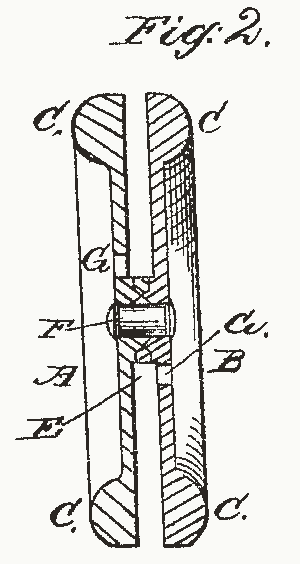
A string held fast to the yo-yo leaves it no way to spin in place. Once its string has run out, the yo-yo has to wind it back on, as the tied string of Fig. 1 does, and climb.
A loop that lets it sleep
By the same account, in 1928 Pedro Flores, an immigrant from the Philippines working as a porter at a hotel in Santa Monica, California, made the yo-yo popular there. In place of a knot round the axle he used a loop, which let the yo-yo sleep, or keep spinning with all its string let out. He went on to open the Yo-yo Manufacturing Company in Santa Barbara. Donald Duncan later bought it out.
Someone asked on Physics Stack Exchange why a yo-yo bounces back up by itself once its string is fully out. The answer they accepted describes the loop as a little larger than the axle. The spinning axle slides on the lower part of the loop, and the weight of the yo-yo, pulling on the string, stops the loop being swept round with it. The rubbing slowly takes the spin away.
A beginner’s guide posted on the YoYoExpert forums says a wooden yo-yo with a fixed axle sleeps for about 10 seconds. Fig. 3 gives its wooden axle that much friction. Dropped as in Fig. 1, it stops turning 10 seconds after reaching the bottom. Beside it is a yo-yo on a ball bearing, given the 30 seconds the guide gives one with a small bearing. Before you leave both of them in Fig. 3 asleep for five seconds, guess how far up a tug could then bring the one on the wooden axle.
What the drawing shows
A tug then could bring it only 24 cm up the metre. After five seconds the wooden axle still turns at half its first speed, but the energy in a spin goes with the square of its speed, so a quarter is left. The bearing still has enough then for 68 cm. Even a tug at once brings either one up only 98 cm. The other 2.2% of the energy was its falling speed, and that went when the loop stopped the fall.
Waking it with a tug
A slight upward jerk on the string wakes a sleeping yo-yo. A patent of 1965 for a yo-yo on a ball bearing has the jerk wedge one or more turns of string between the bearing and the disks, and the yo-yo comes quickly back to the hand.
Someone asked on Physics Stack Exchange what a flick of the wrist changes. In the answer they accepted, the flick raises the friction between the string and the axle until the string starts to wind. After that, string lying on string grips harder still. It rarely slips. Another reader wrote that a jolt can double the string up on itself in the narrow gap. The answer on the loop has the hand drop a little first, so that the string goes slack and the spinning axle can drag it round and catch it. Press Tug in Fig. 3 to see those steps in the order the readers give them: the loop comes free, is dragged round, and a turn of string closes over it. The drawing poses those steps. It does not compute them.
On a ball bearing
Milton S. Isaacson, of Trotwood, Ohio, filed that patent in January 1963. It was granted on 30 March 1965 as US Patent 3,175,326. Its string loops round the outer ring of a ball bearing, and the disks turn with the inner ring on a shaft. Isaacson wanted the yo-yo to keep turning, fully let down, for long periods. He also advised throwing it down backhand, to give it somewhat more momentum. By one collector’s list of US yo-yo patents, it is the first known true ball-bearing yo-yo.
The YoYoExpert guide sorts bearing yo-yos into two kinds. A responsive one has a smaller bearing and something in the gap for the string to grip. It sleeps about 30 seconds. A tug still brings it back. An unresponsive one has a wider bearing and pads set flush with the walls. It sleeps a very long time, and comes back only if the player does a bind, doubling the string over inside the gap.
A Reddit user asked r/Throwers how long others had made a fixed-axle yo-yo sleep. As a child, the post says, they saw others get more than 30 seconds from a plain Duncan, while they were lucky to get 3. Replies include 15 seconds with a cotton string, and a minute with a nylon one. One player adds that ten seconds of spin is plenty for most transitions on a fixed axle.
What the drawings leave out
The sizes are the drawing’s own. Both moving drawings leave out the air and treat the string as weightless. Fig. 1 has no friction while the yo-yo falls or climbs, which is why its tied yo-yo gets all the way home. One reader on Physics Stack Exchange names the rubbing at the axle and the air as what stops a real one. Fig. 1’s string winds in one stack, a turn on a turn. Its discs are flat and even, with none of the extra metal Haven and Hettrick put in the rim. And its yo-yo is only let go, though Isaacson advised a throw.
In Fig. 3 both yo-yos slow at a steady rate, to sleep times taken from the guide’s round numbers. Players on the YoYoExpert forums say a sleep depends mostly on the thrower and how straight the throw is. The drawing’s yo-yos never tilt or touch the walls of the gap, and the tug itself lifts nothing. Each string is drawn as a single line.
Sources
Read in November 2026.
- J. L. Haven and C. Hettrick, US Patent 59,745, “Whirligig”, 20 November 1866, the bandelore: the text and the drawing sheet.
- M. S. Isaacson, US Patent 3,175,326, “Ball bearing toy”, 30 March 1965.
- University of California, Santa Barbara, physics lecture demonstrations, 28.33, Maxwell’s yo-yo.
- M. E. Solino and S. Mintz, “The Engines of Our Ingenuity”, episode 2796, “The Yo-Yo”, University of Houston, first aired 29 May 2012.
- R. Brough, “U.S. Yo-Yo Utility and Design Patents”, version of November 2017.
- Wikipedia, “Yo-yo”, for the bind.
- Physics Stack Exchange, “Why does a Yo-Yo sleep, and then awaken?”, June 2015, with the answers given. User report.
- Physics Stack Exchange, “Why does a yo-yo bounce back up after reaching its full extension?”, March 2021, and the answer accepted. User report.
- shatterFX, “A Beginner’s Guide to Yoyo”, YoYoExpert forums, June 2019. User report.
- YoYoExpert forums, “Sleep time?”, January 2016. User report.
- r/Throwers, “What’s the longest you’ve gotten a fixed axle yo-yo to sleep?”, January 2023, via the Arctic Shift archive. User report.
The type is Playpen Sans by TypeTogether, under the SIL Open Font License 1.1.