Kaleidoscope
Down the length of David Brewster’s kaleidoscope run two strips of reflecting glass, touching along one edge. A few loose pieces of coloured glass lie in a shallow cell at the far end. Look in through the eyehole and whatever lies between the two strips comes back again and again, round a centre, as one ring.
Two plates in a tube
Each strip is a flat plate of glass, five to eight inches long (13 to 20 cm), and the two are joined along one edge. They are cut narrower at one end, one to two inches wide at the far end and half an inch at the end you look through. Their backs are ground or blackened. Only the front faces reflect.
The plates go into a tube at an angle, their joined edge running along its length. At the eye end they reach the very end of the tube, because your eye has to come as close to them as it can. With plates of one width all along, the joined edge lies near the bottom of the tube, and the eyehole sits just above it. At the far end the pieces lie in a cell that touches the ends of the plates. Those were Brewster’s three conditions for a perfect picture: an angle that is a whole part of a circle, the pieces against the plates’ far ends, and the eye at the corner. Fig. 1 has two engravings from his book of 1870.
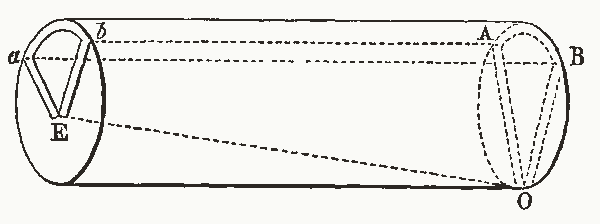
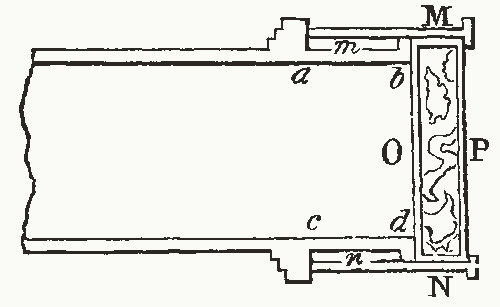
Brewster pointed the tube at the brightest part of the sky by day, or at a candle in the evening, and liked best a window shutter a little to one side of the light. Never point a kaleidoscope at the Sun. It is not safe to look straight at it without special eye protection, and through a camera lens, binoculars or a telescope with no solar filter the bright Sun injures the eye at once. A short kaleidoscope has a lens at its eye end.
Copies from copies
Set the plates at 60°, a sixth of a circle, and you see the opening between them six times round the centre. One of the six is the opening itself, seen straight. Two more are its images in the two mirrors, each reversed like a face in a looking-glass. The image in one mirror then stands in front of the other mirror like a new object, so it has an image there too, and that copy of a copy is the right way round again.
Harris’s “Optics” explained the sixth part, opposite the opening, as one more reflection of a copy beside it. Brewster showed that it is two halves, one seen in each mirror, meeting along a line, and called Harris’s account absurd, since two images would then lie on top of each other.
The light from one brass piece is traced to each of its copies in Fig. 2. Before you slide the piece across, guess which mirror shows you the copy that needs three bounces.
What the drawing shows
The copy that needs three bounces always shows in the mirror the piece is nearer to. One more image reaches the eye from the nearer mirror, so at 60° that mirror shows three copies and the farther one two. Slide the piece over the middle line and that copy changes mirrors, though it keeps its place in the ring. With the piece nearer B, that copy’s light meets B, A and B again, deep in the corner.
The two halves of the last copy meet along a seam on the line from the corner through your eye, so the seam moves whenever your eye does. Someone on Reddit noticed this at two mirrors meeting in a corner, where the line between them always sat on one eye, and a reply said each eye sees a different reflection. When a kaleidoscope’s angle is a little off, the last copy can look doubled, because the pupil lies on both sides of that line. A very small eyehole cures it.
Turning the cell
In the simplest build, two glass discs hold the pieces at the far end, kept apart by a ring, and you turn the whole tube in your hand. New pieces come before the opening by their own weight. Turning the whole tube brings the darkest parts of the ring, the ones made by the most reflections, to the top, which Brewster called very disagreeable.
His better build holds the pieces in a box of two glasses an eighth or a tenth of an inch apart, in a cell that turns on the tube’s far end. You hold the tube with the corner down, by a mark on its upper side, and turn the cell with the other hand. The pieces are carried round in circles across the opening. They fall back by their own weight. Fig. 3 draws that cell and the view through the eyehole together, at 60°. Before you turn the cell, guess what becomes of a piece that lies across the edge of the opening.
What the drawing shows
Only the part inside the opening shows, and it meets its own reflection along the mirror’s edge, so the ring gets a shape that is the same on both sides of that line. Brewster called this the fundamental principle of the instrument. It joins a shape to its reversed image, so a lopsided piece becomes a symmetrical one.
Later makers also put liquids in the box. In 1873 C. G. Bush of Boston patented a sealed glass vessel, like a tiny spirit level, holding two liquids of different weight and colour, which move past each other by their weight as the box turns. A vessel holding one liquid and a bubble of air was already in ordinary use.
Angles that close the ring
The angle must go into 360° a whole number of times, and for any piece in any place that number must be even, as for 60°, 45° or 30°. To set his plates, Brewster pointed the tube at a line lying very slanted to one plate, then opened or closed them until a star of 8, 10 or 12 parts appeared with no line broken.
Fig. 4 puts a slanting stick and a bead in the opening. Before you set the mirrors to 72°, a fifth of a circle, guess whether the stick’s copies will still join.
What the drawing shows
At 72° the slanting stick breaks at the seam. Every other join stays clean. The two parts that meet there are both turned copies, never a copy and its reflection, so they cannot match unless the piece lies the same way to both mirrors, as the square stick does. At 50° the ring has 7.2 parts, the last part on each side is cut off after 5°, and the copies at the seam miss each other or meet at a bend that no other join has.
Brewster counts the reflected images as one less than the number of parts, five at 60° and four at 72°. A physics site’s rule takes the whole part of 360 divided by the angle and subtracts one, except when that number is odd and the piece is off the middle. On Physics Stack Exchange one user drew six images at 65°, where the rule they had been taught gives five, and another drew eight at 50° for an object on the middle line; the accepted answer agreed on eight.
The drawing’s geometry gives eight there too. From the corner, where a kaleidoscope puts your eye, only six of them are in view, so that point shows seven times counting itself, as the bead in Fig. 4 does at 50°; the other two lie past the seam. At 72° a point off the middle has five images, and from the corner you see four.
A patent and a craze
The idea came to Brewster in 1814, during experiments in which light was reflected again and again between plates of glass. The pattern turned regular only later, when he was testing fluids in a trough made of two glass plates cemented at a sharp angle. Some cement had squeezed through at the far end, and it looked far more regular than anything he had seen held away from the plates. That gave him his three conditions.
He took out a patent, given by Nagy as UK Patent No. 4136 of 1817. One of the patent instruments was shown to some London opticians, and the kaleidoscope became known before any number could be made for sale. By the reckoning of those best able to judge, two hundred thousand were sold in London and Paris in three months, and perhaps not a thousand of them were made on scientific principles. He described the instrument in a treatise of 1819 and again in a book of 1870.
Hinged mirrors were older. James Watt wrote to Brewster about two looking-glasses hinged to open and shut and stood on a drawing, from a gardening book by Bradley of 1731. Watt had seen one in his father’s house seventy years before, and thought the kaleidoscope very different.
Three mirrors
Brewster also built kaleidoscopes from three or four plates, which he called polycentral, because their pictures repeat round several centres. Three plates make a prism with a triangle for its end, so their angles add up to 180°, and each angle must still be an even part of a circle. That leaves three sets: 60°, 60° and 60°; 90°, 45° and 45°; and 90°, 60° and 30°. Four plates work only as a square or a rectangle, since any other four-sided shape has a corner wider than 90°.
With three plates at 60° the opening is a triangle with equal sides, and every copy is a triangle too. The copies gather into six-sided patterns round each of the opening’s three corners, and further reflections add more triangles round those. Only one of the three plates has to be ground to its shape with great accuracy, the one laid with its edges on the faces of the other two.
What the drawings leave out
The sizes are the drawing’s own. A real cell holds many more pieces, and each falls by its own weight. In Fig. 3 each piece rides its own circle and drops back at a set point, so the same turn always gives the same picture, and turning back runs it backwards.
The copies are all drawn equally dark. Real copies lose some light at each reflection. With plates at 18° or 22.5° the darker parts show plainly, while at about 30°, with the eye at the corner, someone new to it can hardly tell the straight view from its reflections.
No lens is drawn at the eye end, and the light’s paths show only end on, as seen down the tube. The mirrors drawn have no thickness. The front face of the glass must do the reflecting, since a looking-glass reflects from its back and leaves a gap as thick as the glass between a piece and its image.
Only the angles come from a source. They are Brewster’s 60°, 45° and 72°, and the 50° a Stack Exchange user drew.
Sources
Read in November 2026.
- D. Brewster, “A Treatise on the Kaleidoscope” (Edinburgh, 1819), the Wellcome Library copy: the three conditions, the patent and the sales.
- D. Brewster, “The Kaleidoscope”, third edition (London, 1870): the plates, the copies and their count, the cell, the angles, three plates, Watt’s letter, and Figs. 21 and 22 shown in Fig. 1.
- D. Nagy, “The kaleidoscope and symmetry”, Symmetry: Culture and Science, 1990: the patent number and Kircher’s angles.
- C. G. Bush, US Patent 143,271, “Improvement in objects for kaleidoscopes”, 30 September 1873: the sealed vessel of two liquids.
- Kenyon College, Early Apparatus: five images at 60° and Brewster’s dates.
- NASA Science, “Eclipse Viewing Safety”, updated 20 March 2026: looking at the Sun.
- Concepts of Physics, “Multiple images with plane mirrors”: the textbook count.
- Physics Stack Exchange, “Images formed by a pair of plane mirrors”, September 2017. User report.
- Physics Stack Exchange, “Why are 8 images formed for a object kept symmetrically between two mirrors kept at angle 50°?”, December 2019, with the answer accepted there. User report.
- r/explainlikeimfive, “ELI5: I just noticed if I stand in front of two diagonal mirrors that meet, the vertical line between the mirrors will always be on whichever eye is closed …”, June 2021, via the Arctic Shift archive. User report.
The type is Playpen Sans by TypeTogether, under the SIL Open Font License 1.1.