Spirit level
From one bubble of air sealed in a short tube of liquid, a spirit level reads the tilt of a surface. The tube is bent very slightly, and the bubble always comes to rest at its highest point. Tilt the level, and that point moves along the tube.
The top of a bent tube
The vial of a spirit level, or bubble level, is a sealed tube, slightly curved and partly filled with liquid. The surface of the liquid stays horizontal. The bubble is much lighter than the liquid, so buoyancy drives it to the highest point of the curve. Every vial has this curve inside it, even where it cannot be seen.
The vial in Fig. 1 is one of Level Developments’ bent vials, number 6044/101. It is 7 mm across and 52 mm long between its shoulders, and its bubble is 9 mm long. Its glass is bent to a radius of 283 mm. That is a gentle bend. Between the middle of the bore and each shoulder, its top drops by only 1.2 mm. Marks on a vial are often 2 mm apart, and the drawing’s marks are spaced that way. Tilt the board in Fig. 1 a mark at a time, and guess how far it must tilt before the bubble reaches the end of the vial.
What the drawing shows
The bubble meets the end of the vial at a tilt of 4.29°, which raises one end 75.1 mm in every metre. Past that it can go no further. Each mark is worth a tilt of 0.405°, or 24.3 minutes of arc, where the maker lists 24. The rule behind all of these is that the bubble’s move equals the radius times the tilt, measured in radians. Aluminium levels are sold with an accuracy of 0.5 mm in each metre. That tilt would move this bubble only 0.14 mm, while a bubble can be centred to about 0.5 mm. A 2 mm move at 0.5 mm in each metre takes a radius of 4,000 mm.
Gentle curves and tight ones
The curve of a vial is a piece of a larger circle. The radius of that circle sets how curved the vial is, and so how sensitive. A larger radius lets the bubble react to smaller movements. Sensitivity is measured on a level a metre long, by how far one end must rise to move the bubble 2 mm. For most spirit levels on the market the standard is 10 mm, which is a radius of 200 mm. Levels five and ten times as sensitive are sold too, and their radii work out at 1 and 2 metres.
On the Practical Machinist forum, a member wrote that the radius sets a vial’s sensitivity first. After it come the evenness and finish of the inside and the thickness of the liquid. This is a user report, from their own use of levels.
Vials are made with radii from 30 mm to 100 metres. For a 2 mm move, the tilt is 57 minutes 18 seconds of arc at a radius of 120 mm, 14 minutes 20 seconds at 480 mm and 3 minutes 35 seconds at 1,920 mm. Fig. 2 bends four tubes of one size to those three radii and leaves the fourth straight. Before you tilt the frame, guess which bubble will move furthest, and where the straight tube’s bubble will go.
What the drawing shows
The bubble in the gentlest bend moves furthest. At a tilt of 0.5°, it travels 16.8 mm in the 1,920 mm tube, 4.2 mm in the 480 mm tube and 1.0 mm in the 120 mm tube. At 0.63° the gentlest one reaches the end. Its tube still looks straight. Its bend drops 0.18 mm between its middle and each end, far too little to see in a tube 7 mm across and over 50 mm long. The straight tube’s bubble runs to the raised end at the smallest tilt. A straight tube has no highest point of its own, only a higher end, and with one, levelling would be impossible.
Thevenot and Huygens
In 1692 Christiaan Huygens wrote out how to use the level of Mr. Thevenot. He described it as a small glass tube almost full of water, with an air bubble about a quarter of its length. He found it very sensitive, above all with a fairly large bubble. Such tubes are never found perfectly straight, he wrote, and that hardly matters. The reader should turn the side that looks slightly convex upward. The inside then curves like a very large circle, little different from a straight line.
The editors of Huygens’ collected works date Thevenot’s first description to a letter to Viviani of 15 November 1661, and name a letter to Huygens that was probably earlier. An unsigned work printed in Paris in 1666 described it again. Thevenot’s own description, they note, spoke only of a cylindrical tube. They quote a 1913 history of physics by E. Gerland, which calls a tube exactly cylindrical inside over-sensitive, and so useless for its purpose.
Scientific American told it differently in 1869. It dated the level to Thevenot in 1666 and its description to the Journal des Savants of 15 November 1666. There it was called an air level, a glass tube sealed at both ends, containing spirits of wine, “which do not freeze”. So the two accounts differ on the liquid. Huygens wrote of water, and the magazine wrote of spirits of wine. Wikipedia names Thevenot the inventor before 2 February 1661, from his letters to Huygens.
Marks that read a slope
Thomas Obadiah Sharp of Roxboro, North Carolina, was granted US Patent 807,873 for a spirit-level on 19 December 1905. His tube has a flat underside, which sits on the flat floor of a pocket in the stock. Its ends are square. Its upper surface is curved on a segment of a circle. Graduations run from zero, at its highest point, out to each side. In his words they “are the same as lineal measure, on the scale of one inch to the foot”. In Fig. 3 they are numbered in eighths, out to 1 1/8.
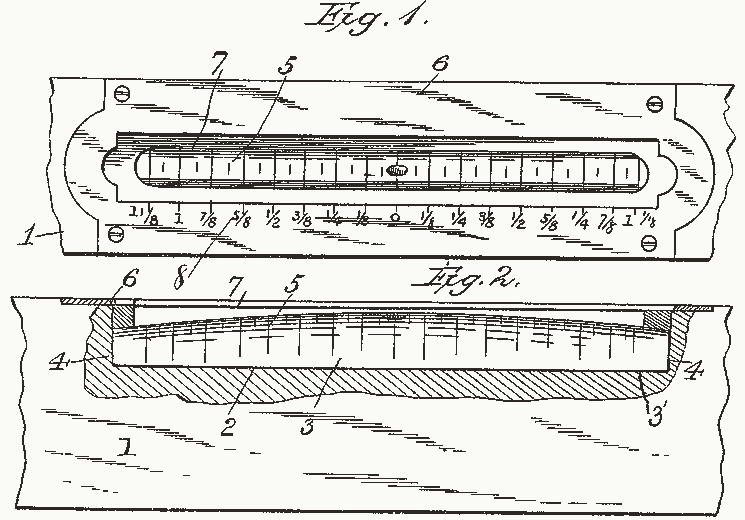
Sharp gives no radius. Suppose his words mean that a mark an eighth of an inch from zero stands for a rise of an eighth of an inch in each foot. For the bubble to move that far at that tilt, the curve needs a radius of one foot, about 305 mm. That is close to the bend of the vial in Fig. 1. Sharp also gives an example. On a wall sixteen feet long, a bubble under the one-eighth mark means “one end of the wall is two feet higher than the other”. By his own scale the rise is two inches.
Bent glass and ground walls
A bent vial works only one way up. Turn it over and its middle is lowest, so the bubble runs to an end. A bore curved on both sides, like a barrel, has a highest point in its middle either way up, and levels that must read upside down use such a tube. One maker grinds the inner walls of its vial block, made of acrylic glass, and sets its reference rings flush with the surface, so the bubble moves freely. Its levels made for both positions are accurate to 0.5 to 1.0 mm in each metre the other way up, and 0.5 mm the right way up.
Readers meet both kinds. Someone posting on the Home Improvement site of Stack Exchange wanted to know why a level had its vials in pairs, side by side, and why the two bubbles in each pair did not agree. Its one answer said some vials are curved, not bulging in the middle. You read the one that arches upward, and with both ways up you need not turn the level over. A reader on Woodworking Stack Exchange asked what “0.42 mm/m” meant on a Starrett level. The answer quoted a dealer, for whom each graduation is a tilt of 0.005 inch in a foot, or 0.42 mm in a metre. Both are user reports.
Bent vials are generally less sensitive than ground ones. Ground glass vials are made 6 to 18 mm across, with sensitivities from 2 seconds to 10 minutes of arc. Starrett’s 98 series machinists’ levels are named for their ground and graduated vials, and machinists’ levels are more accurate than common construction levels.
What fills the vial
One maker fills its vials with a coloured liquid based on alcohol, such as ethanol. Alcohol’s low viscosity and low freezing point let the bubble move quickly, even in the cold, and the word “spirit” in the name refers to it. Joseph H. Jackson’s 1902 patent for a level hung on a line calls its tube “filled with spirits”. Vial 6044/101 comes with a yellow or green liquid, and another of the same maker’s bent vials, number 13266, with a clear one.
Not every maker uses alcohol. Starrett puts a high-grade mineral oil in the vials of its machinists’ levels. Oil resists expanding and shrinking with heat. It also keeps extra bubbles from forming in handling, and is safe if a level breaks. Another maker’s liquid is fluorescent and resists UV rays, and its bubble and ring spacing keep the bubble within the rings from minus 20 °C to 50 °C.
What the drawings leave out
The sizes are the drawing’s own. A vial’s bore, its glass wall, the bubble’s height and the places of its marks come from no source. No vial was measured. The places of the level and the board are the drawing’s too. The bore’s inside is drawn as a perfect arc, with rounded ends of its own width.
The bubble keeps one size, although the rings of one maker’s levels are sized for a bubble that changes with temperature. It is drawn a little below the glass so you can see its edge, and it jumps to where it would come to rest, without the moment a real one takes to slide there. The board turns on a point at its middle, and the level lies on it without any gap.
Fig. 1 draws the level at one scale and its vial below at five times that size. The four tubes in Fig. 2 share one size so that only their bends differ, and the straight one is perfectly straight, which Huygens says no real tube is. A tilt of 0.1° is too small to see in the frame, so the readout gives it in numbers. The vial’s radius, length, width and bubble are those of vial 6044/101.
Sources
Read in November 2026.
- Level Developments, “Sensitivity & Accuracy of Spirit Level Vials”, its table of radii, and its pages on bent vials, for vial 6044/101, and ground vials.
- Hultafors, “What is a spirit level’s sensitivity?”
- Stabila, its page on how its levels are made.
- Deli Tools, “What Is a Spirit Level”.
- Starrett, its machinists’ levels.
- T. O. Sharp, US Patent 807,873, “Spirit-level”, 1905: his graduated tube. Its sheet gives Fig. 3.
- J. H. Jackson, US Patent 691,631, “Spirit-level”, 1902: a level for a line.
- Christiaan Huygens, his collected works, volume 21, his 1692 notes on Thevenot’s level, with the editors’ notes.
- Scientific American, “Invention of the Spirit Level”, 1869.
- Wikipedia, “Spirit level”, for the date it gives and the barrel-shaped tube.
- Home Improvement Stack Exchange, “Why does this bubble level have spirit tubes in pairs?”, December 2023. User report.
- Woodworking Stack Exchange, “Spirit Level Reading”, February 2022. User report.
- Practical Machinist forum, “Spirit Level Specifications”, July 2015. User report.
The type is Playpen Sans by TypeTogether, under the SIL Open Font License 1.1.