Toaster
Bread stands on a small metal rack inside each slot of a pop-up toaster, and a spring is always trying to lift that rack. Pushing the lever down takes the rack and the bread into the slot against the spring, and at the bottom something has to catch the rack and hold it there until the toast is done.
Down against a spring
The rack is called the carriage. It is a bar under the slices with an arm at one end. The arm runs out through an upright slot in the end of the case to the lever you press. Springs run from the arm up to brackets on the inner wall near the top. They stretch as you push the lever down, and they pop the toast up when nothing holds the carriage any more.
Near the bottom of its travel the carriage closes the switch that feeds the elements. A small projection on the arm presses it shut. The switch is really two, one in each of the two wires from the plug, so while the lever is up neither the elements nor the timer gets any current.
Something still has to hold the carriage down against the springs once your hand lets go, and let it rise again when the toast is done.
A magnet for a catch
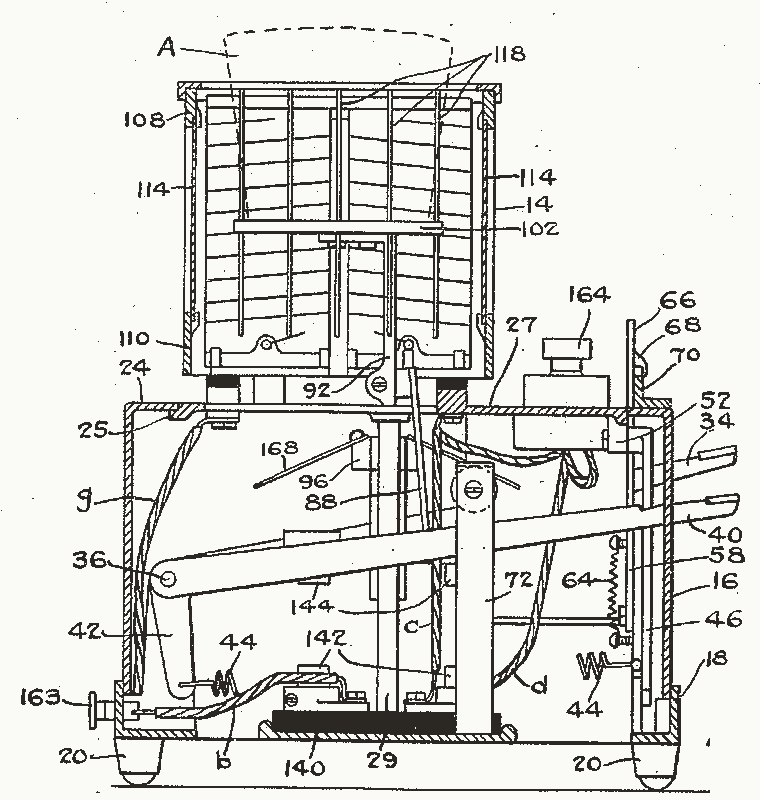
In many toasters the catch is an electromagnet. A plate of iron under the carriage comes down onto the two tips of a U-shaped iron core with a coil of wire round it. While current flows in the coil, the core is a magnet and holds the plate, and the springs cannot lift the carriage. The coil is fed through the same switch the carriage closes, so the magnet can hold only while the elements are on.
Fig. 1 shows the toaster from the side with the near wall cut away. Before you let go of the lever with the toaster unplugged, guess whether the carriage will stay down.
What the drawing shows
It comes straight back up. With no current in the coil the core holds nothing, and the springs pull the carriage to the top. A toaster of this kind will not latch down unless it is plugged in, and its lifter should be up before you pull the plug. In the drawing, unplugging while the magnet holds lets the carriage go at once.
A thread on Reddit’s r/explainlikeimfive asked why a toaster clicks down only when it is plugged in. The reply with 259 points said the lever is held by a magnet that gets its current through the switch the lever closes, and that the timer lets it go by cutting that current. That is a user’s account, and the patents agree with it.
Bare wire on mica
The heat comes from bare wire. Each element is a card of mica, or a pair of mica sheets, with the wire, or a flat ribbon of it, wound round in spaced turns, as in toasters of 1921 and of 1945 (Fig. 2). Mica does not conduct electricity, so the turns can touch it. Each slot has an element on both sides of the slice, and a cage of guide wires between them keeps the bread off the hot wire.
The wire is usually nichrome, an alloy of nickel and chromium. Albert Marsh of Lake Bluff, Illinois, applied to patent it in March 1905 for the Hoskins Company of Chicago. He wrote that it resisted oxidation and did not turn brittle when heated and cooled. Most metals heated in air oxidise fast and break. At red heat nichrome grows a thin skin of chromium oxide, and that skin keeps the air off the metal under it.
How long the magnet holds
The magnet lets go when a timer stops its current. In the toaster that Fig. 1 follows, the timer is a capacitor, a part that stores charge, filling through a resistor, and the browning knob turns a variable resistor in that path. When the charge reaches a fixed level, a switching part, a silicon controlled rectifier, shorts out the magnet’s coil. The springs lift the carriage, and as it leaves the switch, the switch opens and the elements are switched off.
Fig. 3 draws that timer as a curve of charge against time, beside the magnet and its plate. Before you move the time along, guess what a darker setting changes, the level the charge must reach or how fast it climbs.
What the drawing shows
It changes the climb. The level stays where it is, and a darker setting puts more resistance in the way, so the capacitor fills more slowly and the magnet holds longer. Some timers are an integrated circuit whose time is set by a variable resistor in the same way, with modes such as reheat for a shorter time and bagel for a longer one.
Fig. 3 lets go after 85 s at setting 1 and 170 s at 6, to match one owner’s toaster described on Electrical Engineering Stack Exchange. That toaster ran 1 minute 25 seconds at its lowest stage and 2 minutes 50 at its highest. A reply there pointed to a fixed resistor in series with the knob’s, so even the lowest setting leaves some resistance in the path.
A timer counts seconds and takes no notice of the bread. Bread from the fridge may need a darker setting than the same bread at room temperature. Under a timer the elements stay on even if what is in the slot catches fire, and foods with sugar or fat can. A toaster patented in 2013 adds a bimetal switch that opens if it gets far hotter inside than in normal use.
Strips that bend
Older toasters time the toast with heat. A bimetal strip is two metals joined face to face that grow by different amounts when warmed, so the strip bends. In one kind the strip sits near an element and bends further as the toast cooks, until it switches the heat off, and the browning control sets how far it must bend. In William Kitto’s design for Hoover, patented in 1950, a small heater of its own warms the strip, a rheostat sets how fast, and the strip has to cool again before it lets the carriage go.
One Reddit user described such a toaster. Their old one stayed down with no power at all, because nothing electric held it, and its strip bent slowly until it released a latch. They also named its weak spot. A second batch toasted for less time, since the strip was still warm from the first. That is one owner’s report.
Clockwork, 1921
The first pop-up toaster ran on clockwork. Charles Strite, of Minneapolis, applied for his patent in June 1920 and was granted it on 18 October 1921. Wikipedia says the idea came from the burnt toast served in the cafeteria of a factory in Stillwater, Minnesota, where he worked during the First World War.
His toaster has two levers. You push the first one down as far as an adjustable stop, and on the way it pulls a chain that winds the clockwork. The second lever lowers the bread carriers and closes a switch with carbon contacts, and a three-sided catch, which swings into place by its own weight, holds it down. The clockwork then draws the first lever slowly back up. When it reaches the catch it lifts it clear, and a spring pulls the second lever up. That opens the switch and lifts the toast partly out of the slots (Fig. 4).
A handle, set in one of a row of numbered notches, raises or lowers the stop. The lower the stop, the further the first lever goes down, and the longer the clock takes to bring it back. Strite expected one or two trials to find the right notch for a kind of bread, with less time for dry bread and more for moist. A buffer of two spring arms and a pad stops the lever from coming up too hard. Wikipedia’s article on the toaster says the Waters Genter Company sold a redesigned one for homes, the Toastmaster 1-A-1, in 1925; its article on Strite gives 1926.
What the drawings leave out
The sizes are the drawing’s own. Fig. 1 has one spring where the 1976 patent has two, one at each end, no elements, and a plain bar for a carriage. Fig. 3 draws the timer as a curve, with none of its parts. Other designs, like that patent’s own Figs. 13 and 14, put a hook and a latch between the carriage and the magnet. The drawings let the magnet hold the carriage itself, as the patent’s first design does.
Fig. 3’s times, from 85 to 170 seconds, are the one thing taken from a real toaster, the owner’s above. The curve and the level it climbs to are the drawing’s model.
If toast jams, unplug the toaster and let it cool before you turn it over and shake it out, and never reach in with a fork or other utensil, which can start a fire or give an electric shock. Repairs are for the maker or a qualified person, and this page gives none. A toaster left working unattended is a fire risk.
Sources
Read in November 2026.
- C. P. Strite, US Patent 1,394,450, “Bread-toaster”, 18 October 1921, for the clockwork toaster, with its drawing sheets. Fig. 4 shows his Fig. 12.
- R. G. Borley, Best Products, US Patent 3,956,978, “Electric toasters”, 18 May 1976, for the toaster held down by an electromagnet, with its capacitor timer, which Figs. 1 and 3 follow. Text only.
- Hon Man Choi, US Patent 8,402,884, “Anti-burn/anti-jam electric toaster with electromagnetic latch”, 26 March 2013. Text only.
- Hamilton Beach, toaster use and care guide 840231800: latching, stuck food, repairs.
- A. L. Marsh, US Patent 811,859, “Electric resistance element”, 6 February 1906, for the nickel and chromium wire.
- H. L. Newell, General Electric, US Patent 2,367,044, “Toaster”, 9 January 1945, for elements on mica and wire guides. Text only.
- W. H. Kitto, Hoover, US Patent 2,502,655, “Electric toaster”, 4 April 1950, for a strip warmed by its own heater. Text only.
- C. Woodford, Explain that Stuff, “How does an electric toaster work?”, for the bending strip.
- S. Hollister, The Verge, “Why a toaster from 1949 is still smarter than any sold today”, 25 November 2021, for the Sunbeam that lowers its own bread and its service manual.
- Wikipedia: “Toaster”, “Nichrome”, “Charles Strite” and “Alan MacMasters hoax”.
- r/explainlikeimfive, “how does a toaster only click when it’s connected to electricity?”, January 2022, via the Arctic Shift archive. User report.
- r/explainlikeimfive, “How do toaster levers know that the power is on and stay down, but spring back up when the power is off.”, April 2023, via the Arctic Shift archive. User report.
- Electrical Engineering Stack Exchange, “Reduce burning time for a toaster by changing resistor?”, July 2020. User report.
- Further reading, named by Reddit replies and not used as a source here: Technology Connections, “The Electromagnet in Your Toaster”, a video.
The type is Playpen Sans by TypeTogether, under the SIL Open Font License 1.1.