Jack-in-the-box
When the lid of a jack-in-the-box closes, it squeezes the spring inside the jack, and a small catch holds the lid down against that push. Turning the crank plays a tune, and at the end of it a part turned by the crank pushes the catch aside, so the spring throws the lid open and the jack up.
A tin box with a handle
A small red handle sticks out of one side of the Mettoy jack-in-the-box in the Young V&A Collection, a painted tin box 13 cm high and 14 cm wide, made in England in the late 1940s. A small catch holds its lid down. Turn the handle and the box plays “Pop goes the Weasel”. Inside is a clown with a painted plastic head, a red felt cap and a spotted body over a large metal spring.
Schylling’s Kangaroo Jack in Box works the same way. Its tin base is 5.5 inches (140 mm) square, and the plush ’Roo pops out when the song ends. With the puppet out, the toy stands 10 inches (254 mm) tall. A Mettoy box of about 1955, in the Powerhouse in Sydney, works in the same order. When the song is complete, the lock is released and the lid opens.
The toy has gone by other names and forms, among them a Punch box, an admiral on a stick and a Johnny jump-up. A patent of 1880 calls one a “surprise-box”, and one of 1906 speaks of “wizard-boxes”. The Powerhouse calls its box a jack-in-the-music-box.
The spring and the catch
Shutting the lid squeezes the jack into the box. A patent for a jack-in-the-box that Theodore R. Duncan filed for Mattel in 1959 says the figure is springy, or has a spring inside, “so that it must be compressed” into the box. Once the lid is shut, the figure pushes up on it all the time. A spring at the hinge may help, but Duncan calls it not essential.
The lid stays down only while something holds it. In Duncan’s box a bracket under the lid carries an eye, a small loop. A latch turns on a rivet beside it and reaches up with a hook that catches the eye. A spring keeps the latch upright. Below the rivet the latch has a tongue, which reaches into the case of a small record player mounted inside the box. Push that tongue far enough and the hook leaves the eye. Nothing else holds the jack down.
When the crank lets the lid go
The crank on Duncan’s toy is the end of the record player’s spindle, bent outside the box, so each turn of the crank turns the record once. A needle on a pickup arm runs in the record’s groove. A reset lever is pivoted on the record itself and goes round with it, held folded against the spindle by a wire spring (Fig. 1). Guess on which turn the lever will reach the latch.
What the drawing shows
The lever passes under the latch on every turn of the tune. It touches nothing. The drawing’s tune lasts three turns. Then the needle runs in past the playing area, and the lever, coming round, lifts the arm and takes the needle in a notch in its curved edge. As the record turns on, the lever swings outward to carry the arm back to the start of the groove, and small teeth on its edge catch the latch’s tongue. In the drawing the hook clears the eye 3.42 turns from the start, 0.42 of a turn after the tune has ended.
The cover opens, in Duncan’s words, “at a predetermined point in the playing of a record”. The lever reaches the tongue only once it has the needle, and it gets the needle only at the end. Then, the patent says, it lets the needle go, and the latch springs back. Where a music box takes the place of the record, the drum can do the job. In one box sawn open on video, the drum’s one high note lets the puppet go.
Shutting the jack in again
Children get help to reload the toy, which means pushing the jack down and shutting the lid on it. Duncan’s patent does not say how the eye gets back past the hook, but two other patents do. In Melvin L. Harding and Albert I. Hoxworth’s box of 1906 the latch is bevelled, so a closing door’s keeper springs past it and is held. In Joseph E. Mitchell’s of 1970, a tang on the lid rides over the rounded top of the catch and pushes it aside, and then the catch moves in above it. The drawing gives Duncan’s hook a sloped top for the same job (Fig. 2). Before the lid comes down, guess whether anyone has to push the hook aside by hand.
What the drawing shows
The falling eye moves the hook itself. In the drawing the lid meets the jack’s head at 85° open and squeezes the spring from 208 mm to 94 mm by the time it shuts, 114 mm in all. At 2.64° the eye’s bar reaches the slope on the hook and starts pushing the latch back against its spring. Just before the lid shuts, at 0.2°, the bar slips under the hook’s lip, and the latch springs upright over it. From then on the lid stays down when you take your finger away.
Older boxes
A US patent of 1870 already treats the jack-in-the-box as a known toy. Henry Splitdorf’s patent of 1870 places his spring toy-ball in “that class of toys denominated surprise-toys, including the toy called ‘jack in the box’”. In 1880 Charles C. Shepherd of Passaic, New Jersey, wrote that boxes had been made “with a spring man or monkey that flies up when the cover is removed”. His own jack was made “in the usual manner, of flexible material around a spiral spring”. His sliding cover let it go only once it had been drawn along to a certain point.
Melvin L. Harding and Albert I. Hoxworth of Mannington, West Virginia, patented a box with a figure at each end in 1906 (Fig. 3). Each end holds a figure made of a spiral spring covered with fabric, shut in by a hinged door with a keeper on its free end. A weight in the middle compartment slides down a spiral rod, turning as it falls, and knocks the latch rod of the uppermost door. Turn the box end for end and the other door goes.
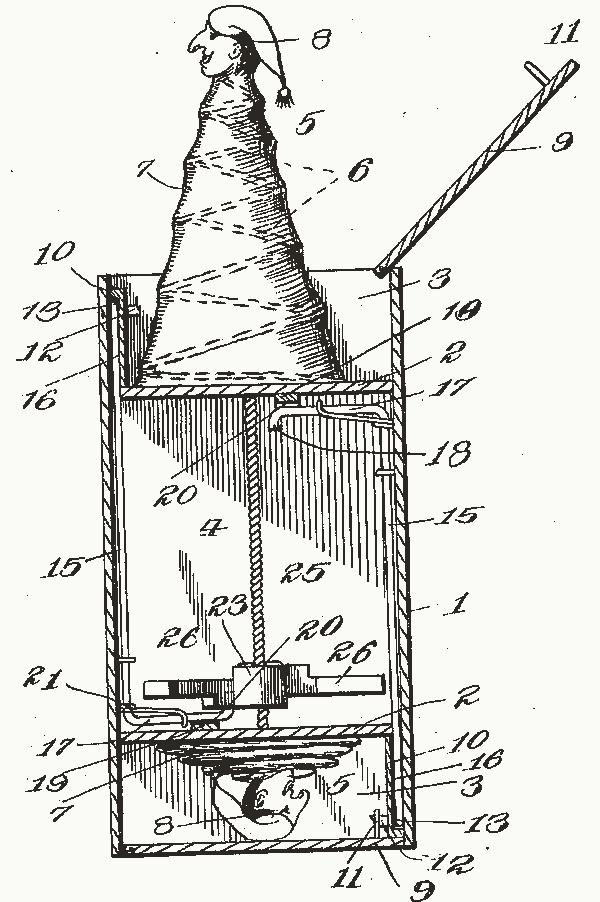
The jack-in-the-box went into the National Toy Hall of Fame in 2005, and the toy dates to the 16th century. Makers built the box first in wood, then in printed cardboard, and in the 20th century most familiarly in lithographed tin. Only Wikipedia, citing a collectors’ site, names a German clockmaker called Claus as the first maker, early in the 1500s. A Mattel “Jack in the Music Box” of 1945–1955 is in The Strong’s collection, and Duncan’s patent of 1962 was assigned to Mattel. In 1986 Bernhard Schaub and Steven Taylor wrote that pop-up clown toys worked by a crank were well known, but that very young children lack the coordination to turn the crank. Their toy has a cylinder to roll.
What the drawings leave out
The sizes are the drawing’s own. Only two follow a source: the box is Schylling’s 140 mm square, and with the lid open the toy is as tall as Schylling’s, 254 mm. Duncan’s 1962 patent gives the parts in words only, so where each one sits is the drawing’s choice. None of the 120 US patents before 1931 in the classes for leaping toy figures, the jack-in-the-box’s among them, was found to show a crank that works a catch. The box’s near wall is left off, the crank is drawn as an outline so the parts behind it show, and the jack’s cloth body is left off its spring. The enlarged view of the player is drawn at about 2.6 times the scale of the whole box. The lever lifts the pickup arm before it takes the needle, and the drawing shows the needle riding over the lever’s edge for those last few degrees. The arm and the lever lie at different heights, so they cross. The hook goes through the eye’s loop, drawn flat.
Sources
Read in November 2026.
- Theodore R. Duncan, assignor to Mattel, US Patent 3,037,779, “Phonograph reset and exterior latch mechanism”, filed 13 April 1959, granted 5 June 1962: its words, for Figs. 1 and 2.
- Melvin L. Harding and Albert I. Hoxworth, US Patent 817,316, “Toy”, 10 April 1906: its words, and its drawing for Fig. 3.
- Joseph E. Mitchell, assignor to Lakeside Industries, US Patent 3,495,348, “Jack-in-the-box toy”, 17 February 1970.
- Charles C. Shepherd, US Patent 230,502, “Toy”, 27 July 1880.
- Henry Splitdorf, US Patent 99,023, “Spring toy-ball”, 18 January 1870.
- Bernhard Schaub and Steven Taylor, assignors to The Quaker Oats Company, US Patent 4,798,555, “Toy pop-up figure”, filed 17 October 1986.
- Schylling, “Kangaroo Jack in Box”, the maker’s product page, as the Internet Archive saved it on 1 February 2026.
- Young V&A Collection, “Jack in the Box”, MISC.76-1988, Mettoy, 1945–1950.
- Powerhouse Collection, “Jack-in-the-Box made by Mettoy Playthings”, 2008/158/13, about 1955.
- The Strong, National Toy Hall of Fame, “Jack-in-the-Box”, for the toy’s history and names.
- The Strong, on Google Arts & Culture, “Jack-in-the-box: Jack in the Music Box”, object 103.2007, Mattel, 1945–1955.
- Popular Mechanics, “You Have to Saw Open a Jack-in-the-Box to Really Appreciate How Clever It Is”, May 2016, on Dan Markham’s video.
- Wikipedia, “Jack-in-the-box”, for the story of Claus.
- USPTO Patent Public Search, the 120 patents before 1931 in classes 446/309 to 446/312, each read for a crank, a cam or pin, and a catch.
The type is Playpen Sans by TypeTogether, under the SIL Open Font License 1.1.