Umbrella
All the ribs of an umbrella open at once when one collar slides up its shaft. That collar is the runner. Short rods called stretchers join it to the ribs, a spring catch holds it at the top, and a strong gust from below can push the whole frame inside out.
The parts of a closed umbrella
Hold a closed umbrella by its handle, and the shaft runs up from your hand to the tip. Near the top, under the folded cloth, is a small fitting called the top notch, and every rib hangs from it on a hinge. Lower down, a sleeve called the runner slides on the shaft. From the runner a stretcher reaches up to the middle part of each rib. These five parts, shaft, top notch, runner, ribs and stretchers, make up the basic structure of an umbrella.
How many ribs there are depends on the model, and there are usually six or eight stretchers, one to a rib. Rib lengths vary too. In the English trade, ribs were made in sizes from 16 to 36 inches until 1934, when the frame maker Fox cut its range to 18 to 26 inches. When the umbrella is closed, a spring catch on the shaft, the bottom spring, holds the runner down.
One runner for every rib
Push the runner up and each stretcher pushes on its rib. The stretcher is hinged at both ends, to the runner below and to the rib above, and the rib is hinged at the top notch. Those three hinges make a triangle. Two of its sides, the rib from notch to joint and the stretcher, never change length. The third is the stretch of shaft between the notch and the runner, and it gets shorter as the runner rises, so the triangle has to open out and carry the rib with it. Every stretcher hangs from the same runner, so one push swings all the ribs by the same angle at the same moment.
Fig. 1 shows a frame with 24-inch ribs, and only the two ribs that lie in the plane of the page. Before you slide its runner up, guess whether the ribs open at an even rate as it rises.
What the drawing shows
They do not. In this drawing the runner slides 356 mm from closed to open, and the first tenth of that travel swings each rib out by 20°. The last tenth adds 4.5°. At the start the stretchers lie almost along the shaft, so a small rise tips them through a wide angle. Near the top they stand out from it, and the same rise moves each joint much less. Each rib tip, meanwhile, swings through an arc of 745 mm, about twice as far as your hand moves.
The catch under the runner
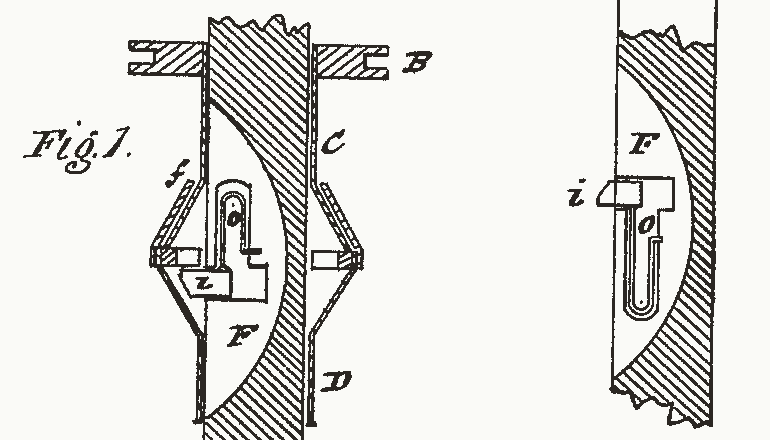
Let go of the runner in Fig. 1 and nothing would stop it sliding back down. On a real umbrella a second catch, the top spring, holds it up. Charles A. Thompson of St. Louis described the pair in a patent of 1876. Each was a catch on the end of a steel spring, set into a slot in the staff, and the lower one was “placed to work in the opposite direction”.
Shafts today are tubes. The usual catch is a springy tongue formed in the shaft that sticks out through a slot in the tube. Its lower face slopes, and its top is a square step. Fig. 2 cuts open a shaft with a catch of that shape. Before you bring the runner back down, guess what it will take to get past the catch.
What the drawing shows
The runner lands on the step and stops. It can pass only while the catch is pressed into its slot, so closing an umbrella means pressing the catch with a finger while you pull the runner down. A catch that sticks in its slot leaves the runner nothing to rest on. “Why does my umbrella not stay open” is one of the questions Google offers as you type.
Pinched fingers
That press puts a finger next to a moving runner, and inventors have written about the result since at least 1876. Thompson filed his patent on 7 October 1875. He made his runner in two parts. To close it, you turned the lower part until one of the slots in its ring lined up with the catch, and the runner slid over. The spring and catch sat inside the runner, he wrote, “so that the danger of pinching the fingers thereby in opening and closing the umbrella is avoided”. Fig. 3 shows his drawing.
The problem did not go away. In 2001 Toshio Okuda patented a runner “which will not trap or pinch a user’s fingers between the runner and the upper catch”. In 2006 Fu Tai patented one that closes when you pull it down, with no press at all. Its patent names the step it does away with the “lateral depression operation”.
When the wind gets underneath
The cloth of an open umbrella curves down from the top notch. A strong wind or a sudden gust against the inside of the canopy can flip it to curve upward, and ribs can break. Vents in the cloth let some air through, but they are not large enough, and in most cases the canopy still turns inside out.
Look at where the frame is braced. Each stretcher meets its rib partway out, so only the inner part of the rib is held by the triangle from Fig. 1. The outer part reaches past the joint with nothing under it but its own spring and the cloth. Wind-resistant designs brace exactly that part. A patent of 2017 adds a second strut from each stretcher to a point further out on the rib, with a stop, so that “the rib cannot bend upwardly”. Okuda’s of 2001 ties a cord to each rib between the tip and the stretcher’s joint.
One Reddit reader explained that a round umbrella sets “flexible spring ribs against the cloth’s resistance to stretching”. Fig. 4 draws the cloth’s pull as one arrow at the tip, toward the shaft. Before you push the tip up, guess the point at which the rib stops springing back.
What the drawing shows
It springs back until the tip is level with the joint, and not after. While the tip hangs below the joint, the cloth’s pull turns the outer rib down, back into shape. Level with the joint, the pull turns it neither way. Past level it turns it up, so the same cloth that held the canopy in shape now holds it inside out, even after the gust has dropped. The jump is called snap-through, and an umbrella turning inside out on a windy day is a common example of it. Some umbrellas are made to flip this way, and they come back when you pull the runner down.
Ribs of steel
The frame in these drawings is steel, and steel frames came later than the umbrella. By Wikipedia’s account, Victorian frames were made of wood or baleen, so they were expensive and hard to fold when wet, though a London newspaper was advertising “improved and pocket Umbrellas, on steel frames” by 1788.
Samuel Fox began making solid steel ribs at Stocksbridge in 1848. On 6 April 1852 he was granted a patent for making ribs and stretchers “of steel formed into hollow trough-like shapes”, and the frames went on sale under the Paragon mark.
Steel of that shape was still at work eighty years later. In Hans Haupt’s patent of 1932 each rib is two channelled bars of U section, and the pawl that locks them runs inside the channel, where it cannot tear the cover. Ribs also had to survive their owners. Before Fox Umbrellas took up a new laminated rib in the 1930s, it tested it for 12 months, rolling the umbrellas up wet and twisting them like corkscrews, “doing everything with them like a careless user would do”.
Shorter umbrellas
A frame like the one in Fig. 1 cannot fold shorter than its ribs. Hans Haupt worked for years on one that could. In 1916 he applied for a patent on a pole of telescoping parts. On 26 April 1930 he applied for the “shortenable umbrella” that the German Patent and Trade Mark Office counts as the birth of his Knirps, German for a small child. He is said to have needed a cane after a war injury, so he could not also carry a full-length umbrella.
The first Knirps went on sale in 1932, made by Fritz Bremshey of Solingen. Haupt’s US patent of that year shows how a rib can fold. Each rib is two bars of U section, the lower sliding inside the upper (Fig. 5). A spring pawl locks them while the umbrella is open. When it closes, the stretcher lies along the rib, presses the pawl’s tail and frees the outer bar to slide in.
What the drawings leave out
The sizes are the drawing’s own. Fig. 1 draws two ribs where a real frame usually has six or eight, leaves off the cloth and keeps every rib straight. Its joint, stretcher and angles are drawn by eye, so the travel and the angles quoted under Fig. 1 belong to this drawing, and a frame with its joint further out or in would give other numbers. The catch in Fig. 2 has the usual shape, a slope below and a step above, and the bottom spring, which works the same way upside down, is left out. Thompson’s drawing in Fig. 3 is as printed, apart from scan specks, and Fig. 5 is drawn from words alone.
Only the ribs’ length has a source behind it, since 24 inches lies inside the frame maker Fox’s range. Fig. 4 has no size from a source at all, and it is the roughest drawing. It treats the outer rib as a stiff piece turning on the joint, where a real rib bends along its whole length, and it draws the cloth’s pull as a single arrow toward the shaft. It gives no wind speed, because the sources give none for the gust that turns an umbrella inside out.
Sources
Read in November 2026.
- C. A. Thompson, US Patent 176,450, “Improvement in umbrella-runners”, 1876, text and drawing sheet, for his two catches and the pinched fingers. Fig. 3 is cut from that sheet.
- J.-S. Ma, US Patent 9,022,049, “Umbrella top notch and runner”, 2015, for the five basic parts and how they are hinged.
- D. and A. Haythornthwaite, US Patent 9,668,553, “Umbrella having an anti-inversion mechanism”, 2017, for the top and bottom springs, inversion, vents and the extra strut.
- T. Okuda, US Patent 6,276,380, “Anti-wind umbrellas”, 2001, for six or eight stretchers, the cord, umbrellas made to flip, and the runner that spares fingers.
- C.-K. Lin and J.-J. Chang for Fu Tai Umbrella Works, US Patent 7,089,950, “Umbrella operatively closed by directly pulling runner downwardly along a guiding sleeve”, 2006, for the catch’s shape and the press it removes.
- H. Haupt, US Patent 1,856,385, “Telescopically collapsible umbrella”, 1932, for the U-section bars that slide and lock. It is later than 1930, so its drawing is not shown.
- German Patent and Trade Mark Office, “Pocket folding umbrella”, DPMA page, for Haupt’s applications, the Knirps and Bremshey.
- Nature 123, 549 (1929), “Calendar of Patent Records”, for Fox’s patent of 6 April 1852 and the Paragon mark.
- Wikipedia, “Umbrella” and “Samuel Fox”, for frames of wood and baleen, the 1788 advertisement and the other dates in the notes.
- Fox Umbrellas, “History of Fox Umbrellas”, maker’s page, for rib sizes, the 1934 range and the 12 months of tests.
- X. Jiang and others, “Snapping of bistable, prestressed cylindrical shells”, arXiv 1804.03072, 2018, for the umbrella as an example of snap-through.
- r/explainlikeimfive, “ELI5: How come Umbrellas are so suseptible to wind?”, April 2018, via the Arctic Shift archive. User report.
- r/explainlikeimfive, “ELI5: Why are umbrellas curved down instead of being plane circle that way they can cover more area underneath ?”, January 2019, via the Arctic Shift archive. User report.
- Google’s suggestions for “why does my umbrella”, as typed on 15 November 2026. User report.
The type is Playpen Sans by TypeTogether, under the SIL Open Font License 1.1.