Accordion
Thin steel tongues inside an accordion sound when air rushes past them, and the bellows between its two ends move that air. Each key or button opens the way to its own tongues. Pushing the bellows in sounds one tongue of a pair, and pulling them out sounds the other.
Two ends and the bellows
An accordion is held between both hands, its bellows in the middle. The right hand commonly plays the treble keys or buttons at one end, and the left hand plays buttons for bass notes and chords at the other. Someone on r/explainlikeimfive asked what all the buttons on the side are for, and the top reply, a user report, said each plays a chord, a few notes that sound well together. The bellows are folds of a special cardboard, glued at every fold and pinched at the corners with chrome. Among the bass buttons sits a bigger one, the air button. Straps hold the bellows together when the accordion is not being played, since left unlocked they can fall open.
The accordion is one of the instruments called squeezeboxes. It comes in two kinds. A chromatic accordion sounds the same note whichever way the bellows move. A diatonic one sounds one note when the bellows close and another when they open. The air button lets the bellows open and close without any sound at all.
A pallet over a hole
Each treble key works a lever. On the lever sits a pallet, a pad of felt and leather that rests on a hole in a board, and a spring holds it there. Pressing the key lifts the pallet off its hole. On the board’s inner side stand reed blocks, usually of poplar wood, each divided into cells, with one cell over each hole.
A reed plate is fixed on the wall of each cell. It is a plate of aluminium with two slots, and over each slot lies a tongue of steel, riveted to the plate at one end and free to swing at the other. One tongue lies on the face toward the bellows and the other on the face inside the cell, and this page calls them the outer and the inner tongue. Over each slot’s other mouth lies a valve of leather or plastic. In Fig. 1 the way from the bellows to the key is cut through for one note. Guess which tongue will swing when the bellows are pushed in with the key down.
What the drawing shows
Pushing sounds the outer tongue. The air leaves the bellows through its slot, crosses the cell and goes out under the lifted pallet, and the same push presses the inner tongue’s valve flat over its slot. Pulling turns the way round. Air comes in under the pallet and leaves the cell through the inner tongue’s slot, and now the outer tongue’s valve is held shut. With the key up nothing moves, whichever way the bellows are worked.
One tongue for each way
A tongue like these speaks only when the air comes at it from the side it is riveted on. The air then pushes it into its slot. Air from the other side only bends it away from the plate, and it does not swing. The bellows blow on the push and suck on the pull, so each note needs two tongues facing opposite ways. In a chromatic accordion they are tuned to one note. In a diatonic one they are tuned apart, and so one button gives one note on the push and another on the pull.
The valves stop air going to waste through the slot whose tongue cannot sound. When two reeds share a cell, both need valves, so the silent one leaks no sound. A question on Music Stack Exchange asked whether a single free reed could sound both ways. One answer said accordion reeds sit a little off centre in their frames, so each sounds one way only, and another that such reeds start almost at once on little pressure. Both are user reports. A valve can be heard, too. When a key is let go its reed swings on for a moment, and through the cushion of air in the slot it makes the valve rattle against the block, loudest and longest on the lowest notes.
Puffs through the slot
At rest a tongue lies flat over its slot and all but closes it. The slot is cut to the tongue’s own size, so the tongue can pass in and out without catching on the edges, and only a thin gap is left all round. A push of air bends the tongue into the slot. At low flows the air’s forces only damp any swing it makes. Past a threshold they feed the swing instead, and it grows to a full swing. The tongue then swings a little slower than it would on its own, as a strip held at one end and free at the other. It needs no pipe to set its pitch.
One swing of the outer tongue at 0.6 kPa is drawn in Fig. 2, with a graph of the air it lets through, a tenth of a swing at a step. Guess for how much of each swing the slot stands open.
What the drawing shows
The slot stands open for only a quarter of the swing, about 0.6 ms in every 2.38 ms. The rest of the time the tongue sits down in the slot, and only the thin gap round it leaks, about a fifth of the peak. A constant push comes out as a row of puffs, one a swing, about 420 a second. A siren makes sound the same way, its turning disc cutting a stream of air into pulses where the tongue cuts it at the slot. The tongue throttles the air so sharply that the puffs are rich in overtones. In laboratory tests one accordion reed never swung right through its thick plate, and the drawn tongue does not either.
Length, thickness and sets of reeds
A tongue’s pitch comes from its length, its thickness and its metal. A longer tongue sounds lower. A thicker one sounds higher. For a plain strip the rate goes with the thickness over the square of the length. Suppose the drawn tongue is 24 mm long and 0.29 mm thick. A plain steel strip that size swings about 426 times a second on its own, a little above the measured reed of Fig. 1, which sounds at 419 to 422. Aluminium would give almost the same note as steel, being about three times less stiff and three times lighter. Brass would sound about a fifth lower.
An accordion with four sets of treble reeds and five of bass reeds has at least 448 tongues. One maker lists its four treble sets as L, M, M and H, for low, middle and high. Switches called registers choose which sets a key sounds. A player on Music Stack Exchange explained, in a user report, that with every set switched on, the number of sets is how many reeds sound for each key, and that one M set is tuned a little sharp of the other so the two beat. Since every note has a pair, four sets switched on mean four tongues sounding together on each push, and four others on each pull.
Pushing harder
Pushing harder makes a note louder. One accordion note can be played over a range of 40 to 50 decibels, heard 1 m away, with no pitch change anyone notices. The pitch does fall a little. In a laboratory test on one accordion reed for G sharp, it went from about 421.7 Hz at 0.1 kPa to about 419.4 Hz at 0.9 kPa, read off the published graph. That is about half of one percent, where a semitone is about 6 percent. Fig. 1 follows the same graph.
Sources differ on what the tongue does as the push grows. A teaching paper on the accordion says the tongue moves farther in and out, and that this makes the sound louder. The same paper also says that past the threshold the plate’s depth sets how far the tongue swings. Measurements on reed-organ reeds found the swing jumping to its full size just past the threshold and then hardly growing, while the air through the reed kept growing with the pressure. The drawings follow those measurements and keep the swing the same at every push. Fig. 1’s tongues stay still below 0.1 kPa, near the 0.08 to 0.1 kPa at which one laboratory reed of a pair began to sound.
Turning the bellows round while a key is held breaks the note for a moment, because the tongue that was sounding stops and its partner has to start. Shaking the bellows back and forth quickly gives a trembling note, like a bowed string’s tremolo. With the air button pressed, the bellows move freely and make a continuous sound of wind.
Five keys, then pairs in every cell
Cyrill Demian, an organ and piano maker in Vienna, and his sons Karl and Guido handed in a description of a new instrument they called Accordion on 6 May 1829. Their Austrian privilege was granted on 23 May 1829 for two years and extended in 1831 for three more. The description, in an English summary, gives a box 7 to 9 inches long with metal tongues and bellows fixed to it. Each key gave one chord on the pull and another on the push, from tongues fixed below their plates for the pull and above for the push. Moving the bellows faster or more gently took the sound from soft to loud. Sources disagree on its first keyboard. That description draws an instrument with five keys and ten chords, and the Austrian music lexicon says it had six keys at first.
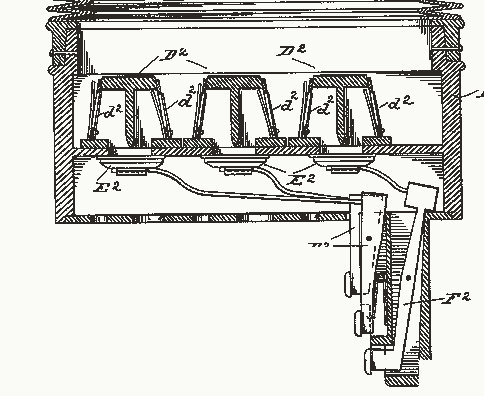
Anthony Faas of Philadelphia wrote in his US patent of 13 June 1854 that the ordinary accordion made half its notes only by pressing and half only by drawing, so few full chords could be played. Joseph Galleazzi of San Francisco patented an accordion on 3 April 1894 whose reed cells each held four reeds. Two of each pitch worked on opposite sides, so the same notes sounded whichever way the bellows moved (Fig. 3).
What the drawings leave out
The sizes are the drawing’s own. Only one cell, one key and one set of reeds appear in Fig. 1. Its key’s arm is a plain rocker. It shows the push as one fixed pressure and leaves the bellows still, though with the key down they move for as long as the air flows. Its pitch follows one measured reed, and the 0.1 kPa at which its tongues start is a rule of the drawing. Its valves lift by one fixed angle while air passes, and its arrows show the air only once a tongue sounds, not the thin leak before that.
The valve in Fig. 2 is held open, and its tongue is a plain steel strip swinging in one shape at one fixed push, where real tongues are filed and shaped. Its air comes from the size of the gap alone. It leaves out the cell, whose own resonance can make a high reed slow to start. Moving its scale back runs the swing backwards.
Sources
Read in November 2026.
- C., K. and G. Demian, Austrian privilege, register number 1757, “Accordion”, handed in on 6 May 1829, held by the TU Wien archive, read in K. and M. Weyde’s English summary, edited by H. Doktorski.
- Austrian Academy of Sciences, “Demian, Familie”, Oesterreichisches Musiklexikon, for the grant and its keys.
- A. Faas, US Patent 11,062, “Construction of accordions”, 13 June 1854.
- J. Galleazzi, US Patent 517,648, “Accordion”, 3 April 1894, for its reeds in pairs and Fig. 3. (US Patent 517,648, 1894, Fig. 4. Public domain.)
- J. P. Cottingham, “Acoustics of free-reed instruments”, Physics Today, March 2011.
- J. Braasch and J. P. Cottingham, “Free reeds: an intertwined tale of Asian and Western musical instruments”, Acoustics Today, winter 2023.
- J. P. Cottingham, “Reed vibration and pitch bending in Western free reed instruments”, course slides for Music 318, Stanford University, 15 February 2013, for the pitch against pressure.
- J. Cottingham, “Reed chamber resonances and attack transients in free reed instruments”, International Congress on Acoustics, 2016.
- J. P. Cottingham, C. J. Lilly and C. H. Reed, “The motion of air-driven free reeds”, Coe College, for the swing past the threshold.
- J. P. Cottingham, C. H. Reed and M. Busha, “Variation of frequency with blowing pressure for an air-driven free reed”, Coe College, for the damping and the air.
- R. Llanos-Vazquez, M. J. Elejalde-Garcia, E. Macho-Stadler and J. Alonso-Moral, “A pedagogical utilisation of the accordion to study the vibration behaviour of free reeds”, Forum Acusticum, Seville, 2002.
- T. Tonon, “Reed cavity design and resonance”, Papers of the International Concertina Association, volume 2, 2005.
- M. Nussbaumer and A. Agarwal, “Aeroacoustics of free reeds”, International Congress on Acoustics, 2016.
- J. W. Strutt, Baron Rayleigh, “The Theory of Sound”, volume 1, 1877, sections 171 and 182, for a strip held at one end.
- Hohner, “Discover the Hohner XS”, for the air button and the reed block.
- Hohner, accordion FAQs, for valve noise.
- Scandalli, “Use and maintenance”, for the valves and the plates.
- Petosa, “AM-1100 Grand Concert”, for its sets of reeds and pads.
- r/explainlikeimfive, “The piano-looking keys are obvious, but what do all those other buttons on the side of an accordion do?”, January 2022, via the Arctic Shift archive. User report.
- Music Stack Exchange, “Is it possible to make a single free reed that plays on both air directions?”, August 2018. User report.
- Music Stack Exchange, question of July 2023, “What is the difference between a voice and a register on an accordion?”. User report.
The type is Playpen Sans by TypeTogether, under the SIL Open Font License 1.1.