Piano
Pressing a key of a grand piano throws a felt hammer up at its string from below. Just short of the string, the lever under the hammer slips out, so the hammer flies the last few millimetres alone and drops back while you hold the key down. When the key comes up, a felt damper falls back onto the string.
A key, a wippen and a jack
A grand piano’s key is a lever balanced on a pin. Press its front down and its back end rises. A capstan screw on top of the back end lifts the wippen, a lever hinged on a rail above the key. The wippen carries two smaller levers.
One is the jack, an upright piece whose top sits under a felt-covered knuckle on the hammer’s shank. The other is the repetition lever, which comes later. As the wippen rises, the jack pushes the knuckle up, and the hammer, hinged at one end of its shank, swings its head up toward the string. On a Kawai grand, set up as the maker’s regulation manual lays down, each key goes down 10.1 mm at its front, and the hammer rests 46 mm below its string.
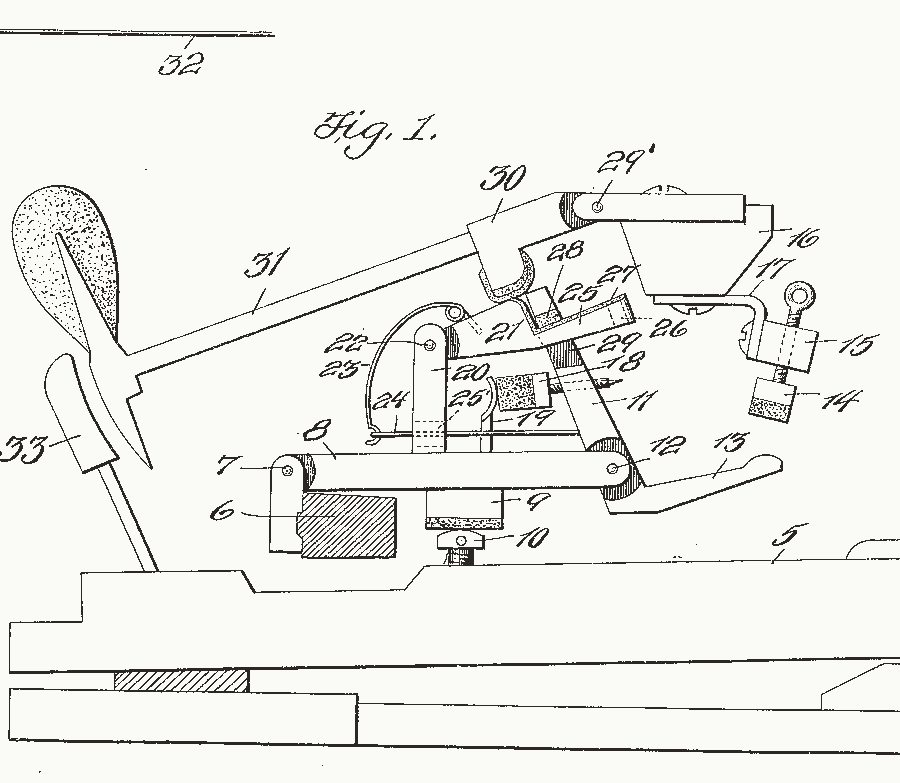
The same parts are in a grand action patented in 1917 by Lycus D. Perry, of New Rochelle, New York, drawn in Fig. 1. Perry numbered every part. His key 5 lifts the wippen 8 on its rail, and the jack 11 lifts the hammer 31 toward the string 32. The repetition lever 21 stands on a post on the wippen. Perry wrote that he set out to simplify the action “without the loss of the repetition qualities”.
The jack lets go
A hammer held against its string would press the string still and smother the note. So the jack lets go before the hammer gets there. A short arm, the jack’s tender, reaches forward from its foot. As the wippen rises, the tender meets the let-off button, a felt button hung from a fixed rail, and the foot is held back while the jack’s pivot goes on rising. The jack tips. Its top slides out from under the knuckle, and the hammer is free. Perry described the same moment: just before the hammer strikes the string, the jack’s trip-arm meets its button, and the jack leaves the hammer-butt.
The gap between hammer and string at that moment is the let-off. It is set at 2.0 to 2.5 mm in the bass and 1.0 to 1.5 mm in the middle and treble. To set it, a technician presses each key down slowly and turns the button’s dowel.
Figs. 2 to 4 draw one bass key of a grand action laid out like Perry’s, set as a Kawai grand is, with a let-off of 2.0 mm. Once the jack lets go, the hammer travels on by itself, like a ball thrown upward, and reaches the string only if it is moving fast enough. Fig. 2 presses the key at one even speed, slow or fast. Before you try the slow press, guess whether its hammer will reach the string.
What the drawing shows
The slow hammer falls short. In the drawing that key goes down at 15 mm a second and takes 673 ms. The jack lets go 2.62 mm below the string, with the felt moving at 0.16 m/s, and the hammer coasts up only 1.15 mm more. Then it stops and drops onto the repetition lever. No note sounds. A ball thrown up at 0.16 m/s would rise 1.3 mm; the hammer rises a little less because it swings on its hinge.
Too slow to sound
A press at an even speed needs at least 22.6 mm a second at the key’s front for the drawing’s hammer to reach the string. The fast press, at 300 mm a second, takes the key down in 34 ms. Its jack lets go at 29 ms, the felt strikes a millisecond later and bounces off, and the hammer falls back toward the key. Either way the key goes on down after the jack has let go. The hammer is already on its own.
Players notice the slow case. Someone on r/piano asked why their Kawai CN301, a digital piano, made no sound when a key went down slowly. One reply said the same happens on a grand pressed too slowly. Another said an acoustic key can be pressed so slowly that the hammer never reaches the strings, and that some pieces ask for this, to lift a damper without a note. Those are players’ own accounts. A technician uses the slow press on purpose, to see where each hammer is let go.
Caught, then lifted again
After a strike the hammer falls back, and if nothing caught it, it could bounce up and strike again. The backcheck catches it. That is a padded block on a wire at the back end of the key, which has risen with the key into the falling hammer’s path. Perry wrote that the hammer’s heel wedges fast in his back-check, 33 in Fig. 1. The backcheck is set to hold the hammer’s top about 15 mm from the string.
Now the jack is out from under the knuckle, and a second press would lift nothing. The repetition lever brings it back sooner. It lies along the wippen under the same knuckle, with a spring pushing its end up. Near the end of a press, a drop screw in the hammer’s rail holds it down, so a hammer let go slowly drops onto it. The drop screw is set to touch the lever as the jack meets its button, and the hammer’s first fall then equals the let-off. The drawing keeps the fall, 2.0 mm, so its screw meets the lever with the key 8.16 mm down, a little before the jack’s tender meets its button at 8.79 mm.
Let the key up a little and the backcheck lets go. The spring lifts the hammer on the repetition lever, and the jack can slip back under the knuckle. The spring should carry the hammer up slowly and easily, without jumping or catching. Fig. 3 starts with the key held down after a firm press. Guess how far the key must come up before the jack is back.
What the drawing shows
Playing a note again
The key has to come up only 1.41 mm of its 10.1 mm in the drawing. Until then the repetition lever holds the hammer 2.6 to 4.6 mm below the string. From there another press lifts the hammer and strikes again, long before the key is all the way up.
This is the double escapement. An Erard grand of about 1840, made in London and now at the Met, has the one that Sebastien Erard invented and his nephew Pierre refined, which the museum calls the basis of the modern piano action. By Wikipedia’s account the double escapement was patented in 1808 and 1821. On Stack Exchange, answering a question on how to check for it, one player wrote that it lets a note be repeated before the key has risen all the way.
Players also report what happens when the reset fails. On r/piano someone found that a key released slowly would not sound again. A reply blamed too little “lost motion”, so that the jack was not getting fully back under the hammer butt. On Stack Exchange the owner of a baby grand wrote that one key stiffened and went silent, and that its jack sometimes fell further than normal. Pressed slowly again and again, the note grew weaker until the hammer no longer reached the strings.
The damper and the right pedal
Behind the hammer, a damper rests on the same string. The damper is a head lined with felt, on a wire that stands on a damper lever over the key’s back end. Pressing the key lifts the lever, the lever lifts the wire, and the damper leaves the string, so the string can ring for as long as the key stays down. Let the key go and the damper drops back onto the string. In a grand the dampers and hammers come back by gravity, where an upright adds springs. The dampers are set to start lifting when the hammer is 23 mm from the string, half its 46 mm travel.
The right pedal, the damper pedal, raises a damper tray under all the damper levers at once. With the pedal down, every damper is held off its string, whatever the keys do. The pedal should move about 1 to 2 mm before it starts on the tray, and lift the dampers as high as a pressed key does. A 1914 patent by Edwin S. Werolin, for Sohmer & Company, draws the same chain, in which the action swings a damper lever up, a spring presses the damper down, and the loud pedal moves the dampers through a lifter and a rod. The Erard grand of about 1840 has its right pedal for the dampers too.
Fig. 4 adds the damper to the action. With its pedal down, guess what the damper does when you let the key up.
What the drawing shows
A note that rings on
With the pedal down, the damper stays where the tray holds it, 4.86 mm above the string in the drawing, when the key comes up. That is as high as a fully pressed key lifts it. The string would go on sounding until the pedal came up.
A note that rings on after its key is up, with the pedal up, has a damper that never got back to the string. Someone asked on Stack Exchange about one key of an upright piano that kept sounding after it was released. One answer gave two causes, a damper rubbing on its neighbour’s felt and dampers left resting on the pedal’s lift, off the strings. That answer is about an upright piano. On a grand, the damper pedal should have 1 to 2 mm of slack, and a damper’s head may keep 1 to 2 mm of play with a black key held down.
From Cristofori to Steinway
By the Met’s account, Bartolomeo Cristofori was the first person to make a successful keyboard instrument with hammers, and so deserves to be called the inventor of the piano. About 1700 he began an instrument whose loudness followed how hard its keys were struck, and called it “gravicembalo col piano e forte”, harpsichord with soft and loud. His action already had an escapement, which let the hammer fall away from the string at once after striking it, and a check that kept the hammer from bouncing back to strike again. No hammer mechanism as sensitive and reliable was made for seventy-five years after his. His grand of 1720, now at the Met, is the oldest of his three that survive. It has 54 keys.
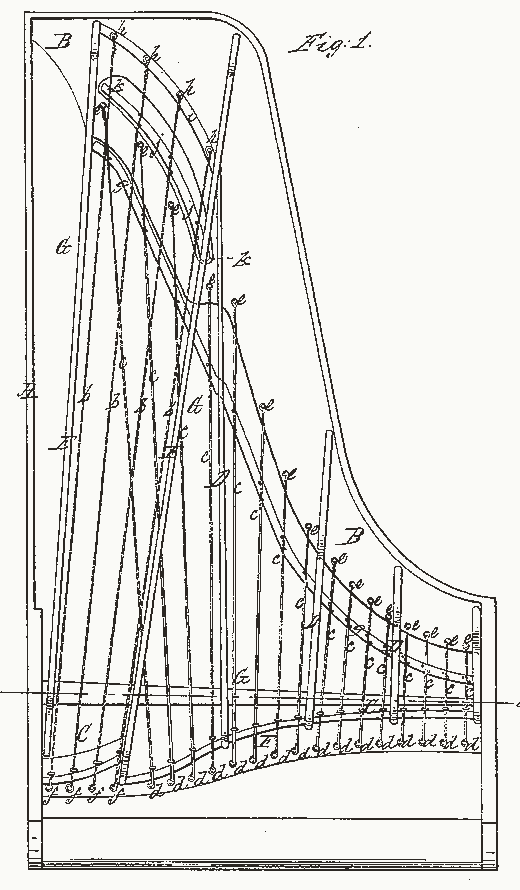
Henry Steinway, of New York, received US Patent 26,532 for a grand piano strung in two tiers. The patent is dated 20 December 1859, and Fig. 5 is his plan. The strings of the lower notes run in the upper tier and slant across the others. He wrote that this brings their bridge nearer the middle of the sound board than in any other grand. He had searched, he wrote, and found no overstrung grand built before his. The patent’s text names him Henry Steinway; the heading on its drawing sheet reads “H. Steinway, Jr.”.
What the drawings leave out
The sizes are the drawing’s own. Figs. 2 to 4 draw one key, one string and one damper, though a real note may have more strings; the Erard is triple strung except in its five lowest notes. The key is drawn with a piece of its middle left out. Its levers, pivots and springs are placed after Perry’s drawing.
The felt is drawn as a hard block. The shank never bends. Friction is left out. The hammer’s weight is taken at one point near its head, and its bounce keeps 0.6 of its speed. The repetition lever holds the hammer up whenever it rests there, and gives way only to the rebound after a strike. At rest the jack waits 0.3 mm below the knuckle.
Every time and speed in Fig. 2 is the drawing’s, since no source gives the timing of a press, and a real finger seldom keeps one speed through a press. The key’s dip, the hammer’s rest, the let-off, the first fall, the backcheck and the damper’s start are a Kawai grand’s.
Sources
Read in November 2026.
- Kawai, Shigeru Kawai Piano Laboratory, “Kawai Grand Piano Regulation Manual”, Vol 1.6, 2013: the part names, and sections 7, 8, 11, 13, 14, 15, 17 and 20 to 22 for the settings.
- Lycus D. Perry, for Ludwig and Company, US Patent 1,231,937, “Grand-piano action”, 1917: Fig. 1, and the layout of Figs. 2 to 4.
- Louis Charpiat, US Patent 904,308, “Repetition-action for pianos”, 1908: the drop screw in the hammer’s rail.
- Edwin S. Werolin, for Sohmer & Company, US Patent 1,097,696, “Action for grand pianos”, 1914: the damper lever and the loud pedal.
- Henry Steinway, US Patent 26,532, “Grand piano”, 1859, in the USPTO’s copy: Fig. 5 and the strings in two tiers.
- The Metropolitan Museum of Art, Cristofori’s grand piano of 1720, and an Erard grand of about 1840, read in the Internet Archive’s copies.
- Wendy Powers, “The Piano: The Pianofortes of Bartolomeo Cristofori”, the Met’s Timeline of Art History, 2003: the escapement and the check.
- Wikipedia, “Action (piano)”, revision of 25 April 2026: grand and upright compared, and the dates of the double escapement.
- r/piano, “Piano making no sound when pressed slowly”, May 2025, via the Arctic Shift archive. User report.
- r/piano, “When a piano key is released slowly it dosent make a sound again”, May 2025, via the Arctic Shift archive. User report.
- Music: Practice & Theory Stack Exchange, “How to check for double escapement in a digital piano?”, January 2014, with an answer of February 2014. User report.
- Music: Practice & Theory Stack Exchange, “Piano keys stiffening on repeated pressing”, September 2015. User report.
- Music: Practice & Theory Stack Exchange, “Piano key sustains without the pedal pressed”, April 2016, with an answer of June 2017. User report.
The type is Playpen Sans by TypeTogether, under the SIL Open Font License 1.1.