Tyre valve
Air from a pump gets into a car or bicycle tyre through a valve that opens only while the pump pushes harder than the air inside and a small spring together. The kind drawn here is the Schrader valve, from the firm August Schrader founded in New York.
Two pushes on one valve
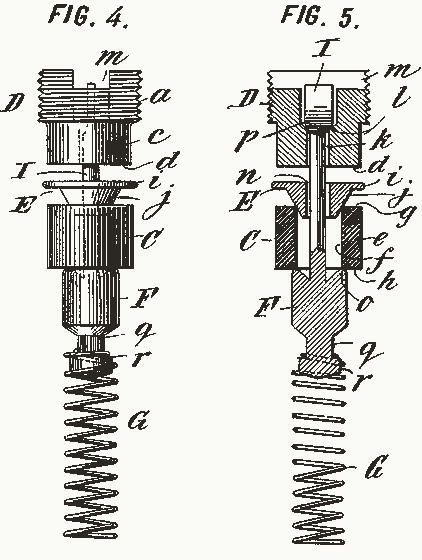
Under the cap of a tyre valve, a thin pin sits in the valve’s open end, its tip about level with the rim. In American English it is a tire valve. Both hands-on figures below are drawn after a patent of George H. F. Schrader’s, and its words name the parts. A plug is screwed into the top of the valve’s shell, and under it sits a short tube of rubber. The lower end of that tube is the seat. Below the seat is what Schrader calls the valve proper, with a spring under it. A thin stem runs from the valve up through the tube and the plug. Schrader calls it the valve or deflating stem. Here it is the pin.
A question on Physics Stack Exchange, a user report, asked how air could get into a tyre through a valve that is closed. Schrader’s patent gives the answer in two sentences. “Air will be pumped in, unseating the valve with the inflow. The internal pressure and the spring will seat the valve against escape of air.” Two things push this valve up onto its seat, the spring and the tyre’s own air, and only the pump’s air pushes it down.
Pumping past the spring
Makers call the spring’s share the opening pressure, the air pressure above the core that it takes to overcome the spring. Schrader Pacific lists its standard air core at 25 to 35 pounds per square inch, about 1.7 to 2.4 bar. The valve in Fig. 1 is given 30, which is 2.07 bar. Suppose the ring on which the valve touches the seat is 2.6 mm across. Then that spring presses with 1.1 newtons. Every pressure on this page is counted above the air outside. The tyre starts at 2.50 bar, the lowest pressure Schwalbe marks on its Marathon 365 in the size 47-622. Before you push the pump’s handle down, guess how far it must go before any air passes the valve.
What the drawing shows
Air reaches the tyre only after the handle is 86% of the way down. Until then the pump squeezes its own air. The valve leaves its seat when the pump reaches 4.57 bar, the tyre’s 2.50 and the spring’s 2.07 together, and the rest of the stroke raises the tyre by 0.05 bar. On the way up the pump’s pressure falls below the tyre’s at once, so the valve is back on its seat. Each stroke ends a little higher, and the valve opens a little later each time. This pump would need 50 strokes to bring the tyre to 5 bar, the top of its marks. Once the hose comes off a valve of today, the core’s spring and the tyre’s pressure close it.
Heads that press the pin
Some pump heads press the pin themselves. A hose fitting put over a tyre’s valve stem pushes the pin in so that air can enter. While the pin is held in, the spring no longer stands in the air’s way. On Bicycles Stack Exchange, in user reports, one answer says that with a Schrader valve, a part in the pump head holds it down the whole time. In the same thread another preferred the Presta valve for hand pumps, as “there’s no spring that the pump needs to overcome”. A Presta valve stays shut by air pressure and a small knurled nut alone.
In another user report, someone asked on Bicycles Stack Exchange why air sometimes will not go in, and noticed that the pump’s gauge then climbs very fast. An answer said the head had probably failed to press the pin properly. Not every head has that part. A reader on r/cycling, also in a user report, found no pin in the Schrader hole of a foot pump, and asked whether it could work. One reply said the pin is there to let air out, and the difference in pressure lets air in. That is the way of Fig. 1.
Holding the pin down
The pin also lets air out. Schrader’s cap had a finger on its top. To let air out, his patent says, the cap is turned over and the finger pressed against the pin, and his Fig. 3 draws it so. That pushes the valve down off its seat, against the spring and the tyre’s air. Schrader France rates how much air a core lets out at 7 bar with its plunger fully open. Its standard cores pass 6 or 9 cubic metres an hour, and Fig. 2’s core passes 6. The catalogue does not say whether its 7 bar is counted above the air outside. Here it is taken to be. Fig. 2 starts with the tyre at 4 bar. Guess how long the tyre will take to fall to 2 bar while you hold the cap down.
What the drawing shows
The tyre is down to 2 bar after 8.8 seconds. It falls fastest at first, from 4 to 3.72 bar in the first second, and more slowly as it empties, since a lower pressure drives less air through. After 31 seconds it is within 0.01 bar of the air outside. Let go, and the spring and the tyre’s air put the valve back on its seat, so the pressure stops where it is. The flow is worked out from the relations for air leaving through a narrow opening.
What the earlier patents show
Wikipedia says the Schrader valve was invented in 1891 and patented in 1893. It cites George Schrader’s US Patent 495,064. That patent, filed on 9 January 1893 and granted on 11 April, describes an air valve closed by screwing it down onto its seat, with packing clamped between. It has a one-way valve as well, which Schrader calls “of well known construction”. That one opens “when the ingress pressure exceeds that within” and closes “in case of excessive inner pressure”. So a valve that let air in and kept it there was already known to him in 1893.
In April 1897 Schrader wrote that tyre valves had “heretofore” been made with a valve proper in a chamber and “a spring for seating the valve proper”. In an application of the day before, he wrote that the working parts should come out without the shell being taken off the tyre. Wikipedia gives 1898 for the replaceable core. The patent he filed on 14 February 1898, granted on 31 December 1901, sells the plug, the rubber seat, the valve and its spring joined together, ready to be screwed into a shell. Fig. 3 shows them so. The patents read here do not say which design was the first whose core came out.
Schrader’s firm tells its own story. August Schrader, a German immigrant, opened his shop in Manhattan in 1844. By 1890 he and his son George had turned to bicycle tyres, and the two developed the valve. By Wikipedia’s account, George patented a cap for it two years after 1893.
Caps, dirt and slow leaks
A shut valve does not keep a tyre full for long. Even the most airtight bicycle inner tubes lose pressure all the time. Their pressures are much higher than a car tyre’s, and their walls much thinner. Schwalbe counts a loss of 1 bar a month as normal, and asks riders to check at least once a month and never to go above or below the pressures marked on the tyre.
The cap guards the core. Caps act as a second seal, and they keep the valve and its surfaces clean while the tyre is in use. A cap with a rubber washer or ring inside can stop a leaking core from losing air, while a plain cap with no seal cannot be relied on. Dirt matters to the core as well, since debris can get into the spring-loaded pin of a Schrader valve and get in the way of filling the tyre.
What the drawings leave out
The sizes are the drawing’s own. The valve’s parts follow the patent’s figures, with no maker’s number behind them, and the 0.8 mm the valve moves when air lifts it is made large enough to see. Figs. 1 and 2 also follow the patent in making the seat of rubber and the valve proper of metal. Today’s cores have it the other way round, with a soft seating washer on the plunger, the part that moves. A core today is a screw plug, a plug with its washer, and a plunger with its spring.
Only the two threads are today’s. The core screws into the stem on a thread called 5V1, given as 5.2 by 0.705 mm, and the stem’s outer thread is 8V1, given as 7.7 by 0.794 mm. The drawing uses the widths in those names. Measured over its crests, the thread inside the stem is at least 5.334 mm across, and the thread on the core at most 5.232 mm.
The pump is a plain barrel that sweeps 250 cubic centimetres a stroke and keeps 12 at the bottom. It takes in outside air as soon as its pressure falls below the air outside. The tyre is taken as a ring of round section 47 mm across, holding 3.6 litres, and it does not stretch. No air warms as it is squeezed or cools as it leaves. The spring’s share comes from one of today’s cores, the flow from another, and both are fitted to a valve of 1898. In Fig. 2 the flow grows with how far the pin goes down. In Fig. 1 the valve opens all at once, by a fixed amount.
Sources
Read in November 2026.
- G. H. F. Schrader, US Patent 690,192, “Tire or other valve”, 31 December 1901. It is the source of Fig. 3, and both hands-on figures follow it.
- G. H. F. Schrader, three earlier patents: US Patent 495,064, “Valve”, 11 April 1893, closed by screwing; US Patent 685,649, “Tire or other valve”, filed 8 April 1897, seated by a spring; and US Patent 661,671, “Tire or other valve”, filed 7 April 1897, whose working parts come out.
- Schrader Pacific, its valve cores catalogue, through the Internet Archive’s copy of August 2024.
- Schrader France, its catalogue of cores and caps, PU 162.
- Yamawa, “Tire Valve Threads for Automobiles”, its technical note 115, with the table of tyre valve threads from JIS D 4207.
- Schrader TPMS Solutions, the firm’s history, through the Internet Archive’s copy of September 2024.
- Schwalbe, on tyre pressure, and the Marathon 365 in size 47-622.
- NASA Glenn Research Center: mass flow choking, isentropic flow and specific heats.
- Wikipedia, “Schrader valve”, for its dates, the pin, Presta valves and caps, and “Standard atmosphere (unit)”.
- Bicycles Stack Exchange, “Why are both Schrader and Presta valves still used on tubes?”, February 2012, with its answers. User report.
- Bicycles Stack Exchange, “Why is it sometimes hard to get air to flow into a Schrader valve?”, November 2026, with the answer by WornChain. User report.
- Physics Stack Exchange, “How air gets filled in bicycle tire without removing its valve tube?”, February 2017. User report.
- r/cycling, “Am I crazy or do Schrader pumps need a pin in the middle”, June 2024, via the Arctic Shift archive. User report.
The type is Playpen Sans by TypeTogether, under the SIL Open Font License 1.1.