Ballpoint pen
At the point of a ballpoint pen sits a hard ball, held in a metal socket so that it can turn but cannot fall out. As you write, the ball rolls on the paper and carries ink to it from inside the pen. In a retractable pen, a click pushes the point out and holds it there.
A ball in a metal socket
A refill is a thin tube of ink with a metal point at one end. In that point are the ball, a socket that holds it, small channels that bring ink through the socket to the ball, and the ink behind them. The ball may be steel, brass or tungsten carbide. BIC’s M10 pen has a tungsten carbide ball, and Schmidt’s refills have a stainless steel point with a ball of 0.8 mm or 1.0 mm.
A patent granted to Pilot in 1999 tells how such a point is made. The ball goes into a small housing and rests on a seat with ink grooves cut into it. Tools then press the front rim of the housing against the ball and bend it inward, so the opening is narrower than the ball. Last, the ball is hammered back a set distance, which pushes the seat back and leaves a little clearance all round. More than half of the ball is buried in its holder, so it cannot drop out.
Friction with the paper turns the ball. Its inner side sits in ink. As it turns, that wet side comes round past the rim and meets the paper, which takes some of the ink. Laszlo Biro’s American patent of 1945 asked for an ink thick and clinging enough to spread over the ball as a thin layer. Fig. 1 draws the point cut through the middle, after the patents of Biro and Pilot. Guess how many times the ball turns in one centimetre of writing, then drag the pen along in Fig. 1.
What the drawing shows
The ball turns a little more than three times in a centimetre. One turn of a ball 1.0 mm across rolls it 3.14 mm along, so 10 mm of line takes 3.18 turns. Count them by the white dot. The side coming out at the front is wet from the groove. The paper takes that ink at the bottom, so the line grows behind the pen.
When the pen stops
Once you stop writing, the ball stops turning and nothing carries ink out. Biro wanted his socket to close the point almost airtight, and the ink to stay in its narrow channel by clinging to the walls, with no pressure behind it. He also asked for an ink that would not dry or go off in the air. The point stands between the ink and the outside air as a buffer, which keeps the quick-drying ink from drying in the tube. Air still has to get in at the back as ink is used, and Biro gave his pen an intake for it.
Some designs add a spring. Pilot’s patent of 1999 is for a refill whose ink is thick while it stands still and runs thinner where the turning ball stirs it. There, a coil spring presses the ball forward onto the inner edge of the rim to keep the ink from drying out or leaking, and a plug called a follower rides down the tube behind the ink. Fig. 2 shows a spring in a far older pen, John J. Loud’s of 1888.
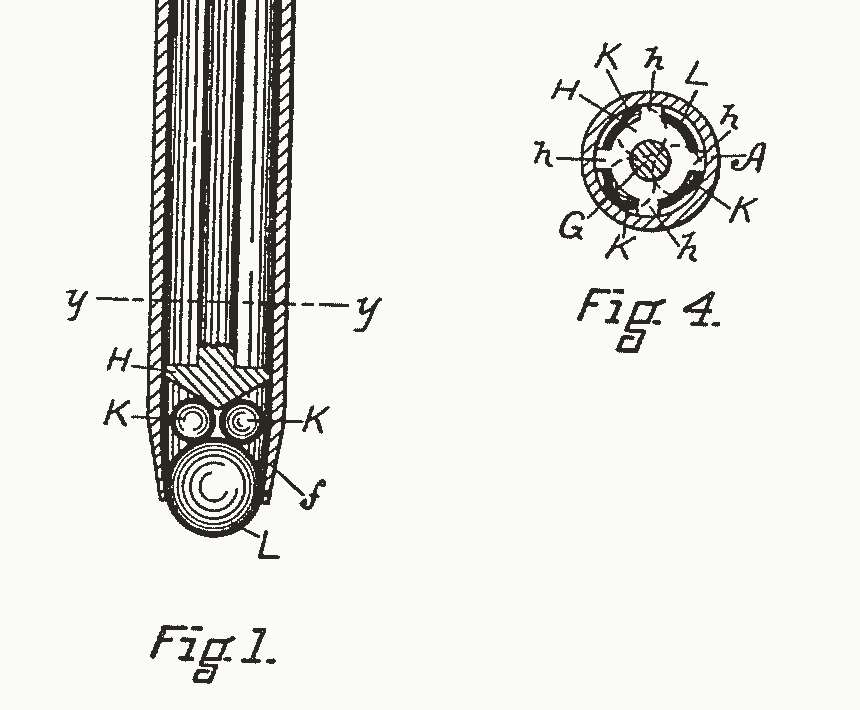
Higher up the tube, Loud’s spring pushes a rod down onto the small balls, and they press the writing ball into its seat. Turn the screw on top all the way down and the ball is clamped shut: in his words, “In this position no ink can escape from the pen.” To write, you turned the screw back a little; when the ball met a surface the spring gave, and ink ran out round it. Loud made the pen for marking wood and coarse wrapping paper, where an ordinary pen could not be used. Wikipedia says it proved too coarse for letters, and the patent lapsed.
One press out, the next press in
A retractable pen asks one button to do two jobs: push the point out and keep it there, then let it back in at the next press. Fig. 3 follows a patent that Nolan Kent Rhoades filed for the Parker Pen Company on 29 December 1953, granted in 1965.
At the back of the refill sits a short cam body that can turn and slide inside a fixed guide tube. Two tabs, the stops, hang inside the guide. They never move. The button’s plunger has two fingers that reach in beside them. A return spring near the point pushes the refill and its cam back toward the button. The cam’s end is cut into faces that all slope the same way, with steps between them that run along the pen. With the stops on the deeper faces the point is in; on the shallower ones it is held out.
Fig. 3 draws the cam unrolled flat, as Rhoades does, so turning becomes sliding to the right. Make a guess first: how far round does the refill turn between one outing of the point and the next?
What the drawing shows
Between one outing of the point and the next, the refill goes half a turn round. Each press and release turns the cam 90°: about 56° while you press, once its steps have slipped past the stops, and the rest as you let go and the stops catch it on the next faces. The point comes out at every second press, so it has gone 180° round each time. Rhoades says this evens out the wear on the ball’s seat and helps work loose dirt caught between ball and seat. The return spring does the turning, and holds the cam in either place until the next press.
Other pens hold the point another way. In Herman Frentzel’s earlier Parker patent of 1952, a flexible rod pushes a small latch that tips over and catches on the front edge of a liner, and the next press tips it back. Other click pens are built from a thruster, two cams and a guide pin.
Why the line skips
A pen skips when the ball stops turning or when ink stops reaching it. After four or five years the ink itself may have set too hard. Write with the point tipped upward and air gets into it and breaks the ink. Oil from your hand can leave the paper so slippery that the ball slides instead of turning, and so can paper that is too smooth, or glass, or plastic. Try a guess for Fig. 4 before you move the pen: on the greasy patch, what does the ball do?
What the drawing shows
On the patch the ball stops turning. The pen pushes it along with the same spot facing down. That spot has already given up its ink, so the line breaks until the ball reaches clean paper. Users on forums give the same reason. In a thread on Reddit’s r/explainlikeimfive about pens that fail in one spot, the top reply, with 2,453 points in an archived copy, blamed a patch of oil or wax that the ball cannot grip. Another reply said the stuck ball rubs that spot smoother, so it slips there again.
Two Physics Stack Exchange threads add more from use. One answer explains why a pen writes better with more pages underneath: the soft stack gives, so the ball sinks in and grips, while a hard backing leaves it little to roll on. In the other thread, one asker tested pens that skipped with plenty of ink left, found that shaking them or blowing into the air hole helped for a while, and decided the ink had grown too thick to flow down as fast as the ball used it. Parker made the ball itself less smooth. Wikipedia says its T-Ball refill of 1957 had a textured tungsten carbide ball that slips much less on slick paper.
Whose pen came first
Sources do not agree on who invented the ballpoint. Wikipedia gives the first patent to Loud, on 30 October 1888. It also names him as the inventor. The Smithsonian’s Air & Space Magazine gives the title to Laszlo Biro, a Hungarian journalist who filed for a British patent on 15 June 1938. Wikipedia says he had seen how fast newspaper ink dried and wanted a pen that could use ink like it. It tells of him working on thick inks with his brother Gyorgy, a dentist, and of a new patent filed in Argentina in 1943. His American patent, the one described above, was granted in 1945.
The first retractable is just as unsettled. Wikipedia’s article on retractable pens gives that to Loud’s patent as well, but the patent describes no point that goes in and out: its screw only clamps the ball against its seat. The same article reports the Frawley Pen Company’s claim to the first retractable ballpoint tip, in 1950. Parker’s Jotter came out in 1954, and a pen blog writes that it retracted where other ballpoints on the market had caps.
What the drawings leave out
The sizes are the drawing’s own. Fig. 1 stands the point upright, draws the clearance and the ink far thicker than they are, and has no spring behind the ball. Fig. 3 gives each half turn one deep face and one shallow one, where Rhoades cuts a short slope beside a deep, narrow notch. Fig. 4 draws Fig. 1’s ball smaller, leaves out the paper’s fibres, and makes the patch slippery all at once, right up to its edges. Fig. 2 is Loud’s own, only cropped.
One size comes from a real refill: the ball in Figs. 1 and 4 is 1.0 mm across, one of Schmidt’s two. Real balls run from 0.28 mm to 1.6 mm across, and a ball’s size is not the width of the line it draws. BIC’s M10 writes for up to 2 km. A ball 1.0 mm across would turn about 640,000 times along a line that long.
Sources
Read in November 2026.
- J. J. Loud, US Patent 392,046, “Pen”, 1888, for his pen, its purpose and Fig. 2.
- L. J. Biro, US Patent 2,390,636, “Writing instrument”, 1945, for his socket, seat, channels and ink.
- N. K. Rhoades for the Parker Pen Company, US Patent 3,205,863, “Writing instrument”, filed 1953 and granted 1965, for the cam, the stops, the fingers and the half turn.
- H. C. Frentzel for the Parker Pen Company, US Patent 2,584,569, “Ball point writing instrument”, 1952, for the tipping latch.
- K. Shiobara, K. Sasaki and T. Fukasawa for Pilot, US Patent 5,984,559, “Ballpoint pen refill and fabrication method thereof”, 1999, for how a point is made and for the spring and follower.
- Tombow, “Tombow Q&A: What to do when the ink does not come out”, for why the ball turns, what stops it, and how much of it is buried.
- Schmidt Technology, “Refills for ballpoint pens with paste or ink from SCHMIDT”, and BIC, “BIC M10 Anniversary 70”, for the balls and the 2 km.
- Wikipedia, “Ballpoint pen”, “Retractable pen” and “Parker Jotter”, for the parts, the ink, ball sizes, Loud’s and Biro’s stories, the claims to come first and the T-Ball.
- R. Maksel, “If You Like Ballpoint Pens, Thank the R.A.F.”, Air & Space Magazine, June 2015, for Biro as the inventor.
- r/explainlikeimfive, “[ELI5] When a ballpoint pen temporarily stops working; why does it work on a different place on the paper, but keeps not working where it initially stopped working?”, November 2019, via the Arctic Shift archive. User report.
- Physics Stack Exchange, “What causes ballpoint pens to write intermittently?”, February 2013. User report.
- Physics Stack Exchange, “Why do ballpoint pens write better on pages that have pages below them?”, October 2017. User report.
- inkstable.com, “A Brief History of The Parker Jotter”, 2023. User report.
The type is Playpen Sans by TypeTogether, under the SIL Open Font License 1.1.