Typewriter
Keys on a manual typewriter are levers, and each one rocks on a fulcrum inside the machine. On the typewriter that C. Latham Sholes, Carlos Glidden and Samuel W. Soule patented in June 1868, pressing a key swings a steel type-bar up under the paper to print its letter. Weights on cords then pull the paper on by one letter.
A box two feet square
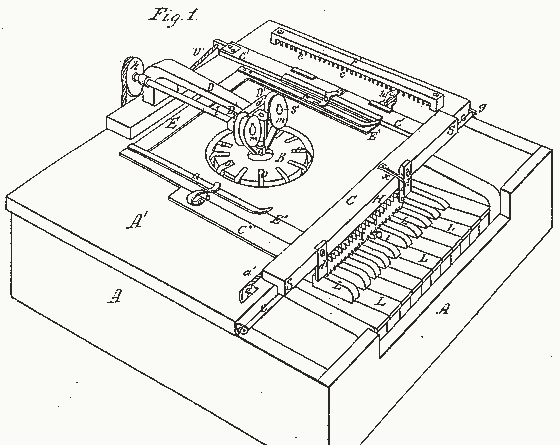
The machine of 1868 is a case about two feet square and four to six inches deep. A circle is cut in its lid, and a ring four to five inches across is set into the circle. This is the disk B. It is of a “hard tough material”, and the inventors “use and prefer brass”. Its central hole is one to one and a half inches across, and its rim half to three quarters of an inch thick. Under it hang the type-bars, one for each type, made of steel in the inventors’ own machine. At the front lies a keyboard “similar to the keyboard of a piano”, with one key for every type and one more for spaces. An arm reaches over the disk from the edge of the case and holds a small block called the platen just above its middle (Fig. 1).
Wikipedia quotes a 1949 history that called it “a cross between a piano and a kitchen table”. The patent calls the type-writer “in every way the best of all machines yet designed for the purpose”.
One spot for every letter
Each type-bar hangs by its outer end from a wire that runs round the outside of the disk. The type is cut in relief on the upper side of its inner end. Grooves on the disk’s underside run in from slots at the edge to the central hole. There are as many grooves as types. Each groove fits one bar.
The patent makes every bar “of the exact length of the radius” of the disk. Thrown up into its groove, each one reaches the same place, the centre. That point lies under the platen. So every letter on the machine is printed at one spot, and the paper has to move between letters.
A second patent to the same three men, No. 79,868, is dated 14 July 1868. Its opening describes the same kind of ring, slotted and grooved to hold and guide the type-bars, as many as the characters to be used.
Key, finger and type-bar
Each key is a long lever that rocks on a beam the patent marks M. The keys reach from the front of the case in under the type-bars. On the inner end of every key except the space key, the patent fastens a finger, made in any convenient way: “we use a stiff wire”. The finger sits under its own type-bar. Press the front of a key down and its inner end rises. The finger then strikes the bar and “throw[s] the type-bar up into its radial groove and its type-end against the central point”.
When nothing lifts them, the bars rest on a cushion set below the circle of fingers and bars. The patent asks only that it be “of any material”.
The patent’s Fig. 7 cuts the machine from back to front, and Fig. 2 here does the same through one key and its type-bar. Guess which side of the paper the type will come from, then press the key and watch.
What the drawing shows
The type comes up from underneath, through the disk’s central hole. In this drawing it rises about 34 mm on the way. The first sixth of the key’s travel lifts nothing, because the finger has to close a small gap before it meets the bar. After that the bar rises faster for the same push. The second half of the key’s travel lifts it 26 of its 35 degrees. Let go, and it falls back.
Printing on the paper’s top side
The paper lies on top of the disk, face up. Over it passes the ribbon, or a sheet of carbonized paper, and above both hangs the platen. The patent hangs it as near the lid’s surface as will let the paper and the ribbon pass easily under it. So the type pushes the paper up against the ribbon, and the ribbon presses the ink onto the paper’s top. The writing faces up. This way of printing needed very thin paper, such as tissue.
The patent makes the platen of “any hard smooth substance”, and its inventors used metal. Its top is rounded and sits in a cup in the bottom of the block above it, which makes a joint that lets it tip. The patent says this self-adjusting platen makes the types meet the paper “evenly and squarely”.
Once it has struck, the bar falls back onto the cushion. The patent gives it no spring, so its own weight brings it down. In the later Sholes and Glidden machine, too, gravity returned each typebar to its place.
Weights and a frame for the paper
The paper lies in a frame of two parts. The outer frame, C, slides from right to left along the front edge of the lid on small flanged wheels. The inner frame, E, slides inside it from front to back. Thin springs press the paper flat in the inner frame’s bed. Moving one way gives a line of words, the patent says, and moving the other gives a series of lines.
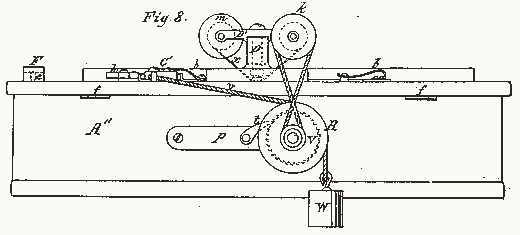
Cords run from two corners of the frame over pulleys. Each one ends in a weight, under or behind the case. The weights are “constantly pulling” the frame from right to left. Left alone, it would run all the way. So the machine has to hold the paper still while each letter is struck, then let it go exactly one letter’s width.
Lines are spaced by a fixed bar at the right of the frame, set with a row of pins. The pins stand as far apart as one line of writing from the next. A pawl on the inner frame has a sloping side as long as that distance. When the frame is pushed back to the right, a pin slides along the slope. The pawl cannot turn out of its way, so the slope pushes the inner frame, and the paper, on by one line.
Two forks and a toothed bar
Behind the fulcrum, a bar the patent marks T lies across all the keys. Whichever key goes down, its rear part lifts T. Midway along the keyboard, a lever H joins T to the front of the machine, pivoted in its middle like a see-saw. So when T rises, the front end of H goes down.
That front end is split into two forks, one above the other. Both forks move together. Between them runs a bar hung from the paper frame, toothed along both its top and bottom edges. The patent calls it the ratchet-bar, or the spacer. Its teeth are “regular and equidistant”. From one tooth to the next is “the exact distance required for a letter”. Each tooth has an upright face on its left and a sloping face on its right. The forks are shaped the other way round, so an upright face meets an upright face.
The forks are set just far enough apart for the bar to pass between them. The patent then puts the under fork’s point “a hair-breadth or slight distance” to the right of the upper fork’s point (Fig. 3). Watch the forks and guess whether the paper moves as the key goes down or as it comes back up.
What the drawing shows
The paper makes most of its move on the way back up. As the key goes down, the under fork drops out of the lower teeth. The bar slips the hair-breadth to the left, until an upper tooth meets the upper fork, and stops there. As the key rises, the upper fork leaves its tooth. Now the bar runs on until the next lower tooth comes up against the under fork, and that is the rest of the letter’s width.
Held while it prints
In the patent’s words, the paper “is moved while the type-bar is falling to the cushion, and stopped and held firmly stationary while the type is struck against it and the platen.” Each press and let-go moves it one notch, “a regular, exact, and equal distance every time”.
The under fork also carries a thin spring on its right side. When the upper fork goes down into its notch, the spring flies back into the next lower notch. Its “office”, in the patent’s word, is to help the under fork “catch every under tooth and not let one slip by”.
Owners of later typewriters write about that fault online, in user reports. An Olivetti Lettera 22 “adds extra spaces when keys are pressed too hard”, its owner wrote on r/typewriters. Its top reply, with 10 points, blamed “bottom typing”, which it described as pressing each key until it stops. It suggested quick taps that “throw” the type at the platen. A lighter touch stopped the skipping, the owner wrote back. Another machine skipped one space in every eleven characters. A reply guessed at a wheel in the escapement with eleven teeth, one of them gummed up or damaged.
When a line is full, a small lever turns the toothed bar down flat. It then slides between the forks freely, and the frame goes back by hand or by a foot treadle.
Dogs and a star wheel
The patent never uses the word escapement. The Sholes and Glidden typewriter took its escapement, the part that governs the carriage’s movement, from clockwork. Its keys came from the telegraph and its type hammers from the piano. The 1868 patent, too, calls its bars “type bars or hammers”.
Remington’s mechanical instructions for its Monarch portable, issued in October 1960, describe an escapement with the same two steps. Its foreword says the book is for mechanics and should not be given to customers. It names every part by number. A spring pulls that carriage. A rack on the carriage turns a small pinion, and with it a toothed escapement wheel. In user reports, owners on r/typewriters call it the star wheel. Two dogs on a rocker take turns at the wheel’s teeth. As the type bar travels toward the cylinder, the loose dog lets a tooth go and the fixed dog catches it. As the type bar returns, the fixed dog lets go and the loose dog catches the next tooth. So that carriage, too, moves in two parts, one at the press and one at the return.
A fresh piece of ribbon
The ribbon runs between two spools on the arm over the disk. One spool turns loose on a short pin. The other is fixed to a shaft that runs to the back of the case, where a pulley on its end is joined by a band to a larger pulley over which one of the weight’s cords runs (Fig. 4).
In a user report on r/explainlikeimfive, someone asked how people could find the corrected text of old novels from an author’s typewriter ribbon. A reply said the ribbon moves on with each letter, so a used one shows which letters were typed, and in which order.
Each time the frame moves one notch, the cord turns that pulley. The band turns the shaft, and the spool winds the ribbon on, “and thus give[s] a fresh place of the inking-ribbon every time for every type to strike against”. Both pulleys are cones of steps, so a change of step sets how fast the ribbon is fed.
From Milwaukee to Ilion
US Patent 79,265, “Improvement in type-writing machines”, is dated 23 June 1868. Its three inventors lived in Milwaukee, Wisconsin. They signed the text on 1 May 1868, and it begins by calling the machine an improvement on one they had applied to patent on 11 October 1867. James Densmore signed both drawing sheets as a witness. The drawing is kept by the National Archives at College Park, Maryland.
Work on the machine had begun in 1867. Soule soon left, and Densmore took his place, giving the money and the drive to keep developing it. E. Remington and Sons made arms and were looking for new trade. They bought the machine in early 1873, made it at Ilion, New York, and put it on the market on 1 July 1874. That Sholes and Glidden typewriter printed only capital letters. Its keyboard was QWERTY. Its typebars struck upward against the platen, so the typist could not see the line being written.
The Sholes and Glidden was the first commercially successful typewriter. Others came earlier. William Austin Burt’s Typographer of 1829 is among the machines listed as the “first typewriter”. Rasmus Malling-Hansen’s writing ball went into production in 1870 as the first sold commercially. Wikipedia’s article on typewriters names Frank Haven Hall with the three men as the 1868 patentees, but the patent’s first page names only Sholes, Glidden and Soule.
What the drawings leave out
The sizes are the drawing’s own. The patent gives few, and none for the key’s travel or the teeth. Of its sizes, Fig. 2 keeps the disk, four and a half inches across, with its hole and its grooves, and type-bars as long as the disk’s radius. Its keys, fulcrum, finger and cushion, and the 35 degrees at which the bars rest, are not in the patent. In the drawing the key’s front goes down about 19 mm.
The patent’s finger strikes the bar and throws it. In Fig. 2 the bar rides on the finger all the way up, so the type meets the paper only when the key is down as far as it goes. It also draws the paper, ribbon and platen touching. Fig. 3 leaves out the under fork’s spring and the lever that turns the toothed bar flat. Its teeth have room for four letters. The hair-breadth is drawn much too wide.
Sources
Read in November 2026.
- C. Latham Sholes, Carlos Glidden and Samuel W. Soule, US Patent 79,265, “Improvement in type-writing machines”, 23 June 1868, and its scan with both drawing sheets. Figs. 1 and 4 show its Figs. 1 and 8; Figs. 2 and 3 are drawn after its Figs. 7 and 2.
- The same three, US Patent 79,868, “Improvement in type-writing machines”, 14 July 1868, first page only, for the disk and its slots.
- National Archives, DocsTeach: “Drawing for a Typewriter”, National Archives Identifier 595503, where the drawing is held.
- Remington Rand, Sperry Rand Corporation, “Mechanical Instructions, Remington Monarch Portable”, issued October 1960, plate 2 on the escapement; kept online by Richard Polt.
- Wikipedia, “Sholes and Glidden typewriter”: the kitchen table, tissue paper, Densmore, Remington, gravity, clockwork.
- Wikipedia, “Typewriter”: Burt, Malling-Hansen and the list of patentees.
- r/typewriters, “Lettera 22 is skipping (dirty escapement?)”, November 2025, via the Arctic Shift archive. User report.
- r/typewriters, “Why is my typewriter skipping spaces?”, May 2024, via the Arctic Shift archive. User report.
- r/explainlikeimfive, “ELI5: How do people find correct text for old novels by using the authors typewriter ribbon?”, May 2017, via the Arctic Shift archive. User report.
The type is Playpen Sans by TypeTogether, under the SIL Open Font License 1.1.