Pencil sharpener
Along one side of a hand-held pencil sharpener’s narrow cone lies a single steel blade. Turn a pencil in the cone and the blade shaves a thin layer off its end each time round, until the end comes to a point. In 1897 John Lee Love patented a box in which gear teeth spin the sharpener round the pencil.
One blade in a cone
A hand-held sharpener is a small cylinder with a cone-shaped opening along it. A cutting blade sits in one side of the cone, its edge just entering it, and a slot along the edge lets the shavings out. At the narrow end a small bore leads out of the cone.
The cone sets the sharpening angle, and its width decides which pencil fits. A standard pencil is 8 mm across. The hole has to fit it closely. A pencil that wobbles is cut in steps, and its point breaks.
Fig. 1 shows such a sharpener with a new pencil in it, flat at the end. As in Love’s box, the sharpener does the turning. Guess how many turns the blade needs to bring the flat end to a point, then turn the sharpener and count.
What the drawing shows
Thirteen turns bring this pencil to a point, and through all of them it keeps its full length. Each turn the blade takes a layer 0.3 mm thick off the cone. That lets the pencil slide 1.4 mm further in. The flat end loses 0.6 mm across each time, and the strip of shaving along the blade gets 1.5 mm wider. The surface behind the blade is a shallow spiral, rising 0.3 mm over one turn, and the next pass takes that step off. After about ten turns the cut reaches the lead.
Where the cutting stops
Once the flat end is gone, nothing in this sharpener tells it to stop. Each further turn cuts wood and lead along the whole cone and takes 1.4 mm off the pencil. You decide when to stop.
Some makers build a stop in. KUM’s Automatic AS 2 sharpens in two stages. In the first, only the wood is cut, until the lead touches the automatic stop and no more sharpening is possible. A second hole then shapes the lead, and the stop again prevents extra sharpening once the point is reached. The cone it leaves is roughly 9 degrees, though its maker does not say whether that angle is measured across the cone or from its middle.
Love’s sharpener ends in its small bore. That bore, his patent says, lets the “finely-divided portions of the point” drop down into the box. The sharpener lifts out and can be turned over to empty the chips.
Love’s box
John Lee Love was living at Fall River, Massachusetts, when his application was filed on 23 April 1897. It was granted on 23 November that year as US Patent 594,114 (Fig. 2). His box holds a round chamber, open at the top. Round its upper edge runs a rim that turns inward, with gear teeth on it. A raised part stands up in the centre of the floor, and an arm is pivoted on that. The sharpener, which he calls “substantially of the usual construction”, sits in one end of the arm, free to turn, and a pinion, or small gear wheel, on its body works against the rim’s teeth.
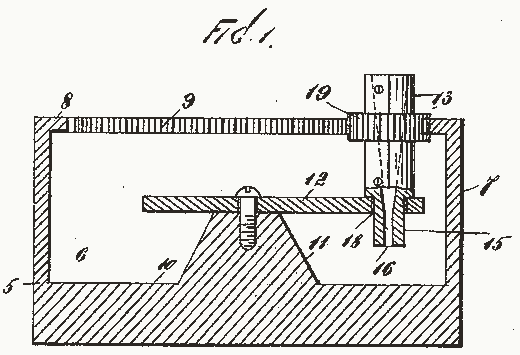
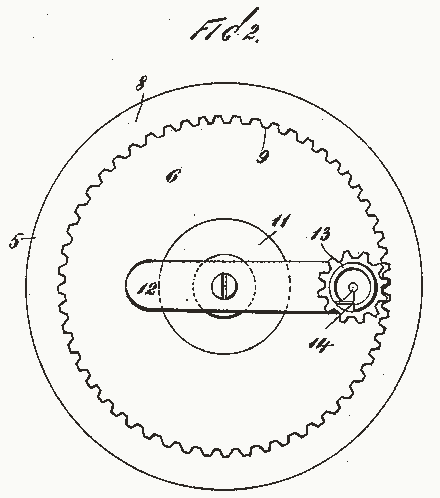
To sharpen a pencil, the patent says, you pass its point down into the sharpener with slight pressure and carry the sharpener round with the arm. The pinion and the teeth then turn the sharpener rapidly round the pencil. The patent names no crank or handle. The hand that holds the pencil does the carrying. Love added that the box could be made as ornamental as anyone wished, and could serve on a desk as a paperweight.
Teeth on the rim
Seen from above in Fig. 3, the box keeps the proportions of Love’s Fig. 2, turned so that the arm starts upright. A line across the end of the pencil shows which way the pencil faces. The blade lies under the pencil, so it is dashed. Before you carry the pencil round, guess how many times the blade goes round it in a single lap.
What the drawing shows
The blade goes round the pencil 3.58 times in each lap, the opposite way to the arm. Love’s drawing shows 55 teeth on the rim and 12 on the pinion, though his text gives no numbers. In one lap the pinion rolls over all 55 teeth, which turns it 4.58 times against the arm.
But the arm has itself gone once round the other way. So against the box, and against a pencil carried round without being twisted, the sharpener turns one time fewer. Fig. 1’s thirteen turns take 3.6 laps. Which way to go round, the patent does not say. Sharpeners are made right-handed or left-handed, for turning the pencil clockwise or anticlockwise. With its one blade, Love’s sharpener would cut only when carried round one way.
A reader on r/explainlikeimfive asked why small hand sharpeners so often break off the tips. One reply blamed the twisting of the arm, which strains the lead. In an electric or battery sharpener, it went on, the sharpener spins while the hand holding the pencil stays still. That reply is one user’s view. In Love’s box the gearing turns the sharpener, so the hand need not twist the pencil, though it does carry it round.
Why points break
A lead most often snaps because the pencil is in the wrong hole. If it sits too loosely, the blade cannot cut cleanly, so the lead breaks and the wood frays. With coloured pencils a loose or blunt blade can do it too, and so can too much pressure, or a lead that was damaged before it went in.
Users say much the same. On r/explainlikeimfive, one reader wrote that the holes are meant to be tight, to keep the pencil in line with the blade. Another said the length of the point comes from the sharpener’s angle, not from the hole. The top reply said a lead that breaks however it is sharpened is probably splintered inside the pencil already, from drops and knocks.
The long point of KUM’s Meisterwerk needs a centred lead. On Arts & Crafts Stack Exchange, one writer says that in most pencils where they live, the lead is not on the exact middle. After sharpening, the bare lead is uneven and breaks often. That writer finishes such points with a blade.
Earlier sharpeners, and cranks
By Wikipedia’s account, the first patent on a pencil sharpener was applied for in 1828, by the French mathematician Bernard Lassimonne. A hand-held sharpener in its recognisable modern form followed in 1847, invented by the French nobleman Thierry des Estivaux, and the first American patent for one was granted in 1855, to a man from Bangor, Maine.
A 2013 Associated Press story by Brian Fraga says that Fall River directories of 1896 and 1897 list Love as a carpenter, and that he received a patent for a pencil sharpener that used a hand crank. His patent shows no crank. What it claims is the box, its toothed rim, the pivoted arm and the sharpener turning in the arm with its pinion.
By the mid-1910s, sharpeners with two cylinders whose cutting edges run in a spiral had driven the other kinds from the US market, by the Early Office Museum’s account. Many earlier ones cut with one or two steel milling cutters instead of a blade. The A. B. Dick Planetary Pencil Pointer, patented in 1896, held the pencil still while two milling disks went round its end, each turning on its own axis as it went, like a planet. The Olcott Climax of 1904 was the first with one such cylinder, and a description of 1905 has it cutting 56 shavings with one turn of the crank.
What the drawings leave out
The sizes are the drawing’s own. No source gives the width of a lead, how thick a shaving is or how many turns make a point. The 2 mm lead, the cone of 24 degrees and the 0.3 mm shaving were set so that each step can be seen, and the thirteen turns follow from them. A different cone or shaving would need a different number.
The long view of Fig. 1 is cut through the blade wherever it has got to, so the blade stays on top while the small view shows it going round. Past the point, a sliver of lead up to 1.4 mm long stands beyond the tip of the blade, on the side the blade passed longest ago. The drawing leaves it off.
Fig. 3 keeps Love’s tooth counts and proportions, but its teeth have straight sides, shaped so that they clear each other in every position. Seen from above, it cannot show that the arm lies lower than the rim and the pinion sits up level with the teeth, as his Fig. 1 does. The hole for its pencil is 8 mm across, like the pencil in Fig. 1, the one width both drawings take from a source.
Sources
Read in November 2026.
- J. L. Love, US Patent 594,114, “Pencil-sharpener”, 1897, with the scan of its sheet. Fig. 2 is its Figs. 1 and 2, and Fig. 3 has the tooth counts of its Fig. 2.
- KUM, its page on sharpeners: the cone, the 8 mm pencil, why leads snap.
- KUM, Automatic AS 2, its two stages and its stop; and the Meisterwerk, on a centred lead.
- Wikipedia, “Pencil sharpener”, revision of 31 October 2026: the blade and slot, the fit, handedness, the firsts, Ireland.
- Early Office Museum, “Antique Pencil Sharpeners”: the Planetary, the Climax, the market.
- Brian Fraga, The Associated Press, 14 February 2013, as carried by USA on Race: “Black Man Invented Pencil Sharpener”.
- r/explainlikeimfive, “ELI5: Why is it that even with two different size holes in a pencil sharpener, I still come out with too large of a graphite tip that consistently breaks off?”, May 2018, via the Arctic Shift archive. User report.
- r/explainlikeimfive, “ELI5: why do small manual pencil sharpeners so often break off the pencil tips? Is there any way to prevent this or do I just need to buy a fancier sharpener?”, April 2021, via the Arctic Shift archive. User report.
- Arts & Crafts Stack Exchange, “What is the proper way to sharpen a pencil?”, October 2016. User report.
The type is Playpen Sans by TypeTogether, under the SIL Open Font License 1.1.