Mechanical pencil
Near the point of a mechanical pencil, a chuck grips a graphite lead 0.5 mm thick, which needs no sharpening. The chuck is a short sleeve split into jaws. Each press of the button pushes the lead out by a short step. Between presses, a holder in the tip keeps it from sliding back in.
Half a millimetre of graphite
A mechanical pencil’s lead comes in four main thicknesses, from 0.3 mm to 0.9 mm. The commonest is 0.5 mm. The figure is a nominal size. By JIS, the Japanese Industrial Standard, a lead sold as 0.5 mm must be 0.55 to 0.58 mm across. A 60 mm lead may be 59 to 61 mm long.
The grade printed on the tube uses old letters. H stands for hard and B for black. More Hs give a harder, fainter line, and more Bs a softer, darker one, with HB in the middle. F stands for firm.
Graphite is kneaded with a resin that binds it and pushed out through a die as a thin rod, which is dried and fired. The firing turns the resin to carbon and leaves the rod full of tiny pores, and oil is soaked into them to make the line darker and smoother. Last, the rod is cut, usually to 60 mm. A lead’s hardness comes from the kind of graphite and binder and from the way it is made.
What sits inside the tip
In a knock pencil, the kind with a button at the end, the spare leads lie in a tube, the lead tank. At its front, a lead guide lets them out one at a time into the chuck, a short sleeve whose front end is split into jaws. A ring round the jaws, the chuck ring, holds them shut on the lead. A spring pushes the button back up and gives the chuck its grip. The tip covers all of this. It also sets how much lead each press feeds out. Inside it sits the lead holder, which stops the lead from dropping out while the jaws are open. In front of that, a thin guide pipe protects the lead.
Patents name these parts in their own words. Pentel’s of 2006 has a chuck ring and a lead holding member, and one that Kotobuki took out in 1987 has a chuck clamp ring and a lead holding portion. A chuck is split in three, or in two. Fig. 1 draws one with two jaws, cut along its length. Before you press its button, guess how far one press moves the lead, against how far the button goes down.
What the drawing shows
One press moves the lead 0.50 mm in the drawing, while the button goes down 1.30 mm. The rest of the press opens the jaws.
A new hold at every knock
Only the first part of the press moves the lead. From rest, the chuck, the ring and the lead go forward together, until the ring meets a step inside the tip. There the ring stops. The button pushes the chuck on, so the jaws slide forward out of the ring. Nothing holds them shut now, and they spring apart. The ring lets them go gradually. In the drawing they are fully open only once the chuck has gone 0.50 mm past it. All this time the lead holder keeps the lead where it is.
Once the button is free, the spring drives the chuck back, its jaws still open and sliding along the lead. They run back into the ring and close, then push the ring ahead of them to its seat. Sailor’s patent of 1990 has the real grip come only at the end, once the ring is seated and the chuck pulls a little further into it. The jaws now hold the lead 0.50 mm further back along it than before. That is the ring’s travel from its seat to the step. If this travel is too long, the pencil feeds out too much lead at a time.
A ballpoint’s click turns a cam to hold its point out. Nothing turns in this pencil. Each knock lets go of the lead and takes a new hold on it. Let go of the button before the ring reaches the step, and the jaws never open. In the drawing the lead then goes back in with the chuck. No source says what a real pencil does there.
One lead at a time
The spare leads reach the lead guide by gravity. The guide’s hole is wider than one lead and narrower than two, so they drop through one by one, and Pentel’s patent has a hole of the same kind just behind the chuck’s grip. Held point up, the pencil still feeds out the lead it has, but once that lead is used up no new one follows. Two or three spares are enough in a 0.5 mm pencil. More crowd each other and stick.
The last piece of a lead is wasted. When it is too short for the jaws to reach, it slides back in as you write. About 45 mm of a 60 mm lead is usable. At the drawing’s 0.50 mm a knock, that is 90 knocks. A 0.5 mm HB lead with 1 mm showing writes about 5 m, so a whole lead lasts for about 225 m of line.
When the lead slips back or snaps
A lead that sinks back into the tip as you write may be slipping in the jaws, because lead dust has stuck to their gripping face. One cause is pushing the lead back in with the button only half pressed. Pushing short lengths back in again and again also wears the same place on the lead thinner. If the lead holder is lost or worn out, the lead drops out, comes out too far or will not stay put. A lead put out too far breaks easily, and so can a lead inside a loose tip.
Some pencils give way on purpose. In a cushion type the lead goes back in when you press too hard and comes out again at an ordinary pressure, so it does not break. Kotobuki’s patent of 1987 does this with a sleeve cut with slits.
On Reddit’s r/mechanicalpencils, someone who needed a new rubber lead retainer for a 0.5 mm pencil was told to take one out of a cheap pencil. Another reply said some pencils use a sliding plastic funnel in its place. On Engineering Stack Exchange, a user asked why the jaws fly apart, and the answer said plastic jaws are moulded open and squeezed shut. Sailor’s patent describes the same, three jaws that spread outward when nothing holds them.
Tokuji Hayakawa’s pencil
Sharp says its founder, Tokuji Hayakawa, invented a device for pushing out a pencil’s lead in 1915 and put it in a sturdy metal barrel, the Hayakawa Mechanical Pencil. At first, stationers complained that the metal was cold in winter and clashed with kimonos. Sales began with a large order from a trading firm in Yokohama that exported to the West, when the First World War had left Europe short of supplies. The lead was made much finer, and the pencil was renamed the Ever-Ready Sharp Pencil in 1916. The company is named after it. The pencil fed its lead by turning the barrel.
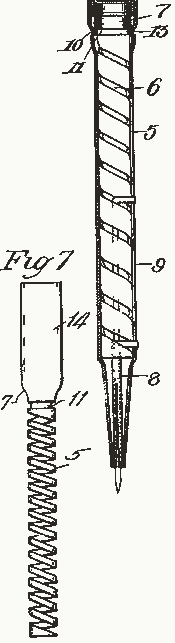
The pencil had patents in the United States. In one of them, filed in 1923 and granted in 1926, Hayakawa wrote that in pencils of this kind the lead carrier often broke and was usually soldered to the inner tube, so both had to be replaced. His wire clip holds the parts together, so they can be taken apart for repair. Fig. 2 is part of his sheet of drawings.
A spiral and a slot
Hayakawa’s inner tube has a slot along its side. Inside it turns the guide tube, which may be a tube with a spiral groove or, as in his drawing, a coil of thin metal strip. The lead carrier sits inside, and a hook on its back end reaches out between two turns of the strip and into the slot. The head does not hold the guide tube itself. A tube fixed to the head grips the tube of spare leads by friction, and that tube is fixed to the guide tube, so the three turn together. Turning the operating head turns the guide tube, and the slot keeps the hook from turning with it. Guess how far a whole turn moves the carrier before turning the guide tube in Fig. 3.
What the drawing shows
A whole turn moves the lead carrier forward by one pitch of the spiral, 1.2 mm in the drawing. Four turns move it 4.8 mm. The guide tube does not move along. It only turns, and the place where its strip crosses the slot travels down the tube, taking the hook with it. Turn it back and the carrier comes back too. Hayakawa does not say whether it pulls the lead back with it, so the drawing leaves the lead out where it was pushed.
Leads made with resin
Thin leads like those in Fig. 1 came later. Pentel’s history says that in 1960 it sold the first leads made with synthetic resin in place of clay, Hi-Polymer leads in sizes from 0.5 mm to 0.9 mm, with a knock pencil for 0.9 mm lead that needed no sharpening. JWIMA and Wikipedia give 1962 for the 0.5 and 0.7 mm sizes. Clay leads had to be 1.5 or 1 mm thick to be strong enough, and the new 0.5 mm lead was half as strong again as clay lead. Pentel sold a drafting pencil for 0.3 mm lead in 1968.
Who was first is argued over. On the Knockology pencil forum, one user quoted a book of 1988 by Hambly, “Drawing Instruments 1580–1980”, which credits Faber-Castell with polymer leads in the 1950s. Another replied that no primary source confirms it. The pencil itself is older. Pilot and JWIMA place its invention in America in the 1830s, while by Wikipedia’s account the first patent for one that pushes out its lead went to Sampson Mordan and John Isaac Hawkins, in Britain in 1822.
What the drawings leave out
The sizes are the drawing’s own. No source gives how far a real knock moves the lead, so the 0.50 mm of Fig. 1 is not a measured figure. Fig. 1 has two jaws and draws its spring as a zigzag in the cut. It leaves out the last small pull that tightens the jaws once the ring is seated, and the slight slip back of the lead that Pentel’s patent mentions. Its lead holder never lets go, and its lead never breaks.
Fig. 1 also starts with the lead already in the jaws, leaving out the first step, where a new lead drops to just behind the chuck and the first knock carries it to the lead holder. Fig. 3 shows the coil as cut ends with dashed turns between them, and leaves out the casing, the operating head and the clip. Fig. 2 is only cropped from Hayakawa’s sheet. Only the lead’s 0.57 mm in Fig. 1 comes from a source.
Sources
Read in November 2026. The Japanese pages were read in Japanese.
- Mitsubishi Pencil, “The science of the mechanical pencil”, for the order of a knock’s steps, the split chuck and what sets a lead’s hardness.
- S. Maruyama, M. Shigemori and H. Kodama for Pentel, US Patent 7,128,487, “Mechanical pencil”, 2006, for the chuck ring and its step, the lead holding member, the hole behind the chuck, JIS lead sizes and the slip back.
- K. Ohshita for Sailor, US Patent 4,976,560, “Mechanical pencil with a plastic chuck”, 1990, for the ring’s return, the end wall and jaws that spread when free.
- H. Kageyama for Kotobuki, US Patent 4,687,363, “Mechanical pencil and method for assembling the same”, 1987, for the parts’ names and the slit cushion sleeve.
- JWIMA, the pages on how it works, on kinds and grades, on making leads, with common questions, on care and on history.
- T. Hayakawa, US Patent 1,578,515, “Propelling pencil”, filed 1923, granted 1926, for his parts and Fig. 2.
- Sharp, “Hayakawa Mechanical Pencil”, its founder’s story for 1915–1926 and its corporate overview, for the pencil’s history and name.
- Pentel, company history, and Pilot, “What is inside a mechanical pencil?”, 2022, for the resin leads and for Hayakawa’s turning barrel.
- Wikipedia, “Mechanical pencil”, for the 1822 patent and the dates of the thin leads.
- r/mechanicalpencils, “Does anybody know how can I make an O-ring (lead retainer) for a 0.5 mm pencil?”, December 2023, via the Arctic Shift archive. User report.
- Engineering Stack Exchange, “Why Do the Fingers in Mechanical Pencils Fly Out?”, January 2023. User report.
- Knockology mechanical pencil forum, “History of polymer-bound fine leads”, December 2025. User report.
The type is Playpen Sans by TypeTogether, under the SIL Open Font License 1.1.