Bottle opener
Twenty-one corrugations in the steel skirt of a crown cap are pressed in under a ridge round the top of a bottle’s neck. A bottle opener is a short lever whose far end rests on the cap’s top while its lip hooks under the skirt’s edge on your side.
A steel cup pressed under a ridge
A crown cap is a shallow steel cup, 26.75 mm across inside and 6 mm high, from steel 0.20 to 0.22 mm thick. Its skirt has 21 corrugations and flares to 32.1 mm across before it goes on. A liner of plastic compound covers the inside of its top. Makers call the cap a crown. William Painter’s patents call it a sealing cap, and his opener a “capped-bottle opener”.
When the bottle is filled, a capping head presses the cap down and squeezes its skirt in to between 28.57 and 28.83 mm across. The liner is pressed hard onto the rim of the glass. That seals the bottle. The inner folds of the corrugations are pushed in under a ridge round the neck. On a standard neck the ridge is 26.55 mm across. At 3.85 mm below the top the glass is only 24.35 mm across, so the folds sit under a ledge, which Painter called the locking shoulder (Fig. 1).
The folds hold the cap down against the squeezed liner and against the gas in the bottle. One maker asks its caps to hold at least 90 psi, about 6.2 bar, without a leak. Another asks for at least 7 bar.
A lip below and a fulcrum on top
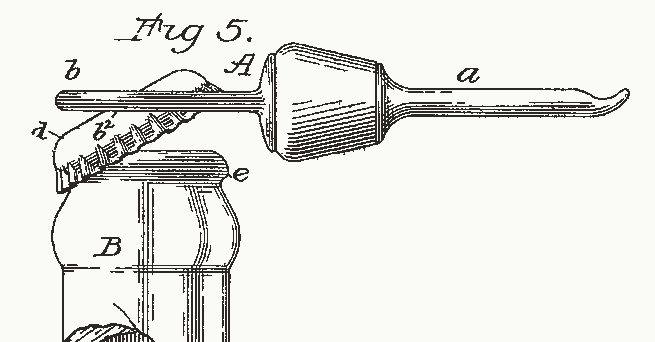
Painter’s opener patent names three parts: a handle, a “centering gage” and a lip in line with the handle. The gauge is an open loop that fits over the cap, and its two sides touch the cap’s sides, so the lip lands under the skirt’s edge. The loop’s far end rests on the cap’s top, and that is the fulcrum. Raise the handle, and the lip pries the cap up. So the opener presses on the cap’s top and pulls under its edge.
A lever turns about its fulcrum, and it trades distance for force. The force out over the force in equals the arm of the push over the arm of the pull, each measured from the fulcrum. In Fig. 2 the grip is 100 mm from the fulcrum and the lip about 25 mm. So the lip pulls about 4 times as hard as your hand pushes, and moves about a quarter as far. Guess where the cap gives way first as the handle comes up in Fig. 2.
What the drawing shows
The cap gives way at your side, under the lip. The near half of the top folds up about the fulcrum, which holds the far half down, and the skirt beside the lip is bent out over the ridge. The liner leaves the glass at once, so gas starts to get out before any corrugation is free. The corrugation in line with the lip lets go when the handle has turned 6°, after the grip has risen 10 mm and the lip 2.5 mm. Painter wrote that a plate steel handle “may be quite short”. With the drawing’s short handle, half as long, the lip pulls only twice as hard as your hand, and the grip rises half as far.
Which corrugations let go first
Painter wrote in 1891 that a special opener needs “quite heavy detaching force”, because it frees the cap “at many points of locking contact” nearly at once. In the drawing, while the near half of the cap folds up, each corrugation’s fold rises by its distance from the crease times the turn, and it lets go once it is up level with the ridge, 2.35 mm in this drawing. The farther a fold sits from the crease, the sooner it goes. The fold in line with the lip is 22.4 mm from the crease, and those at the sides only about 11 mm. Fig. 3 shows the same cap from above, as the same lift goes on. Before you move it, guess how many corrugations are free by the time the handle has turned twice as far as it did for the first.
What the drawing shows
Eleven of the 21 are free by a turn of 11.9°, a little under twice the 6° the first one took. They go in pairs, either side of the lip. The first five go within 0.7° of each other, and the pairs farther round need more turn each time. The other ten, round the far side, let go only when the bent cap tips over its far edge, as in Painter’s drawing of the cap half lifted, and then rises. All 21 are free once the lip is 11.1 mm up.
A crease under the fulcrum
A cap comes off bent because the opener pushes and pulls on it in two places at once. The fulcrum presses the far half of the top down onto the glass. Meanwhile the lip drags the near edge up, so the top folds along a line under the fulcrum, by 11.9° in the model. The skirt beside the lip is bent out by up to 7°, and the far skirt by up to 12° as it slides over the ridge. The model keeps both bends. Painter’s patent of 1890 says his caps were cheap enough to throw away after one use, even when opening had done them no real harm. A reply on a Physics Forums thread, a user report, says the top is often dented by a tooth as the flange is lifted.
Painter’s 1891 patent says the openers of his time bore either on the cap’s top or on the rounded glass below it. His 1894 patent also turns the lever round (his Fig. 6). There the lip sits at the loop’s far end, the handle points up, and the hand pushes it down.
The gas under the cap
For many lagers and ales the beer holds between 2.3 and 2.8 volumes of carbon dioxide for each volume of beer. Beer with 2.5 volumes is in balance with 11.3 psi of gas over the outside air at 3.3 °C, and with 13.3 psi at 5.6 °C. Warmer beer presses harder. Cold beer keeps more gas in. In a closed bottle that gas sits under the cap, at 0.78 bar in the colder case. The cap is made to hold 8 to 9 times as much.
Suppose the liner seals at the edge of the bore. That is 17 mm across. Then the gas pushes up on the cap with about 18 N, which helps the lip a little. That help ends as soon as the near half lifts, because the gas leaves through the gap under the liner before the cap is free. As the pressure above the beer falls, more carbon dioxide comes out of the beer.
Patents of 1890 to 1894
Painter, of Baltimore, applied on 16 June 1890 to patent a metal cap whose flange is corrugated through its depth, parallel with its axis, so that it is springy both round and across. One size of cap could then fit bottle heads that vary, its inner corrugations taking hold of the shoulder on the glass, and the lower end of each outer corrugation gives an opener an edge to catch. A second patent, applied for on 19 May 1891, keeps a disk of cork pressed under the cap and bends the flange in under the locking shoulder. Both were granted on 2 February 1892. In the second, Painter wrote that his caps took so much force to remove that “openers of special form were a necessity”.
Alfred L. Bernardin, of Evansville, Indiana, applied on 14 March 1893 for a “bottle-uncapping tool” for his own caps, which have a bead round the edge. Its lip goes under the bead, and a bar with small teeth bears on the cap’s top. It came fixed to a counter, with the bottle as the lever, or with a handle to carry. His patent was granted on 11 July 1893. Painter applied for his opener on 5 June 1893 and received the patent on 6 February 1894, assigned to the Crown Cork and Seal Company of Baltimore (Fig. 4). Bernardin’s was granted seven months sooner.
What the drawings leave out
The sizes are the drawing’s own. The cap’s and the neck’s diameters, the cap’s height, its 21 corrugations and the 3.85 mm to the locking line come from makers’ sheets. The ridge’s height, the shape of the shoulder, the liner, the steel’s thickness and the whole opener do not. Each skirt is drawn as a solid band, so the corrugations’ folds and ridges show only in Fig. 3. Seen from above, the cap stays flat.
The model treats the cap’s top as two stiff halves joined at a straight crease under the fulcrum. A skirt bends about its top edge only as far as the glass makes it, and stays bent. A fold lets go once it has risen level with the ridge. No source says how far a cap tips over its far edge before that side gives way, so the bent cap turns 8° there and then rises 6 mm, by rules of the drawing’s own. Moving the handle back runs the drawing backwards, though a real cap stays bent.
The lever’s numbers suppose that nothing bends in the opener and nothing rubs, with the lip pulling along its path and the hand pushing square to the handle. They are ratios only. Without a measured force for a cap, the page gives no force in newtons for the lip, and the gas’s push rests on where the liner is supposed to seal. The arrows for the gas show only while the cap is still on the neck, once the liner has lifted 0.15 mm, a figure of the drawing’s own.
Sources
Read in November 2026.
- W. Painter, US Patent 468,258, “Bottle-sealing device”, 2 February 1892, for the corrugated cap.
- W. Painter, US Patent 468,226, “Bottle-sealing device”, 2 February 1892, for the locking shoulder, the cork disk and the openers of the time.
- W. Painter, US Patent 514,200, “Capped-bottle opener”, 6 February 1894, for the opener and Fig. 4. (US Patent 514,200, 1894, Fig. 5. Public domain.)
- A. L. Bernardin, US Patent 501,050, “Bottle-uncapping tool”, 11 July 1893.
- Crownman, “Crown closures, pry off”, a product sheet, for the cap’s sizes, its liner and the pressure it holds.
- SBI, “Technical specifications for the 26 mm pry off crown cap”, 2024, for the crimped diameter.
- Krones, “KRONES cap specifications”, section 2, for the crown and its neck finish.
- OpenStax, “College Physics 2e”, section 9.5, for the lever.
- Brewers Association, “Facts about draught beer carbonation”, for the gas in beer.
- Physics Forums, “Force and deflection needed to remove a crown bottle cap”, November 2005. User report.
The type is Playpen Sans by TypeTogether, under the SIL Open Font License 1.1.