Corkscrew
Both arms of a winged corkscrew hang down by its sides until you start turning the top. As the spiral works its way into the cork, the arms rise. Push them back down, and the cork comes up out of the neck of the bottle.
Twisting the top
A winged corkscrew stands on the rim of the bottle on a ring-shaped socket, at the foot of a body of cast metal. A shaft runs up through a tube in the body’s top. It has a bar to turn it by at the upper end and a pointed spiral of wire, the worm, at the lower end. In between are rings, which the patent these drawings follow calls rack teeth in the form of ribs running round the shaft. An arm hangs from a pin on each side. Its end by the pin is a toothed disc, a gear, whose teeth reach in through a slot to sit between the rings.
The rings go all the way round. So the shaft can turn inside the gears and stay meshed with them. The patent’s claim gives the ringed part free movement in its bore, both along it and round it. Before you turn the top in Fig. 1, guess how many turns it takes to lift the arms as high as they go.
What the drawing shows
Four turns, in this drawing. Each turn drives the worm one pitch deeper, 9.5 mm here, because the body stands on the rim and the cork holds still in the neck. So the shaft slides down, the rings turn both gears, and each arm swings up through 136°, to above level, where the patent wants it. Watch the coils while you turn. They stay put. Only the point goes deeper, with the top end of the wire coming down after it, since every bit of a screw turned in at its own pitch follows the track its point cut. After the fourth turn the bar on top rests on the body, and the worm can go no deeper. Its point stops 7 mm short of the far end of the 45 mm cork.
Pushing the arms down
The patent’s instructions are short. Stand the bottle on something firm, take an arm in each hand and push both down. The gears turn back and drive the rings up. The cork rises with the shaft and worm, while the socket on the lip holds the body still. Each arm is a lever on its pin. Guess, before you push the arms in Fig. 2, how far your hands travel for each millimetre the cork comes up.
What the drawing shows
About 6.9 mm. The gear’s teeth meet the rack 16 mm from the pin, and the end of each arm is 110 mm from it. Both turn together, so the end moves 110 divided by 16, or 6.9, times as far as the rack. The work you put in comes out at the cork. With no friction, and pushing square to the arms, the pull on the cork is 6.9 times your push.
A 45 × 24 mm cork should take 15 to 45 daN to pull out, a day after bottling. That is 150 to 450 newtons. With a plain handle, the top of that range takes the force needed to lift 46 kg. Through the drawing’s gears, both hands together push 65 newtons, about the weight of 6.7 kg. Friction in real gears takes a share of the push.
On Reddit’s r/wine, in a thread about what is wrong with winged corkscrews, one user liked that the pull always goes straight up. Another wrote that you still have to “strongman” the last of the cork out. Fig. 2 too leaves 7 mm of it in the neck.
Wire spiral or solid screw
The bar on top meeting the body stops the worm in Fig. 1, as a disc on the shaft did in the first patent for a corkscrew. That patent went to the Reverend Samuel Henshall, born in Cheshire, as No. 2061 of 24 August 1795, and the disc came to be called the Henshall button. It also made the cork turn with the handle, which broke the cork’s grip on the glass, and its underside was slightly hollow, to press on the top of the cork. Corkscrews were in use long before the patent, from the middle of the 17th century, when cork became the usual stopper.
Fig. 3 sets the worm of the first two figures beside an older rival. In 1860 M. L. Byrn, of 66 Nassau Street, New York, wrote that wire spirals went into a cork easily but often broke while drawing it out, and that their thin points snapped against the neck of the bottle. His patent of that year put a T handle on a gimlet screw, a thread cut round a solid stem and ending in a point. The stem was long, so that the screw could be driven well into the cork. He wanted its threads larger, wider and farther apart than those of a wood screw, to grip the cork, and he claimed the screw would enter a tightly packed cork more readily and be less likely to break it.
Some users now say the opposite. In the same thread on r/wine, one wrote that winged corkscrews all seem to have solid cores, which destroy some corks. Another wrote that many have a flat thread, and that the round “pigs tails” do better. The patent that Figs. 1 and 2 follow calls its screw “similar to the ordinary cork screw”, and draws it as a twisted spiral.
Rosati’s cork extractor
That patent is Dominick Rosati’s cork extractor. He signed his application at Chicago on 22 October 1928 and filed it a week later, and the patent, US 1,753,026, was granted on 1 April 1930. Fig. 4 shows its first two figures, with the arms hanging and then raised. He wanted the device sturdy, compact and cheap enough to sell at a moderate price, and he tapered the inside of the socket so that necks of different sizes would fit. Wikipedia calls him Domenico, an Italian who had come to Chicago as a bartender before Prohibition, and his patent the first American one for a winged corkscrew.
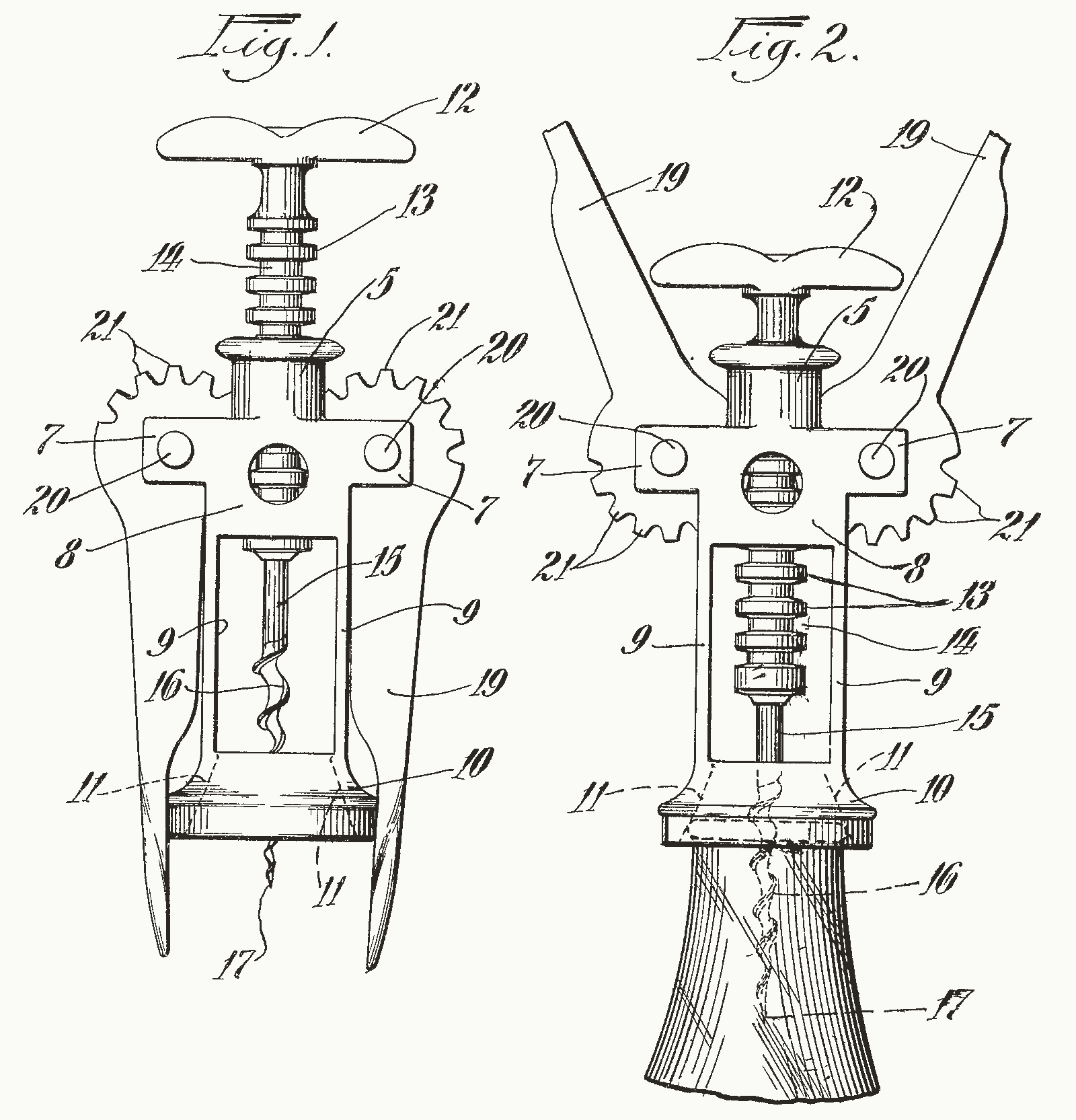
By one collector’s account, the common brass and chrome winged corkscrews are very like Rosati’s, and the double lever is older. The collector names William Burton Baker’s British patent No. 2950 of 1880 as the first double-lever corkscrew, made by James Heeley & Sons of Birmingham. On the same account, Heeley patented an improved version in 1888, with the arms fixed to a collar that rides on the shaft, and sold it as the A-1 Double Lever well into the 20th century. The collector also lists a similar French patent, No. 647,023, which went to A. Desbordes on 23 July 1928, three months before Rosati filed.
What the drawings leave out
The sizes are the drawing’s own. The teeth have straight sides, and nothing in the drawing has play or rubs. Many real winged corkscrews carry a bottle opener or a foil cutter on top, which the drawings leave off.
A few sizes come from real things. Hanging, the drawn tool is 197 mm long, close to the 8 inches the collector gives as the usual size. The neck has a straight bore of 18.5 mm, the bore of one standard neck, and the cork is 45 mm long, as in the pull test above.
The drawn cork is a plain cylinder that keeps its shape, but a real cork springs out wider as it leaves. On Physics Stack Exchange someone asked why the end that was inside the bottle usually ends up the wider one. A user who works in a wine testing laboratory answered with a French bottle standard, which has the bore 18.5 mm wide a few millimetres down the neck and 20 mm wide at 45 mm down.
Sources
Read in November 2026.
- D. Rosati, US Patent 1,753,026, “Cork extractor”, filed 1928 and granted 1930, for the body, the ringed shaft, the gears, how it is used, and Fig. 4.
- M. L. Byrn, US Patent 27,615, “Corkscrew”, 1860, for the gimlet screw and what he thought of wire spirals.
- UK Intellectual Property Office, “Uncorking innovation”, March 2025, for Henshall’s patent and his button.
- Wikipedia, “Corkscrew”, for the worm, the button turning the cork, the type’s other names, Rosati’s story and the openers on top.
- Natural Cork User Group, “International Guide for Buying Cork Stoppers for Still Wines”, May 2007, for the force to pull a cork and the bore of the neck.
- D. Bull, The Virtual Corkscrew Museum, “Heeley’s A-1 Evolution”, November 2007, for Baker and Heeley. User report.
- D. Bull, The Virtual Corkscrew Museum, “Double lever corkscrews”, 1997, for Desbordes, the likeness to Rosati’s and the usual size. User report.
- r/wine, “What’s wrong with winged corkscrews?”, March 2023, via the Arctic Shift archive. User report.
- Physics Stack Exchange, “When a cork is pulled out of a wine bottle, why does the inner end often expand more than the outer end?”, September 2022, and the answer from a wine laboratory. User report.
The type is Playpen Sans by TypeTogether, under the SIL Open Font License 1.1.