Nail clipper
Springy steel holds the two jaws of a nail clipper apart until the short lever on top presses them shut. The jaws are the ends of two strips fastened together at the back, and they close on the nail several times harder than your thumb pushes. First the lever must be swung round from where it lies folded.
Two strips and a pin
The two strips are spring steel, cut from sheet and joined at the back, often by a rivet. Toward the front they spread apart, and there each one is bent toward the other and ground to a cutting edge. The spring of the steel holds the edges apart. Each strip is one jaw.
The jaws close head on, and their edges come straight at each other until they are nearly in contact. Scissors cut the other way, with edges that slide against and past each other.
Near the edges, a pin goes up through a hole in each jaw. It has a head under the bottom jaw and a notch near its top, and the lever pivots in that notch. The lever lies back along the top jaw. Under it, close to the pivot, a rounded bump rests on the top jaw. This is the cam, which does the pressing.
Pressing the lever
The clipper in Fig. 1 has its lever up, ready to cut. Press the end of the lever and it turns about its pivot. The cam pushes the top jaw down. At the same time the pivot pulls up on the pin, and the pin lifts the bottom jaw. In some clippers the lever’s forked end hooks under the top of the pin, which is its fulcrum, while curved cam shoulders on the lever press on the top jaw.
Guess, before you press the lever in Fig. 1, how far its end must come down to close the 2.4 mm between the edges.
What the drawing shows
In the drawing the end comes down 18.1 mm, about seven and a half times as far as the edges travel. The work your thumb does over that long stroke goes into the short one at the edges, so they press on the nail several times as hard as you press on the lever. Let go, and the springy jaws open again and lift the lever back up.
Two levers in a row
The lever is the first of two levers. Your thumb presses about 40 mm from its pivot, and at the bottom of the stroke the cam bears on the top jaw only about 3 mm behind it. So the lever in the drawing pushes on the top jaw about 13.6 times as hard as you push on the lever.
The top jaw is the second lever. It bends near the joined end, as if hinged there. The cam presses it 34 mm out from that bend, and its edge is 46.5 mm out, so the edge passes on about three quarters of the cam’s push. Together the two make the push at the edges about 10 times the push on the lever, at the bottom of the stroke. At the top of the stroke the cam bears farther from the pivot, and the drawing gives about 6 times.
A reader of the forum r/explainlikeimfive once asked why clippers cut only when the lever closes them, and not when the jaws are squeezed with the fingers. The best-scored reply, from another user, said the lever multiplies the force many times at the teeth.
Swinging the lever round
Folded for a pocket, the lever lies flat along the top jaw, upside down, with its cam on top. There the cam touches nothing. To get the lever ready, you lift it until it stands up, turn it half round and lay it back down. The turn works because the pin itself turns in its holes.
This is the usual arrangement. The lever pivots in a notch near the top of the pin, and pin and lever turn 180° together in the holes, between the folded place and the working one. Before you swing the lever in Fig. 2, guess which way its cam will face once it stands up.
What the drawing shows
Standing up, the cam faces forward, toward the edges. The half turn sends it to the back, so laying the lever down brings the cam onto the top jaw, ready to press.
The pin also holds the clipper together. Another reader of the same forum asked how clippers work, because theirs had come apart with all its pieces and no longer clicked or cut. Google suggests “how do nail clippers go together” after “how do nail clippers”. Putting one back together means hooking the lever’s cross arm into the notch in the pin, which takes a little squeeze of the jaws. Then the spring of the steel holds every part in place.
From knives to a lever
Wikipedia says the first American patent for a better nail clipper, then called a finger-nail trimmer, was filed by Valentine Fogerty in 1875. His patent has no jaws. A cutter or file on a ring is swung by a handle round a cup that holds the end of the finger, and Fogerty preferred to take the nail off as filings.
Jaws closed by a lever came in 1881, from Eugene Heim and Celestin Matz of Cincinnati (Fig. 3). Their jaws were one plate of spring steel bent into a U, and a yoke on one jaw held the pivot of a “cam-headed lever”. Trimmers with two hinged jaws already existed, closed “by the direct pressure of the operators thumb and finger”, so Heim and Matz did not claim jaws. Their reissue that November claimed any pair of gaping nail jaws closed by a lever, which they said worked “with greater ease and better effect”. Max Schnefel’s lever that swings round on its pin was filed 44 years later, in 1925, and granted in 1929.
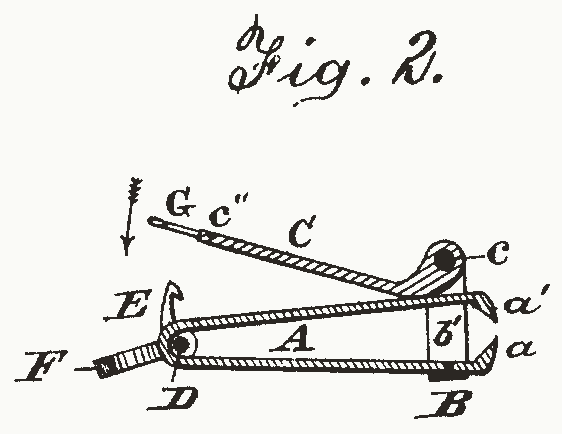
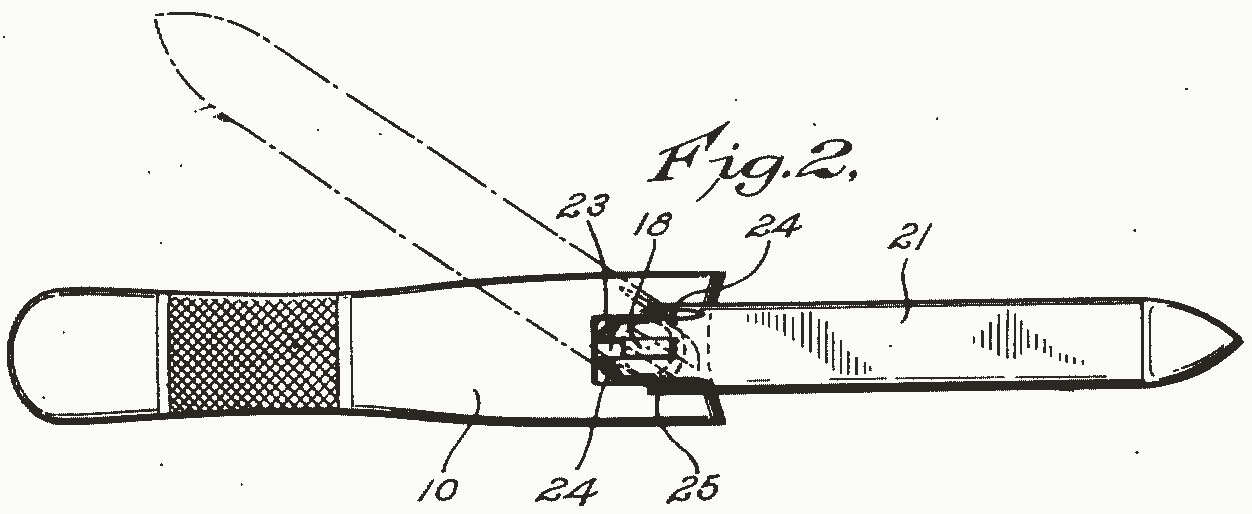
The hole at the back
Many clippers have a small hole at the back, past the joint. “Why does my nail clipper have a hole in it” is the first question Google suggests after “why does my nail clipper”. The old patents give one answer. Heim and Matz added a bow so that their trimmer could hang from a belt or a watch chain, and it hangs from the bend of their U, on the same pivot as the catch. In Chapel S. and Hedley P. Carter’s patent of 1922, the bottom jaw runs on past the rivet into what they call a perforated suspension arm, for a watch chain or a key chain. Their patent went to the H. C. Cook Company of Ansonia, Connecticut, which also owned a patent of 1976 on the usual pin and lever. Today’s clippers have the hole for the same use, to keep them on a key ring or a lanyard.
What the drawings leave out
The sizes are the drawing’s own. Neither drawing is measured from a real clipper, and the forces worked out above come from the drawing too. The jaws are drawn as even strips that bend only near the joint, where real ones have their jaws ground or machined. No nail is drawn between the edges. The numbers leave out the push that goes into bending the jaws, and the rub of the cam on the top jaw. In Fig. 2 the turning lever is a flat bar 8 mm wide, seen as its side narrows and its face comes round.
Many clippers also carry a small file. Some hold the folded lever still with a catch, or with the pin’s head sitting in a recess under the bottom jaw, so that the jaws must be squeezed before the lever will turn. The drawings leave those out. The lever is drawn as one flat piece, too, where the Carters bent theirs from a strip of metal into an upside-down U, for strength and lightness.
Sources
Read in November 2026.
- E. Heim and C. Matz, US Patent 244,891, “Finger-nail trimmer”, 26 July 1881, and its drawing sheet, cropped for the first drawing in Fig. 3.
- E. Heim and C. Matz, US Reissue 9,921, “Finger-nail trimmer”, 1 November 1881, for the wider claim.
- M. Schnefel, US Patent 1,702,137, “Nail clipper”, filed 16 May 1925, granted 12 February 1929, and its sheet of drawings, the source of the second drawing in Fig. 3.
- P. P. Loda, US Patent 3,937,234, “Nail clipper”, 10 February 1976, for the usual pin and lever and how they fit together.
- C. S. and H. P. Carter, US Patent 1,436,010, “Finger-nail trimmer”, 21 November 1922, for the hanging arm and for the lever lifted by the jaws.
- V. Fogerty, US Patent 161,112, “Improvement in finger-nail trimmers”, 23 March 1875.
- Wikipedia, “Nail clipper” and “Scissors”.
- Family Handyman, “What That Little Hole at the End of Nail Clippers Is Actually For”, for the hole.
- r/explainlikeimfive, “ELI5: How do nail clippers work?”, August 2011, via the Arctic Shift archive. User report.
- r/explainlikeimfive, “ELI5: Why do nail clippers only work if they are pushed together with the lever and not pushed together with fingers?”, July 2017, via the Arctic Shift archive. User report.
- Google’s suggested searches after “why does my nail clipper” and “how do nail clippers” (15 November 2026), a user report.
The type is Playpen Sans by TypeTogether, under the SIL Open Font License 1.1.