Can opener
Squeezed onto the rim of a can, the usual hand-held opener holds that rim between two small wheels, one sharp and one with teeth. Turn its key, and the toothed wheel drives the can round while the sharp wheel cuts out the lid.
The rim and the two wheels
The rim of a food can is a seam. The edge of the lid and the top of the wall are rolled together there, in several layers of thin steel. The middle of the lid sits lower, so the seam stands up round the end like a low wall. Can sizes are measured over the seam. A can sold as 303 by 406 is 3 3/16 inches (81 mm) across the seam and 4 6/16 inches (111 mm) tall.
The opener on this page cuts down through the lid, inside the seam, as most openers do. Its two handles are hinged near the wheels, and a key with two wings stands out from one side. The sharp cutting wheel goes inside the rim and rests on the lid. The toothed wheel stays outside, under the lip of the seam. In the usual design the knob turns the toothed wheel, and the cutting wheel turns because the can is pulled round past it.
Squeezing the handles
Open the handles and the wheels move apart, far enough to go either side of the rim. Close them and the wheels come together with the rim between. Charles A. Bunker of Kansas City described this squeeze in a patent he filed in 1926. His two levers pivot on a pair of plates, at two points a little apart. Each lever carries one wheel, so closing the handles swings the wheels toward each other. He wanted the cut inside the seam, where earlier openers had cut through the side wall of the can. As his handles close, the toothed wheel catches the lower edge of the seam from outside. The rest of the squeeze forces the cutting wheel down into the lid and through it, close to the inside of the wall.
In Fig. 1 the rim is cut across where the two wheels meet it. Only the wheels and the ends of their shafts are drawn. The handles are off to the right. Before you squeeze the handles in Fig. 1, guess which wheel reaches the can first.
What the drawing shows
The toothed wheel gets there first. Once its teeth are under the seam it can rise no further. So it holds the opener up while the cutting wheel goes on down. In Bunker’s patent a shoulder on the cutting wheel stops the edge at the right depth, and the face of the wheel then presses the cut edge of the can down against the inside of the wall.
Turning the key
Once the lid is pierced, the key does the rest. Its shaft carries the toothed wheel, whose teeth press up under the seam. Each turn moves the seam along by the length of the wheel’s rim. So the can turns under the opener, and the lid slides past the cutting wheel. Nothing drives that wheel. The moving lid turns it, and it slits the lid as it goes.
Fig. 2 shows the rim from outside the can, and the whole can from above. Before you turn the key in Fig. 2, guess how many turns one trip round the can will take.
What the drawing shows
In the drawing it takes 5.3 turns. Its toothed wheel drives the seam at a circle 15 mm across, and the seam is driven at a circle 80 mm across. So the can goes round once for every 80 ÷ 15 turns of the key. Both sizes belong to the drawing. They were not measured from an opener. With the same can, a smaller toothed wheel would need more turns and a bigger one fewer.
The cut leaves the edge of the lid sharp. It can be jagged, too. The edge left on the can is sometimes sharp as well.
Cutting into the seam
Not every opener goes through the lid. Hand openers fall into three kinds by where the blade goes in: down through the top, into the side wall below the rim, or partly into the rim itself.
Anthony Peters, who filed a patent in 1985 for one that cuts into the side of the rim, set out the case against cutting through the lid. The part of the lid that is cut touches the food, so the cutting wheel often touches it as well. Slivers of metal may come off and fall into the can, and the cut edges may be sharp or jagged.
Someone opening a can of condensed milk asked the Reddit forum r/explainlikeimfive what keeps pieces of the can out of the food. The answer with the most votes said that nothing does. The rubbing at the edge of the blade carries some particles in, it said, and the wear shows on used blades as a change of colour. Further down, one reply said a clean opener used with care should leave no shavings at all. Another writer had seen hair-thin shards about 1 mm long and now holds a strong magnet over the can. All three are users’ reports.
In the opener Peters drew, the cutting wheel goes only into the outer wall of the rim and never enters the can, while a drive wheel feeds the rim between the two wheels. The edge left this way is not jagged, and the lid can be set back on as a cover, though it does not seal. On these openers the toothed wheel has finer teeth, at the bottom of a groove shaped like a V that wraps the rim on three sides.
What the drawings leave out
The sizes are the drawing’s own. Both drawings are far larger than life. Fig. 1 makes the steel of the lid and the can many times thicker than it is, and it draws the seam as one rounded lump where a real seam is folded in layers. Its wheels slide straight up and down, where a real opener swings them on the pivot of the handles. In Fig. 2 the rim is drawn straight, the plates that carry the wheels are left out, and the key is only an outline, so that the toothed wheel shows through it.
In Fig. 2 the opener stays still and the can turns, as in the patent of 2007. Bunker’s patent tells it the other way round. There the wheels travel round the seam. His opener also had two gears, one on each shaft, which the squeeze brought together. Its key turned the cutting wheel, and the gears turned the toothed wheel with it.
Who put the wheels together
William W. Lyman of Meriden, Connecticut, was granted a patent on 12 July 1870 for an opener with a cutting wheel. You pushed the point of his opener through the lid and turned it under to make a pivot. A small cutting wheel sat further along the handle, and as you swung the handle round the pivot, the wheel cut the lid. By Wikipedia’s account it was the first patent for a cutting wheel that runs round a can, and having to pierce the can first meant the design did not last.
Edwin Anderson of Seattle patented a pair of pliers with a wheel on each jaw. In the patent granted to him on 30 November 1920, a cutting disk turns at the end of one handle and a knurled roller at the end of the other. Squeezing clamps them on either side of the can’s flange, and a crank turns the roller, so the can turns against the disk (Fig. 3). His disk cut through the wall of the can below the seam and took the whole top off.
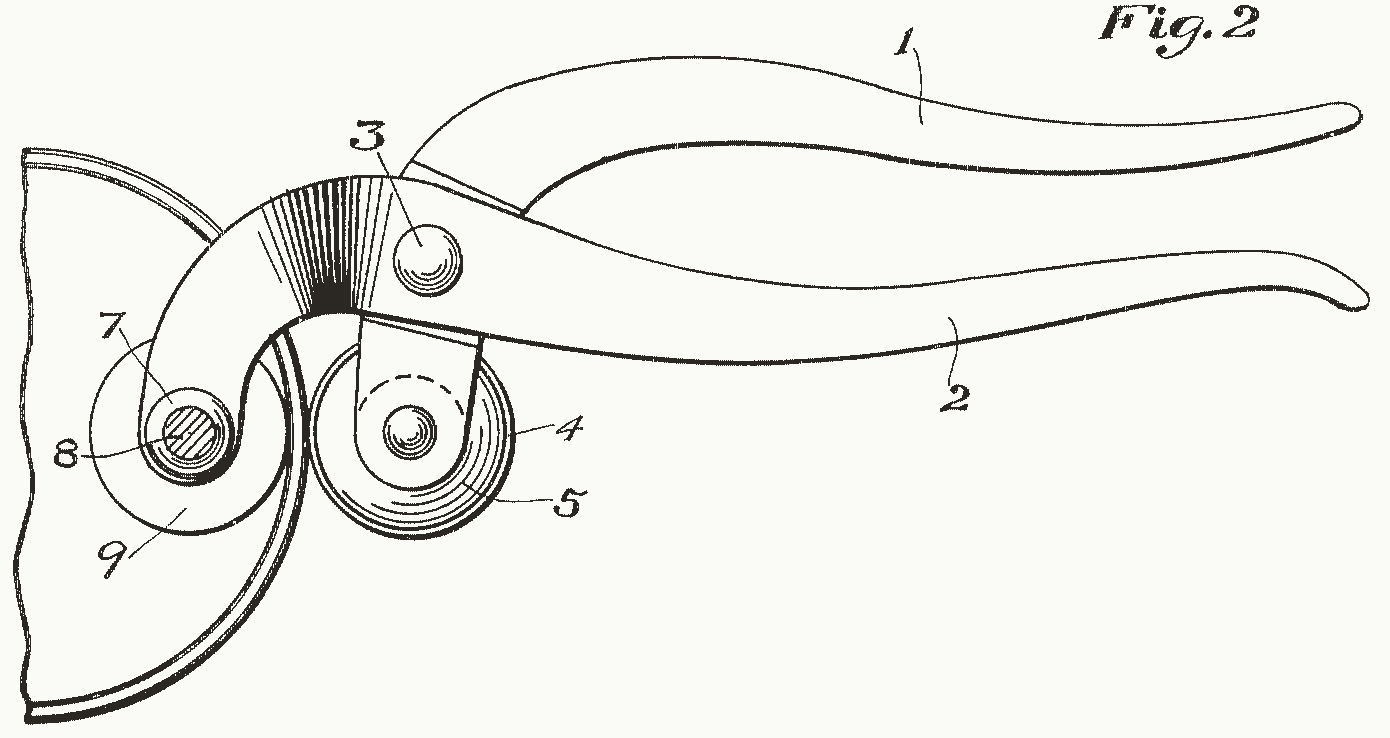
Anderson assigned the patent to the Star Can Opener Company. Wikipedia credits Star, of San Francisco, with adding a second, toothed wheel in 1925, though Anderson’s drawing of 1920 already has both. Star sued the Bunker-Clancey Manufacturing Company of Kansas City for infringing the patent, and lost. On 18 July 1930 the appeal court agreed with the court below. Anderson’s opener, it said, cut the top off through the wall, while Bunker-Clancey’s cut the top out through the lid, as earlier patents by Wolfer and by the German Weigel had done.
No single source names the inventor of the opener on this page. Bunker had filed his own patent in May 1926. It was granted on 29 December 1931, five years and seven months later.
Sources
Read in November 2026.
- W. W. Lyman, US Patent 105,346, “Improvement in can-openers”, 12 July 1870, with its drawing sheet: his opener with a pivot point and a cutting wheel.
- E. Anderson, US Patent 1,360,256, “Can-opener”, 30 November 1920: pliers with a disk and a roller. Fig. 3 is his Fig. 2, in the public domain.
- E. Anderson, US Patent 1,528,178, “Can opener”, 3 March 1925, assigned to Star: a second design of his.
- C. A. Bunker, US Patent 1,838,525, “Can opener”, filed 20 May 1926 and granted 29 December 1931: an opener that also grips the can.
- US Court of Appeals, Eighth Circuit, Star Can Opener Co. v. Bunker-Clancey Mfg. Co., 41 F.2d 142, 18 July 1930: the ruling, in an archived copy.
- A. J. V. Peters, US Patent 4,734,986, “Can-openers”, 5 April 1988: an opener that cuts the side of the seam.
- S. So, US Patent 6,675,487, “Can opener”, 13 January 2004, for its account of three kinds of hand opener.
- K. K. So and Y. C. Wan, US Patent 7,168,170, “Can opener”, 30 January 2007, for its account of the usual wheel and knob.
- Wikipedia, “Can opener”.
- EH Can, a table of can sizes, taken from a 1982 bulletin of the National Food Processors Association.
- r/explainlikeimfive, “ELI5: When opening a can with a can opener, what keeps metal particles from falling into the food from where you’re cutting?”, June 2022, via the Arctic Shift archive. User report.
- Seasoned Advice, Stack Exchange’s cooking site, “What is the proper way to maintain a can opener?”, December 2010, with its answers. User report.
The type is Playpen Sans by TypeTogether, under the SIL Open Font License 1.1.