Scissors
Only one point of a pair of scissors cuts at a time, where the edge of one blade slides past the other’s. Close the handles, and that point runs out along the blades toward the tips. It cuts only while the two blades press against each other there, and a slight bow in each blade keeps them pressing.
Two halves on one screw
Each half of a pair of scissors is one piece of steel, with a blade in front of the pivot and a handle behind it that ends in a ring for the thumb or the fingers. A screw or a rivet through both halves makes the pivot. William Whiteley & Sons have made scissors in Sheffield since 1760. They drill and tap each pair to take its pivot screw, and the last step is to set that screw to the right tension.
Each blade is ground to a cutting edge along one side. With the scissors open, the two edges face each other across a V, one on each blade. As the handles close, the edges slide past each other, face against face, and whatever lies between them is sheared through. The cut is a mix of cutting and shearing. At any moment the edges cross at one point only. The cutting happens there.
Where the edges cross
In Fig. 1 each edge runs 4.5 mm to one side of the pivot’s centre, the upper blade’s edge just below it and the lower blade’s just above. So the edges always cross on the line through the pivot, and where they cross depends only on how wide the blades are open. Wide open, 40° apart, the drawing’s edges cross 13 mm out. Closing the handles turns both edges toward that line. The crossing runs out along the blades.
Your fingers push on the rings 61 mm behind the pivot. The paper pushes back on each blade at the crossing, and the nearer that is to the pivot, the harder the blades can press. Guess, before you close the handles in Fig. 1, how much harder the blades press on the paper at the start of the cut than at the tips.
What the drawing shows
The press falls nearly eight times in the drawing, from about 5 times your squeeze to 0.64. The crossing also gathers speed. Half the handles’ travel takes it only 26 mm out, and it reaches the tips after 87%. Meanwhile the angle between the edges narrows from 40° to about 5°. A wide angle between the edges tends to push the material out along the blades.
A user of the Reddit forum r/explainlikeimfive asked why scissor tips cut worse than the part nearest the hinge. A reply with 86 points put it down to the lever, which gives more force close to the hinge. Scissors bite hardest at the first cut and lose that gain as the cut moves out. The Sheffield firm Ernest Wright keeps the blades of its kitchen scissors short and close to the pivot, so that the lever gives more force.
Held face to face
Shearing needs the two faces kept together. The paper pushes back on both edges, and part of that push tries to force the blades apart sideways. Thin blades tend to spring apart in the cut, so William Hildebrandt’s snips, patented in 1979, lean their blades toward each other to keep them pressing where the edges meet. A reply on r/explainlikeimfive, in a thread about why scissors work in one hand only, put it from the user’s side. The material tries to force the blades apart, it said, and your hand squeezes them back together.
Fig. 2 is a cut across both blades at the crossing, seen from the tips. Choose a loose screw, and guess what the paper will do when the blades close.
What the drawing shows
With the screw tight, the edges pass with their faces together and the paper parts along one line. Loosen the screw, and the paper itself pushes the blades apart and folds down into the gap, uncut.
“Why are my scissors not cutting” is the first search Google suggests after “why are my scissors”. A loose pivot is one answer. Another is machine-made blades that lie flat against each other, which may cut well at first but in time stop cutting at the tips and slip round fabric. Ernest Wright’s makers fix the screw for good and ask owners not to turn it, because setting two blades together takes years to learn.
What the pivot screw does
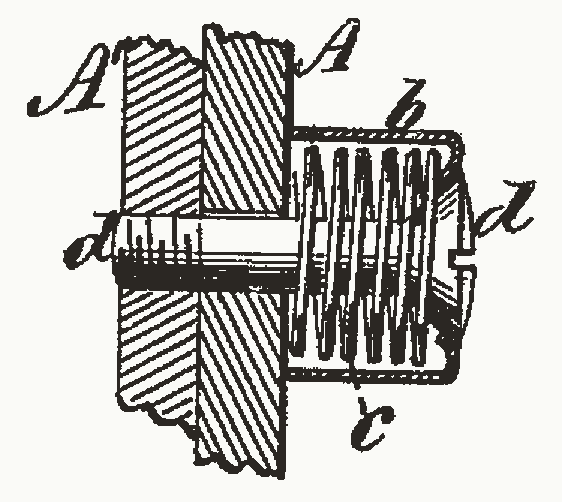
The pivot holds the halves on one centre and presses them together, firmly enough to cut and lightly enough to move. Wear loosens it. Adolph Delkescamp of New York City took out a patent in 1877 for a screw pivot with a coil spring in a small box under its head (Fig. 3). His spring held the edges together “with sufficient, but gentle, firmness” and took up the looseness that wear brings to ordinary scissors. In 1881 John Starks of Kentucky put a spiral spring under the head of his rivet, to keep the blades in contact from the rivet to the points.
The same press makes scissors stiff. “Why are my scissors stiff” comes second in Google’s list. Amontons’ first law of friction says the rub between two surfaces grows in proportion to the load pressing them together. In 1910 Annie Bell Ramsey of Davis, Oklahoma, patented a pivot running on a ring of small balls, so that the blades would work “free and easy” and never work loose. A slight turn of its stud set it for heavy goods or for delicate fabric. Two everyday causes are lint and dust that collect behind the screw, and damp, which carbon-steel blades do not take well.
Right hand, left hand
Your hand presses the blades together too. A cutting hand closes and also squeezes slightly sideways, the thumb pushing away from the palm. In right-handed scissors that squeeze pushes the blades together. In the left hand it pushes them apart, and the upper blade hides the line being cut. Ernest Wright’s left-handed patterns are mirror images, blades as well as handles. Many pairs sold as left-handed only have their rings shaped for the left hand, with the blades still set as in a right-handed pair, so the squeeze still works against the cut.
Of the 50 newest posts with “scissors” in the title on r/explainlikeimfive, 25 ask about one hand or the other. One, asking how scissors “know” which hand is holding them, reached 2,502 points. Its top reply, with 4,199, said there is a little play in the blades, which the right hand squeezes together and the wrong hand pulls apart.
A bow in each blade
The screw presses the blades together only near the pivot. Farther out the press comes from the blades themselves, since each is bent very slightly toward the other along its length. William Jones’s patent of 1906 calls his blades “slightly bowed longitudinally”, to keep the edges in shearing contact through the whole stroke. Ernest Wright calls the bend the curve. Its putters, the craftsmen who assemble each pair, hammer it into every blade by hand, so that the blades touch whatever position they are in.
Fig. 4 shows the same blades from above and, under that, edge on, with the bow drawn far deeper than it is. Guess where along their length the blades will touch once they are shut, then close them.
What the drawing shows
Shut, the blades touch at the tips. A thin gap runs between them all the way back to the pivot. A good pair shows that gap when closed, because the curve makes what Ernest Wright calls a “bite” point wherever the blades meet. In the drawing the gap is widest about two thirds of the way out. Flat machined blades wrap round whatever is being cut.
Putting on the edges
At Ernest Wright the edges go on after the pair is put together, on an old saddle grinder, the Big Wheel, that leaves a burr on each blade. The first time the pair is shut, each blade wipes off the other’s burr. Starks ground the inner faces of his blades hollow, so that they touched only at the rivet, along their very edges and at the points, and he wrote that such blades keep sharp as they wear.
Edges do wear. Hair, silk, tweed and paper each blunt scissors in their own way, which is a reason to keep one pair for each kind of work. On Physics Stack Exchange, someone asked whether cutting sandpaper sharpens scissors. The accepted answer, with 28 votes, said it dulls them, taking metal off the edge haphazardly. After an edge is ground again, the blades often have to be curved again, and the screw may need setting afresh.
Before the pivot
The first scissors had no pivot, John Lienhard says on his radio series about inventions. A single piece of metal was bent so that its two blades sprang apart, and you squeezed them together to cut. Such shears gain nothing from a lever, but sheep shearers still prefer them, because the blades open again by themselves after each cut. Pivoted scissors are harder to make. Their long blades must twist just enough to meet as the handles close.
Lienhard credits the spring shears to the Mesopotamians, about 4,000 years ago, and says Europe went on using them well into the Middle Ages, and China too. Wikipedia, which sorts the older and simpler shears with a springy loop from the newer scissors with a pivot, as archaeologists do, dates the first shears in Europe to about 1000 BC. They were rare at first, it says, because a knife or a razor did most jobs as well and cloth was woven to shape. Pivoted scissors became common in north-west Europe in the 13th and 14th centuries, as tailoring grew more elaborate.
What the drawings leave out
The sizes are the drawing’s own. The numbers worked from them count only the paper’s push at the crossing. They leave out the rub of the faces and of the screw, and the work of bending the paper. The edges are drawn straight. Hildebrandt shaped the edges of his snips in a curve, so that they meet at much the same angle, between 12° and 30°, all the way out. In Fig. 4 the blades only seem to cross beyond the place where they touch; there they stand apart, as in Fig. 1.
In Fig. 2 neither the paper nor the gap is to scale, and the cut paper springs back flat. In Fig. 4 the bow is many times deeper than any maker would hammer it, and each blade bends like one springy strip held at the pivot. Fig. 1 draws the rings alike. Shears often have one ring larger than the other, to take several fingers.
Sources
Read in November 2026.
- Ernest Wright, Sheffield: “The Craft” (the curve, the edges), “Looking after your scissors” (the gap, the screw, wear), its questions page and workshop notes (left hands, the word), and kitchen scissors.
- William Whiteley & Sons, “Our Manufacturing Process”.
- A. Delkescamp, US Patent 188,601, “Improvement in shears and scissors”, 1877, and the drawing sheet that Fig. 3 is cut from.
- J. L. Starks, US Patent 237,781, “Scissors”, 1881.
- W. E. Jones, US Patent 822,456, “Scissors”, 1906.
- A. B. Ramsey, US Patent 967,436, “Scissors”, 1910.
- W. J. Hildebrandt, US Patent 4,150,484, “Shears with improved cutting action”, 1979, cited for its words only.
- J. H. Lienhard, “Scissors”, The Engines of Our Ingenuity, episode 3340, University of Houston, first aired 11 November 2025.
- Wikipedia, “Scissors” and “Friction”.
- r/explainlikeimfive, “ELI5: How do scissors ‘know’ what hand you’re holding them in?”, April 2023, via the Arctic Shift archive. User report.
- r/explainlikeimfive, “Eli5: why are the tips of scissors worse at cutting than the base?”, April 2023, via the Arctic Shift archive. User report.
- r/explainlikeimfive, the forum’s 50 newest posts with “scissors” in the title, November 2022 to September 2026, via the Arctic Shift archive. User report.
- Physics Stack Exchange, “Will cutting sand paper with scissors make the scissors sharper or duller?”, July 2020. User report.
- Google’s suggested searches after “why are my scissors”, November 2026. User report.
The type is Playpen Sans by TypeTogether, under the SIL Open Font License 1.1.