Clothes peg
Either leg of a spring clothes peg is a lever, and both rock on one coil of wire. Squeeze the ends behind the coil, and the jaws in front open. Let go, and the coil’s two arms press the jaws onto the washing on the line.
Two legs and one wire
A spring clothes peg, a clothespin in American English, has two legs of wood and a spring made of a single piece of wire. Midway along its inner side, each leg has a recess. The middle of the wire is wound into a coil that sits in both recesses at once. Solon E. Moore of Swanton, Vermont, was granted US Patent 365,755 for this clothes-pin on 28 June 1887. He calls the legs clamps and the coil a movable coiled fulcrum.
From each end of the coil, a straight arm runs along one side of the pin toward the jaws. Its end is bent across the outer face of a leg and lies in a groove there, so the two arms press the jaws together. Moore’s pin has no other fastening. Near the tip, a curved groove across each jaw makes a round hole for the line. Moore wrote that the parts could be put together quickly and without skilled labour. The wire, he wrote, might be brass or galvanised against rust.
Squeezing the handle ends
Each leg is a lever, and the coil is the pivot for both. Behind the coil, Moore’s legs taper toward their ends, so the handle ends stand apart while the jaws are shut. Press the handle ends together and each leg turns on the coil, which swings the jaws open. Each arm turns with its own leg. So the coil winds by twice the angle that one leg turns. A coil like this is best turned the way that closes its turns, and the coil in the drawings is wound that way.
Fig. 1 takes its shape from the lengthwise section in Moore’s patent, laid on its side. Choose a cloth, and the jaws open to take it. Before you release the towel, guess whether it will be held much harder than the thin cloth.
What the drawing shows
The towel gets only 10% more push than the thin cloth: 4.7 N from each jaw against 4.2 N. The coil is already wound 75° when the jaws are shut. The towel adds 9°. Squeezing works the same way. Each finger must push 3.4 N on a handle end before the jaws part at all, and 4.0 N to bring the handle ends together. These forces come from the spring and sizes of the drawing, worked out in one model.
The coil is the pivot, so it carries the push of the arm and of the finger together. With the handle ends pressed together, each leg bears on it with 9.0 N. No pin holds the coil. The arms run down both sides of the pin, and Moore wrote that this keeps the spring from sliding out sideways.
The spring out of the peg
Moore’s third drawing shows the spring out of the clamps. Out of its peg, the drawing’s spring lets its arms swing 75° until they cross. In Fig. 2 one arm is held still while you turn the other. Wind it round to where it sits in a shut peg, and guess what share of the towel’s push is there already.
What the drawing shows
Nearly nine tenths of the push is there before any cloth goes in, 104 N mm of the 117 N mm on the towel. The formula for that push uses the wire’s thickness, the coil’s width, its number of turns and the stiffness of the steel. The drawing’s steel has the stiffness of music wire, 30 million pounds per square inch. The coil narrows as it winds, by 0.15 mm here.
A reader on Physics Stack Exchange asked why a clothespin spring needs so many loops. One answer said a long wire, coiled to fit a short space, keeps the strain in each part of it small. By the spring maker’s formulas, the bending stress in the wire depends on the push and the wire’s sizes, and not on the turns. What the drawing’s turns give is room to wind the coil further for the same push, and with half of them it would be wound only 54° in a shut peg. A towel would then get 17% more push than a shut peg, where now it gets 12%.
A hinge before the coil
David M. Smith of Springfield, Vermont, was granted US Patent 10,163 on 25 October 1853 for what he called an improved clothes-pin. His drawings in Fig. 3 put it next to the clothes pin “as commonly made and in ordinary use”, one piece of wood with a slot up its middle. Smith wrote that the common pin strained the clothes and could be blown off them by the wind, “a serious evil to washerwomen”.
His pin has two levers joined by a wire or other hinge. A spring between the longer legs pushes them apart, so the shorter ones close on the clothes and the line, and Smith wrote that the spring could be fastened to one leg or both as occasion required. Squeeze the longer legs together and the shorter ones open. The Vermont Historical Society says Smith filed in October 1853. On the patent that is the date of the grant, and Smith signed it on 7 February 1852.
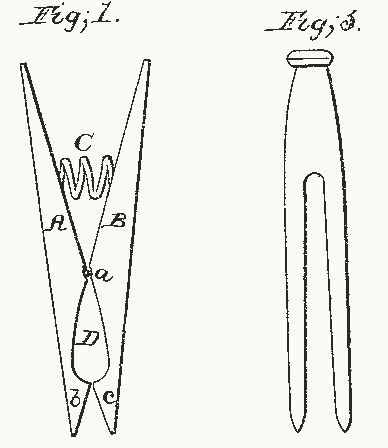
Moore’s patent made the hinge and the spring one piece of wire. He wrote that he knew of pins already made with fulcrum recesses and a coil spring, whose arms went through holes in the legs, and of a double spring set in grooves. He claimed only his own arrangement, with the coil in recesses midway along the legs, the line grooves in the jaws and the ends of the arms in grooves on the outside. By the Vermont Historical Society’s account, with Moore’s pin “the modern clothespin was born”, and Montpelier, Vermont, became the home of the nation’s clothespin industry, which had 15 factories across the Northeast in the 1930s. The last of the city’s makers, the National Clothespin Company, closed in 2003.
Rust, mould and sun
Of all that weather does to a peg, Moore wrote only about rust. Music wire is the most common spring steel. It does not resist a damp atmosphere.
A reader of Reddit’s CasualUK forum asked for stainless steel pegs. Wooden ones go mouldy, they wrote, and plastic ones go brittle in the sun. Others replied that their wooden pegs were 20 years old or more, and one had a set from 80 years ago. One kept them in a mesh bag so they dry out. Another wrote that wooden pegs left out on the line go mouldy, while pegs kept somewhere dry could last a decade or more.
Painted metal pegs that are not stainless, one reader warned, rust where the paint is scratched and stain wet clothes. One family’s wooden pegs never went mouldy but usually fell apart. All of these are readers’ own accounts. Neither patent says what sun or damp does to the wood, and neither spring maker’s page mentions pegs, so the forum is the only word on this page about mould and brittle plastic.
What the drawings leave out
The sizes are the drawing’s own. Moore gives none, and the peg is drawn 71 mm long, with steel wire 1.1 mm thick and a coil of 7 turns, wound 75° when shut. No source gives how far a real peg’s spring is wound when shut. No peg was measured.
The legs are rigid and turn about the coil’s centre, where a real pair rocks in its recesses. The drawn cloth does not squash, so the jaws touch it only at its inner edge. The turns of the coil do not rub on each other or on the wood.
The arms run straight to their grooves, though Moore bends them inward near the ends. They also bend a little under load. The spring maker’s formula counts that by adding their length to the turns, but the drawing shows them straight. Moore allows brass for the wire, while the drawing’s spring has the stiffness of music wire.
Sources
Read in November 2026.
- S. E. Moore, US Patent 365,755, “Clothes-pin”, 1887: two clamps and one wire. Fig. 1 follows its Fig. 2, and the spring in Fig. 2 its Fig. 3.
- D. M. Smith, US Patent 10,163, “Spring-clamp for clothes-lines”, 1853. Its sheet gives Fig. 3.
- Murphy & Read Spring Manufacturing Co., “Torsion Spring Reference Guide”, for the coil’s formulas.
- Acxess Spring, “Music Wire Spring Properties”.
- Vermont Historical Society, “The humble Vermont clothespin”, May 2024.
- Physics Stack Exchange, “Energy stored in a clothespin spring (non linear spring)”, May 2013. User report.
- r/CasualUK, “Stainless steel clothes pegs, anyone got some? Wooden ones go mouldy and plastic ones go brittle because of UV. I need to upgrade”, June 2022, via the Arctic Shift archive. User report.
The type is Playpen Sans by TypeTogether, under the SIL Open Font License 1.1.