Safety pin
Just one length of wire, bent into a coil near one end, makes both arms of a safety pin and the spring between them. That spring throws the point open when you let go of it. The head is a small cap on the end of the other arm. Once the point is in, the same spring keeps it there.
Wire, head and coil
A shut safety pin is two arms of one wire, joined by a coil at one end and held together at the other by a small cap, the head. The straight arm with the head on it is the bar, and the arm with the point is the prong. The coil that joins them is the spring.
In the factory a pin starts as a straight piece of spring-steel wire. One end is ground to a point. A machine coils the wire round a spindle and bends the unsharpened end into a hook, and a cap stamped from steel sheet is crimped onto the hook. Brass and stainless steel are used too.
Start typing “why does a safety pin” and Google offers to finish it with “have a hole”. The round hole at the bend is the middle of the coil. Hunt’s patent of 1849 marks that loop “the coiled spring B”. The coil keeps the tension that holds the point in its guard.
Pressing the prong
Each arm is a lever, and the coil is its pivot. The twist a push gives the coil is the push times its distance from the coil. In the drawings the point is about 32 mm out, so pressed halfway along, the prong would need twice the push for the same twist. As the point comes up toward the bar, the coil winds tighter. Both arms bend too.
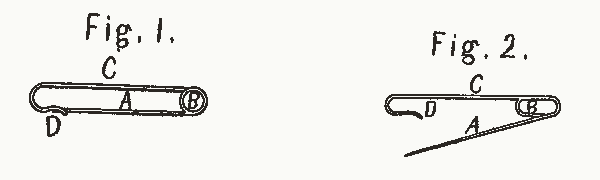
Before you press the point up in Fig. 1, guess which way it has to move to get out of the head once it is in.
What the drawing shows
It goes toward the bar first. The head of the pin in common use is a U. One side is fixed to the bar, and the other is a channel that opens toward the bar, while the spring pushes the prong the other way, into the channel’s floor. In the drawing the point must come up 1.6 mm against the spring before it clears the walls and can slide out. Even so, the common pin comes open by accident quite often, because nothing stops a prong that has been pushed up and to one side.
How many turns
The coil and its two arms make what spring makers call a torsion spring. The usual formula for such a spring puts the coil and the arms side by side at the bottom of the fraction. The coil counts the length of wire in its turns, and the arms count a third of their combined length. With arms 32 mm long and a coil 3.4 mm across, the arms count for more, so in the pin as drawn they do 57% of the bending.
Before you add turns in Fig. 2, guess whether the pin gets easier or harder to shut.
What the drawing shows
It gets easier. With 2.5 turns, shutting the pin takes 78% of the push that 1.5 turns need, and with 3.5 turns it takes 64%. The bending stress in the wire depends on the twist and the wire’s thickness but not on the number of turns, so it falls by the same share. Past its elastic limit, a spring takes a set and stays bent.
A sewer on Reddit wrote that pins bought recently were flimsy, that some did not close properly, and that they used to be a heavier gauge. Replies pointed to pins from tailoring suppliers, to nappy pins and to old brass ones.
In his patent of 1916, James Boye wrote that one turn gave a safety pin “ample resiliency”. Fewer turns than usual, he wrote, saved money on a thing made in such numbers. He also named “the familiar bow of the safety-pin”, the bend in the arms that lets the point slip from its keeper under strain.
Hunt’s dress-pin
Walter Hunt of New York was granted US Patent 6,281 for a “Dress-Pin” on 10 April 1849. He claimed pins made from one piece of wire, with no joint or hinge, that combine a coiled spring with a catch. In the catch the point is “by its own spring securely retained”. His catch is the bar’s own end. Fig. 3 shows the first two of his drawings, which he says are full size.
How Hunt came to make it is told in more than one way. The Lemelson-MIT Program says he owed a man $15, twisted a piece of wire until he had the pin, and sold the rights for $400. A 2013 post on Smithsonian Magazine’s design blog adds a name and a time. It says Hunt worked the pin out in three hours to settle a $15 debt to J. R. Chapin, a draftsman who drew his patents, and that Chapin later paid $400 for the rights to every twisted-wire variation Hunt could think up. The patent itself shows only that a Jno. R. Chapin signed it as a witness, and that the rights went to Wm. and Jno. Richardson.
Brooches that fasten in much the same way are far older. A bronze brooch from Cyprus, made in about the 8th century BCE, is catalogued as a “Bronze fibula (safety pin)”. The fibula was a clasp that worked somewhat like a modern safety pin and kept cloaks shut in an age without buttons, and Hunt’s pin improved on such brooches.
When the $15 story went round Reddit’s Today I Learned forum, the reply with the most votes said that the machine to make the pins mattered at least as much as the design. The forerunner of today’s pin-forming machines, E. J. Manville’s automatic fourslide machine, dates from 1864.
What the drawings leave out
The sizes are the drawing’s own. The pin is 38 mm long, its wire 0.7 mm thick and its coil 3.4 mm across, all likely sizes for a pin of that length, with none measured from a real one. The arms bend as straight beams loaded at one point, which is the case the spring formula covers, and every number of turns starts from the same open shape. In Fig. 1 the point slides sideways out of the page, so only the section shows that move, and the section leaves out the end of the head behind the cut. In the view from above, every part is a single line, and the turns are spread apart so they can be counted. Real pins also have bends that the drawings leave out, such as the hollows Boye’s patent shapes beside the coil so that cloth is guided into them and kept out of the turns.
Sources
Read in November 2026.
- W. Hunt, US Patent 6,281, “Dress-Pin”, 10 April 1849, with its drawing sheet. Fig. 3 shows his Figs. 1 and 2.
- J. P. Lindsay, US Patent 198,890, “Improvement in safety-pins”, 1 January 1878.
- F. T. Clark, US Patent 628,598, “Safety-pin”, 11 July 1899, for the bar and the coil’s work.
- J. H. Boye, US Patent 1,170,508, “Safety-pin”, 8 February 1916, for one turn, the bow and the hollows by the coil.
- A. E. Piplack, US Patent 2,903,773, “Safety pin clasp”, 15 September 1959, for the head of the common pin and the prong.
- Tokai Spring Industries, “Torsion Springs: Calculation Formulas”, and Acxess Spring, “Torsion Spring Rate”: how turns and arms set the stiffness.
- Newcomb Spring, “Stress in Torsion Springs”, after the Spring Manufacturers Institute; Acxess Spring, “The Importance of Max Safe Travel and Max Load”.
- Wikipedia, “Lever”, for force times distance.
- R. M. Rottner, “Safety Pin”, How Products Are Made, on materials, the factory steps and Manville’s machine.
- Lemelson-MIT Program, “Walter Hunt”; J. Stamp, “The Inventive Mind of Walter Hunt, Yankee Mechanical Genius”, Smithsonian Magazine, 2013.
- The Metropolitan Museum of Art, “Bronze fibula (safety pin)”, 74.51.5543; Cleveland Museum of Art, “Crossbow Fibula”, 1930.227.
- Sciencing, “Why Do Safety Pins Really Have Those Tiny Holes?”, which retells a Reader’s Digest interview with Larry Schwartz of Wholesale Safety Pins, for the hole and the coil’s tension.
- What Google offers to finish “why does a safety pin”, as typed on 15 November 2026. User report.
- r/sewing, “ISO High quality safety pins”, July 2026, via the Arctic Shift archive. User report.
- r/todayilearned, “TIL that Walter Hunt invented the safety pin in 1849 to pay off a $15 debt, twisting an 8-inch piece of brass wire into a spring-loaded clasp, then sold the patent for $400; the buyer later made millions from the design.”, April 2026, via the Arctic Shift archive. User report.
The type is Playpen Sans by TypeTogether, under the SIL Open Font License 1.1.