Screw
Round the shank of a screw runs a ridge, the thread, and every time it goes round it climbs the same short step along the screw. That ridge is a slope wrapped round a rod. Turning it drives the screw far harder than you push on the screwdriver. Friction on the same slope holds the screw when you let go.
A slope rolled round a rod
The thread of a screw is a ramp wound round its shank. To work out its forces, engineers unwrap the ramp back into a flat slope, and they need only two numbers to do so: the diameter of the shank and the pitch, which is the distance from one ridge of the thread to the next.
The slope rises one pitch in the length of one trip round the shaft. Its angle is called the lead angle. A fine pitch on a thick shaft makes it gentle.
A right-angled triangle of paper makes the same kind of slope. Fig. 1 lays one flat with a rod along its tall edge. Guess what its long slanted edge will look like on the rod, then roll the paper on.
What the drawing shows
On the rod the slanted edge winds round and round. It rises by the same step every time, because its slope is the same all the way along. That step is the pitch. Two turns of paper make two turns of thread, one pitch apart.
One turn of the driver
A screw turning in a threaded hole climbs its own thread, as a nut would climb the slope. In one turn it moves along by one pitch. The screw in Fig. 2 is a metric screw 6 mm across. Its pitch is the usual coarse one for that size, 1 mm, so each turn takes it 1 mm deeper into the block.
Guess how far the screw will go in while the brass dot on its thread goes once round, then turn the handle of Fig. 2.
What the drawing shows
The dot comes back to the front one ridge lower. The screw has gone in 1 mm. In that turn your thumb, on the rim of a handle 30 mm across, has gone about 94 mm round. If no work were lost, the screw would push along its length with about 94 times the force your thumb puts on the rim. A fatter handle or a finer pitch would make it bigger.
A reader of Feynman’s “Lectures on Physics” asked on Physics Stack Exchange where one of his numbers came from. Feynman had 1.6 pounds on the end of a 20-inch handle lifting a ton with a screw of 10 threads to the inch. The answer voted highest got there the same way, from the work going in and the work coming out, and it said it was ignoring friction.
Why a screw stays in
Friction takes a large share of that push. In the drawing’s model, with a friction coefficient of 0.12 on the thread, the screw in Fig. 2 pushes about 31 times as hard as your thumb. That is a third of the friction-free 94.
The same friction keeps the screw from turning back. Whatever the screw holds pushes back along it. On the unrolled thread, that push tries to slide the nut’s thread down the slope. Before you make the slope in Fig. 3 steeper, guess the angle at which the nut starts to slide.
What the drawing shows
The nut slides once the slope passes 6.8°, whose tangent is 0.12. Below that, it stays. This boundary is called the self-locking angle. A screw with a smaller lead angle holds its load by friction alone. A screw with a larger one lets the load turn it back.
The 6 mm screw’s lead angle is 3.4°, half the 6.8° of this model. Dry steel screws in steel holes have friction coefficients of 0.12 to 0.18, so a dry screw like this one stays well inside the limit.
Threads that match
A screw fits only a hole whose thread has the same pitch and the same shape. Threads cut on a lathe with a tool guided by hand came out a little different every time, and a nut made for one bolt would probably not fit another. Henry Maudslay’s screw-cutting lathe held the tool in a slide rest, moved by a lead screw that the lathe turned, with change gears to set the pitch.
The sources date it differently. The sizes.com history says 1797. The Linda Hall Library says he had perfected it by about 1797, and Wikipedia gives about 1800.
Joseph Whitworth, who had worked for Maudslay, read a paper to the Institution of Civil Engineers in 1841. He had gathered screw bolts from the main workshops of England and averaged the thread for each size. Their sides met at about 55°, so he used 55° for every size. Metric threads have sides at 60°.
Slot, square and cross
Turning a screw also needs a grip on its head. Someone asked on Reddit’s r/explainlikeimfive why screws have so many kinds of head when all they do is tighten and loosen, and 392 comments followed.
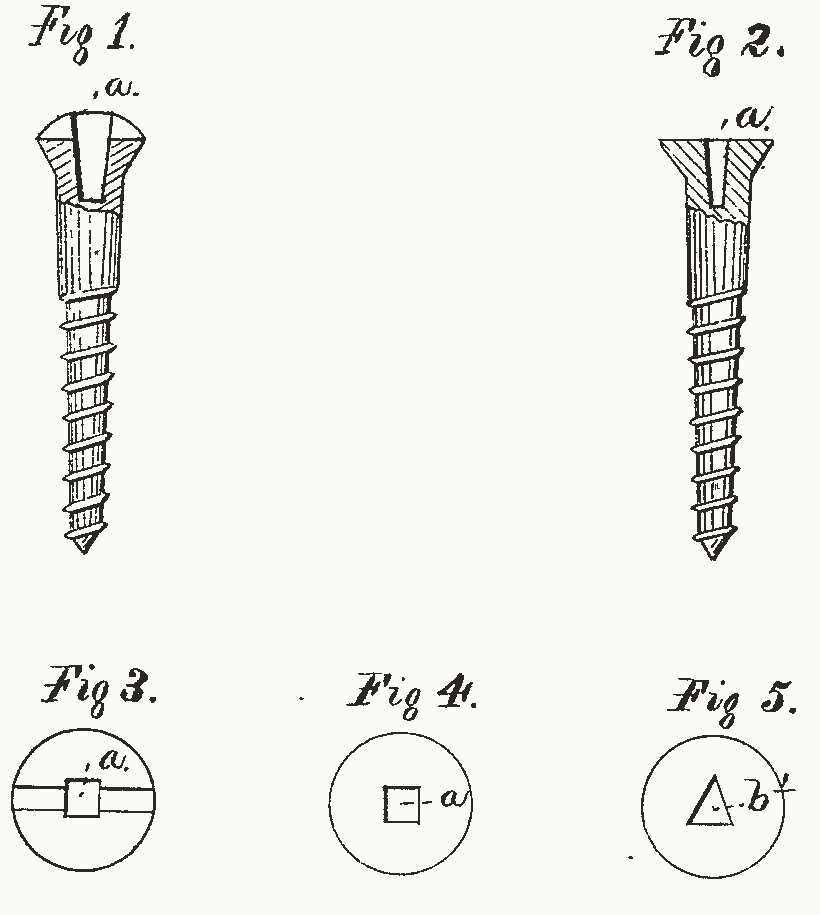
The patents give their inventors’ reasons. In 1875 Allan Cummings of New York patented a wood screw with a tapering cavity in the middle of its head, square in his drawings, for a driver of the same shape (Fig. 4). The ordinary slot, he wrote, is damaged “mainly by the slipping of the screw-driver from the slot”. On screws long embedded, the driver slips out again and again until the screw cannot be started at all.
Peter Lymburner Robertson of Hamilton, Ontario, patented a machine in the United States in 1911 that punches a square socket into the cold head of a screw blank. The sides of the socket close in very slightly toward the bottom. He wrote that it held the driver so well that the screw “may be carried upon the point of the driver”. His patent also says a slot shaped like a cross had been proposed before, and gave a poor hold.
Henry F. Phillips’s cross, patented in 1936, is a set of flat-bottomed grooves running out from the middle of the head. They taper down to a point on the screw’s centre line. Among his aims was a recess that centres the driver by itself, whether the driver is turned by hand or by power.
What the drawings leave out
The sizes are the drawing’s own. Fig. 1’s slope is nearly four times as steep as a real screw’s, so that its turns are easy to see. In Fig. 2 the hole’s thread has exactly the screw’s shape, with no gap between them, and the handle is a plausible 30 mm, not one measured from a real screwdriver. The numbers in the readouts follow from the drawings’ own model. It has a flat ramp at the screw’s middle diameter, friction of 0.12 on the thread, and no friction anywhere else.
Only Fig. 2’s screw follows a standard, the metric screw 6 mm across with its pitch of 1 mm. Its friction of 0.12 is the low end of the range for dry steel.
A real screw also rubs under its head once it presses on something, and that friction is counted on its own. A real thread is a V, which holds as if its friction were 15% higher than on the flat ramp of Fig. 3. A screw that holds itself in place is no safe brake, because oil, wear, shaking and the shape of the thread all change how it behaves.
Sources
Read in November 2026.
- J. Moore and contributors, “Mechanics Map”, section on power screws, an open engineering textbook: the thread as an unwrapped ramp, the torque equation and the self-locking angle.
- RoyMech, equations for power screw torque, for the lead, the lead angle, friction under the head, the V thread and its warning; and RoyMech’s table of friction coefficients for screw threads.
- Wikipedia, “ISO metric screw thread”, for the shape, pitch and diameters of the 6 mm thread.
- J. Whitworth, “A Paper on an Uniform System of Screw Threads”, read in 1841, as reprinted in his “Miscellaneous Papers on Mechanical Subjects”.
- Wikipedia, “Henry Maudslay” and “British Standard Whitworth”.
- Sizes, Inc., “History of screw threads”.
- W. B. Ashworth Jr., Linda Hall Library, “Scientist of the Day: Henry Maudslay”.
- A. Cummings, US Patent 161,390, “Improvement in wood-screws”, 30 March 1875, whose sheet of drawings is the source of Fig. 4.
- P. L. Robertson, US Patent 1,003,657, “Screw-blank-heading machine”, 19 September 1911.
- H. F. Phillips, US Patent 2,046,343, “Screw”, 7 July 1936. Its drawing is not shown here.
- Physics Stack Exchange, “Calculating the force required to lift a weight with a screw”, December 2014, with its highest-voted answer. User report.
- r/explainlikeimfive, “What is the significance of having various screw head types when the basic action is just tightening or loosening?”, March 2026, via the Arctic Shift archive. User report.
The type is Playpen Sans by TypeTogether, under the SIL Open Font License 1.1.