Desk lamp
Pairs of springs beside the two arms of a jointed desk lamp hold its shade up wherever you leave it, high over the desk or low and far out. Each spring is hooked to a point straight above the joint it works on, and it pulls harder the longer it is stretched.
Base, arms and shade
Seen from the side, a jointed desk lamp stands on a heavy base. A support turns on the base. Two arms rise from it, hinged together at an elbow, and the shade hangs from the upper arm’s outer end. A thinner bar runs beside each arm, and a pair of coiled springs hangs beside each arm too. You can lift the shade, push it out over the desk or draw it back in. When you let go, it stays there.
The lamp in the figures follows the words of George Carwardine’s patent of 1937. The patent calls the arms levers, each thin bar a link, the elbow a conjunctive member and the piece that holds the shade a carrier. The whole is an equipoising mechanism. A device that holds up a weight and still lets it move is sometimes called an equilibrator, and this kind a spring-and-lever balancing mechanism.
One maker calls its lamp of this kind the Original 1227. Its arms and shade are aluminium, and the shade is 14 cm across. Fixed to a desk, it reaches 72 cm out and 90 cm up. The maker’s sheet notes that the bulb’s weight is critical for the balance, and gives about 25 to 60 g for a bulb.
A spring hooked above the joint
Take the upper arm first. The shade’s weight turns it down about the elbow’s pin, and how hard depends on how far out from that pin the shade sits, measured level. With the arm upright that distance is nothing, so the weight does not turn the arm at all. With the arm level the distance is the arm’s whole length. The turning effect is then at its largest, and it falls away again as the arm points lower.
The arm’s springs run from a pin on the elbow piece, straight above the arm’s own pin, to a pin partway along the arm. As the arm leans out, those two pins move apart, and the springs stretch. Their turning effect is their pull times the distance from the arm’s pin to their line. Carwardine’s patent says it was already known that a spring set out like this balances a weight on a pivoted arm exactly, provided its pull is always in step with the distance between its two ends. Their length then cancels out. What is left grows and shrinks with the lean in the same way as the weight’s turning effect, so a spring of the right strength matches the weight at every angle. The lower arm works the same way. Its springs are hooked to the support above its pin, and its weight is everything beyond the elbow.
Lean either arm in Fig. 1, and guess before you leave it whether it will stay there.
What the drawing shows
Each arm stays wherever you leave it, at any lean between its stops. At every angle the springs turn each arm back as hard as the weight turns it out, and the readout shows both shares rising and falling together. No pose is easier for the lamp than another, so a light push moves it, and nothing moves it back.
Links that hold the shade’s aim
Each link is as long as its arm and runs parallel to it, pinned a short way off the arm’s own pins at both ends. Arm, link and the pieces at their ends make a parallelogram. As the lower arm leans, the elbow piece moves with it but cannot turn, and as the upper arm leans, the carrier cannot turn either. The shade in Fig. 1 keeps its aim that way, and so does the pin above each joint, which stays straight above it. In the patent’s words, the mass moves in an arc about its pivot but “is prevented from rotating relatively to the base”.
The links also let each arm be balanced on its own. The patent sets out to balance a mass without first finding its centre of gravity, and to balance several masses pivoted one to another. For the lower arm, the upper arm and its shade act as one weight hung at the elbow. The twist they put on the elbow piece is carried by the lower arm and its link, one squeezed and one stretched, and loads no spring. So the lower springs need only match that weight at the elbow, wherever the upper arm points.
Springs wound shut
A plain coil spring pulls nothing until it is stretched past its free length, and then its pull grows with the stretch. The rule above needs more than that. It needs a pull in step with the spring’s whole length, as if its free length were nothing. With any other free length, the balance can hold at one angle only.
Carwardine’s springs are wound with their coils drawn tightly together and much of their strain set in. They already pull while shut. In his patent’s example, a spring that pulls 100 lb when its ends are two inches apart pulls 200 lb at four inches and 300 lb at six. Such a pull comes from a twist put into the wire as the spring is wound. The coils stay shut until the load passes that pull, and the spring then behaves as if its free length were shorter than its shut length, or zero. To suit a heavier or lighter shade, the patent hooks the springs through one or another of a row of holes in the arm.
Fig. 2 gives the upper arm two faults to choose from: plain springs, stiff enough to hold the arm level and drawn like the others, or a bulb too heavy for its springs. Joints grip a little, and here each grip is a tenth of the weight’s largest turning effect. With plain springs, guess which way the arm will go when it is let go from 50°.
What the drawing shows
With plain springs the arm sinks. Let go at 50°, it comes to rest at 76°, a little above level. Springs that hold it level pull too little higher up, where they are short, and too much lower down. From any lean the arm drifts toward level, until the difference is small enough for the joint to hold it, so from 120° it rises to 109°. With the heavy bulb the springs fall short at every angle, most of all when the arm is level. The joint holds the arm only within 30° of upright, and from farther out it sinks to its stop.
Friction and a level desk
No spring keeps exactly in step with its length, and friction in the joints covers the difference. It cannot be taken out of the mechanism entirely, and it lets the arms stay where they are left in spite of small errors in the springs. Carwardine’s patent has a screw that tightens or loosens the elbow. It also suggests linking the joints, since a loose joint could open all the way while a stiffer one hardly moved.
The base must balance too. In a user report on Physics Stack Exchange, a reader designing such a lamp asked why a real one takes some extra weight before it falls over, and an answer pointed to a heavy, wide base. The lamp would tip about the base’s edge, so the base’s weight, close to that edge, has to outweigh the shade’s, far out from it.
One maker’s instructions say to tighten the nuts, if needed, until the shade and arms hold themselves in any position. They also say to stand the lamp on a level surface, since a sloping one upsets the balance, and that a bulb heavier than 25 to 60 g may affect it. On a slope the pin above each joint is no longer straight above it, and the springs no longer match the weight at every angle.
A dentist’s light, then a desk lamp
An arm held up by a spring was patented before Carwardine’s. Harry J. Bosworth of Chicago applied in July 1924 for a light support for dentists and physicians, granted in October 1927 (Fig. 3). Its arm swings up and down about a pin in a round head. A coil spring in the upright post pulls down on a rod hinged to that head beside the pin, and the patent says the spring is set to counterbalance the arm and light so that they are held in any position. The arm slides out to reach farther. A wing nut then presses two rubbing faces harder, to hold the longer arm. The light hangs from a pin at the arm’s end, so it hangs straight down whatever the arm does.
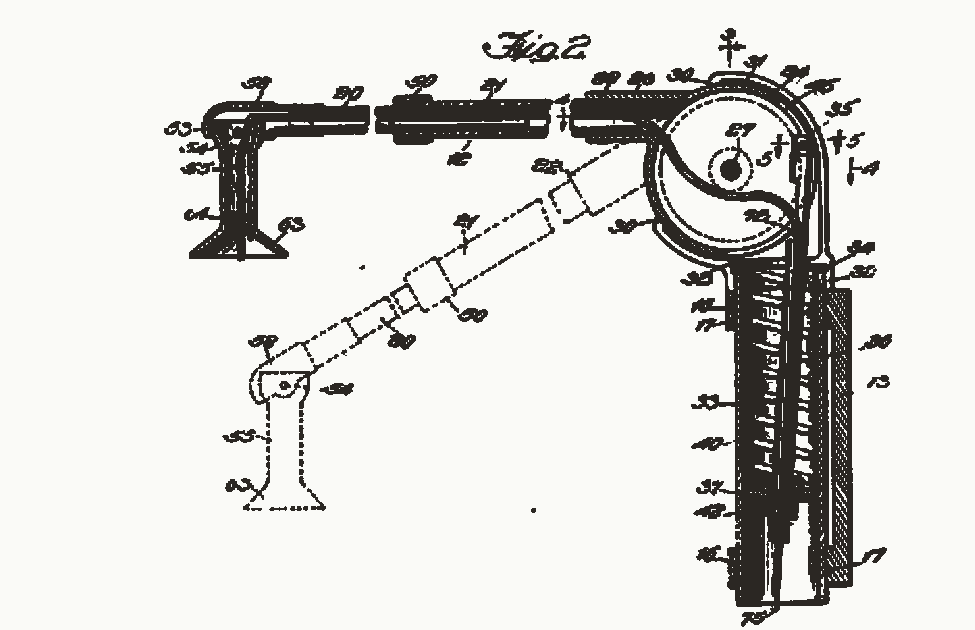
Carwardine designed cars and car suspensions in Bath before he took up balancing mechanisms. He first applied for this patent in Britain on 4 July 1932, applied in the United States on 29 June 1933, and was granted the US patent on 17 August 1937. The Design Museum dates his spring patent to 7 July 1932. A later patent of his put all the springs down at the base, with drawings of the lamp as it came to be made. The maker says the Original 1227 was launched in 1935. As far as French and Widden knew in 2000, the first published account of the mechanism, apart from the patents, was a textbook exercise of 1971.
What the drawings leave out
The sizes are the drawing’s own. No source gives an arm’s length, a spring’s strength, the weight of a shade or the friction in a joint, so the figures give turning effects as shares of the weight’s when the arm is level, and no force in newtons. Fig. 2’s joint grips with a tenth of that, its heavy bulb adds a fifth, and its plain springs balance the arm when it is level. Each arm and each link is drawn as one bar, and each pair of springs as one spring in front of its arm. In the model the arms weigh nothing. Springs can carry their weight too, when each arm’s centre of gravity lies on the line through its pins. The support never turns on its base, and the shade is fixed to its carrier, though the patent’s shade turns on a stem. In Fig. 2 the lower arm stays still, though a heavy bulb would leave its springs short as well. Once let go, the arm swings at a pace no source gives.
Sources
Read in November 2026.
- G. Carwardine, US Patent 2,090,439, “Equipoising mechanism”, 17 August 1937, for the drawn lamp, its springs and its joints.
- H. J. Bosworth, US Patent 1,644,231, “Light support”, 4 October 1927, for Fig. 3 and the dentist’s light.
- M. J. French and M. B. Widden, “The spring-and-lever balancing mechanism, George Carwardine and the Anglepoise lamp”, 2000, for the springs’ rule, the links and Carwardine’s life and patents.
- Anglepoise, technical sheet for the Original 1227 lamp with desk insert and instructions for the Type 75 desk lamp, for the reach, the bulb and the nuts.
- Design Museum, “The Anglepoise lamp”, for its date of the patent.
- Physics Stack Exchange, “Static equilibrium problem”, October 2020, with the reply below it. User report.
The type is Playpen Sans by TypeTogether, under the SIL Open Font License 1.1.