Door closer
Doors fitted with a closer squeeze a spring in the closer’s body as they open, and that body is screwed to the door near its top. Once you let go, the spring pulls the door back through a jointed arm. Liquid in the body slows it down, because the liquid has to pass a small hole on the way.
The box and its arm
Seen from inside the room, a door closer is a metal box on the face of the door, high up on the hinge side, with a jointed arm from the box to the frame above. LCN’s fitting sheet for its 4040XP closer names the parts for a box on the pull side, the side the door opens toward. A main arm stands on the closer’s shaft, and a forearm runs from it to a shoe on the frame. The two meet at an elbow. The patents of the 1890s call the device a liquid door-check, or a door check and closer.
One closer has to suit doors of many widths, so its spring can be set stronger or weaker. LCN’s catalogue gives the 4040XP strengths from 1 to 6. Strength 2 suits the narrowest interior doors. An interior door 864 to 965 mm wide takes strength 3, the setting it leaves the factory with. One 1,372 to 1,524 mm wide takes 6. The same closer can also go on the frame’s top jamb, or on the push side with a parallel arm.
ANSI/BHMA A156.4 is the American standard for closers. It covers closers on the surface, as this one is, and others hidden in the door, overhead or in the floor. A summary of it says a Grade 1 closer must last two million openings and closings of a test door.
A spring that squeezes along the piston
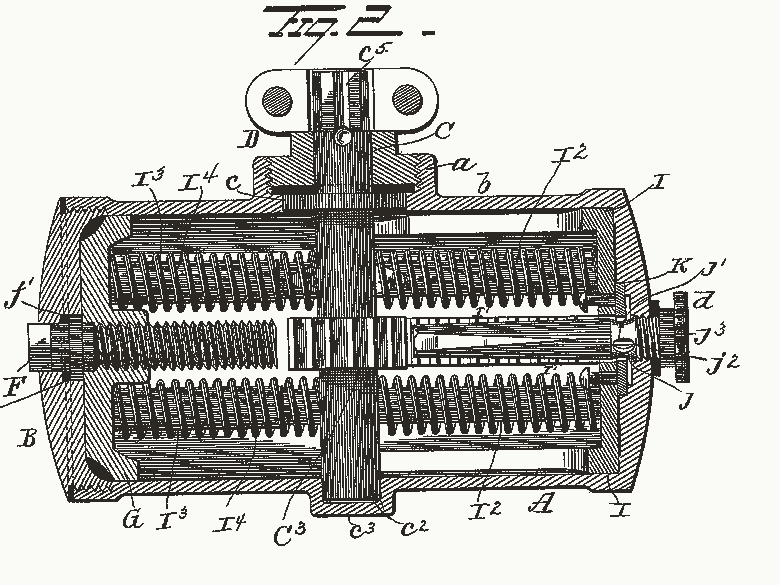
Inside the box a piston slides in a cylinder. The drawings here follow William Gilfillan’s patent of 1897. His piston is hollow, closed at one end, with a rack along its inside. A pinion on the closer’s spindle meshes with the rack. The spindle stands upright, and the arm is fixed to its top. As the door opens it turns the spindle, so the pinion drives the piston along and squeezes the springs. Once the door is let go, the springs push the piston back. The rack turns the pinion, and the arm pulls the door shut.
In the checks then in use, Gilfillan wrote, a clock or coiled spring drove the piston from a box of its own, standing crosswise on the liquid’s casing. His springs lie in the piston’s own chamber and squeeze along its travel. They are coils of round wire. A screw in the removable head moves a disk against them, so they can be given “tension just sufficient to close the door”. LCN’s closer is set the same way, by a screw in the body’s end.
The springs can be too strong. For an interior door that is not a fire door, the 2010 ADA Standards for Accessible Design allow at most 5 pounds, 22.2 N, to push or pull it open. LCN’s catalogue warns that a closer set for so low an opening force may lack the power to close and latch the door reliably. In Fig. 1 the door is seen from above, with the closer’s body cut open, and its turns set the cut-off valve, which comes later. Guess how far the arm turns on the door while the door swings open by 90°.
What the drawing shows
The arm turns about 194° on the door while the door opens 90°, more than twice as far, and the piston moves about 34 mm in this drawing. Near the frame the arm turns 3.2 times as fast as the door. Part way through the swing it slows to 1.7 times. For the same push from the springs, the door is pulled hardest as it nears shut.
Where the liquid goes
Gilfillan’s piston works in liquid, and his patent does not name the liquid. On the piston’s head lies valve K, a loose disk with a hole for the vent tube. That tube is fixed to the cylinder’s integral head, the end away from the springs, and runs through the piston’s head into the hollow piston, where its bore opens. As the door opens, the piston moves toward the springs, and the liquid in front of it has to reach the space behind its head. It pushes valve K a little way off the head and flows freely through. So the liquid hardly resists the opening.
Once the door is let go, the springs push the other way, and the liquid presses valve K onto the head. In Gilfillan’s words, “the closing action of the door” is “checked”. The liquid behind the head can now leave only by a small hole in the tube’s wall, near the cylinder’s head. It runs along the tube’s bore and out of its open end, inside the piston. Guess which way the liquid goes in Fig. 2 when a hand pushes the door shut.
What the drawing shows
Valve K shuts whenever the piston moves back toward the cylinder’s head, whatever moves it. A hand that pushes the door shut has to force the liquid through the small hole too. In this drawing a closing from 90° sends about 38 mL of liquid past the hole and the groove, the volume the piston sweeps.
The cut-off valve
The screw that sets the speed is Gilfillan’s cut-off valve. It sits inside the vent tube, and a thumb-wheel outside the cylinder turns it. Turned in, it covers more of the hole, and the liquid leaves more slowly. “By opening the valve to its limit the door closes at its greatest possible speed”, Gilfillan wrote, and closing it reduces the speed. He gave the valve no shape. In the drawings it is a rod in the tube’s bore, with its end across a round hole 2 mm wide. Each turn moves it 0.5 mm.
Course notes on fluid systems from California State University, Northridge give the flow through a small opening. It grows with the opening’s area and with the square root of the pressure across it. Here the springs make the pressure, pushing on the piston. With the same springs, the door moves faster the more of the hole is open. No source read gives a closer spring’s force or names the liquid, so the model’s times are pinned to a rule instead. The ADA standards ask that a closer take at least 5 seconds to bring a door from 90° to 12° from the latch. The model does that in 5 s with the valve one turn out. Guess what one more turn does to the time there, and what it does at three turns out (Fig. 3).
What the drawing shows
From one turn out to two, the open part of the hole grows from 20% to 50%, and the time from 90° falls from 6.2 s to 2.5 s. From three turns to four it grows from 80% to the whole hole, and the time falls only from 1.5 s to 1.3 s. A round hole opens as a thin sliver at first. From half a turn to one, its open area grows 2.7 times. LCN’s sheet calls 5 to 7 seconds from 90° a “normal” closing time. It also warns that opening the regulation valves too far may make the closer leak.
The last few degrees
Gilfillan’s vent tube has a groove round it, close to its base. As the door comes near shut, valve K reaches the groove, and liquid slips past it round the tube. Then the springs can shut the door “with force sufficient to latch the door”. He wrote that the groove could be left out, and that a tube of one width all along gives “a substantially uniform checking action”. In the drawings the groove opens below about 4°. With the valve one turn out the door slows to about 8° a second near shut, then speeds up to about 25° a second over the groove. Its last 12° take 1.2 s, and would take 1.6 s with no groove.
A DIY Stack Exchange user asked about an entrance door that slammed when its closer shut it. An answer named three screws for setting a closer and said its writer could never work out what backcheck did. LCN’s 4040XP has a valve for each stage. Each can be set on its own. One sets the closing speed from the widest opening to 15°, one the latching speed from 15° to shut, and one the backcheck. Backcheck cushions a door that is thrown open. It works from 75° on.
Checks of the 1890s
Eugene I. Blount, of Gardner, Massachusetts, filed his patent for a “door check and closer” on 27 December 1893. The patent is dated 16 July 1895 and assigned to the Blount Manufacturing Company of Portland, Maine. His piston works in line with the spindle. A cam pushes it down as the spindle turns. The door opens “without any resistance from the liquid”. When the door shuts, the liquid must pass a narrow port that a screw-valve controls, “so that the door may be closed without slamming”.
William Gilfillan, of New York, filed his on 15 October 1896. It is dated 2 March 1897. Fig. 4 is his cut along the cylinder.
Cromwell O. Case, of New Britain, Connecticut, called his patent of 1899 an improvement on Gilfillan’s. It was assigned to P. & F. Corbin. Its aim was to stop the liquid working up round the spindle and out through the packing, which he did with a sleeve and a gland round the spindle and a port that lets any creeping liquid run back down.
What the drawings leave out
The sizes are the drawing’s own. The drawings show one spring where Gilfillan has four, set beyond the piston’s open end, and a plain rod for the cut-off valve. Fig. 2 shows only the end with the valves. Its pinion and rack are drawn as if both lay in the cut. Fig. 1 leaves out the frame above the door, so the arm can be seen. The door has no handle or latch. The liquid itself is not drawn. Gilfillan’s tube may also be tapered or grooved along its length, so that the door is checked more and more as it closes, but the drawings keep it one width all along.
The model leaves out the door’s weight, the rubbing of the seals, the packing round the spindle and any leak past the piston, so in the drawings the door moves only as fast as the hole and the groove let the liquid out. Its times rest on the ADA’s 5 seconds. No source read gives the spring’s force, so the page gives none in newtons. Fig. 1 shows each closing eight times faster than the model’s time, and its readout gives the model’s seconds.
Sources
Read in November 2026.
- W. Gilfillan, US Patent 577,917, “Liquid door-check”, 2 March 1897, read for the mechanism and shown as Fig. 4.
- C. O. Case, US Patent 629,001, “Liquid door-check”, 18 July 1899.
- E. I. Blount, US Patent 542,840, “Door check and closer”, 16 July 1895.
- LCN, 4040XP installation sheet, pull side, 2017, for the parts, the valves and the closing time.
- Allegion, LCN 4040XP catalogue, 2021, for the strengths and the speed ranges.
- US Department of Justice, 2010 ADA Standards for Accessible Design, sections 404.2.8 and 404.2.9.
- BHMA, summary of ANSI/BHMA A156.4 (2024), for what the standard covers.
- Nhut Tan Ho, California State University, Northridge, ME 584 notes, “Orifice Flow Resistance”, for the flow through a small hole.
- DIY Stack Exchange, “Is this door closer okay, maladjusted, or broken?”, October 2014, with its answer. User report.
The type is Playpen Sans by TypeTogether, under the SIL Open Font License 1.1.