Freewheel
Every bicycle that lets you coast has a freewheel, a ratchet that keeps the back wheel turning when your feet stop. Inside it, spring-loaded levers called pawls catch on a ring of teeth when you pedal and ride over them when you stop. The ticking as you roll downhill is the pawls dropping off one tooth after another.
Pedals, chain and back wheel
On the chain side of a bicycle’s back wheel, the sprocket sits on a freewheel, a ratchet screwed onto the hub. It lets the wheel run ahead of the sprocket but never lag behind it. The cranks turn the chainring, and the chain carries that turn back to the sprocket. The bike in Fig. 1 has 36 teeth on its chainring and 18 on its sprocket, so the sprocket goes round twice for every turn of the cranks.
The pawls bite only when the sprocket tries to turn faster than the wheel. Turn the crank or the wheel in Fig. 1 and watch the middle of the freewheel, where a hole marks the sprocket and a notch marks the part that turns with the wheel. Before you roll the wheel backwards, guess what the pedals will do.
What the drawing shows
Pedal forwards and the wheel goes with you. Stop, or pedal backwards, and the two part company: the wheel runs on while the pawls tick over the teeth inside the freewheel, and the hole and the notch drift apart. Roll the wheel backwards, though, and the pedals go back with it. That is the same rule seen from the wheel’s side. The wheel may not turn backwards against the sprocket, so when the wheel goes back, the sprocket and the cranks have to go too.
Inside the freewheel
A thread-on freewheel has two bodies, one inside the other. The inner body screws onto the hub, so it turns with the wheel. The outer body carries the sprocket, and round its inside runs a ring of teeth. Each tooth has a long, gentle slope on one side and a steep face on the other, like the teeth of a saw.
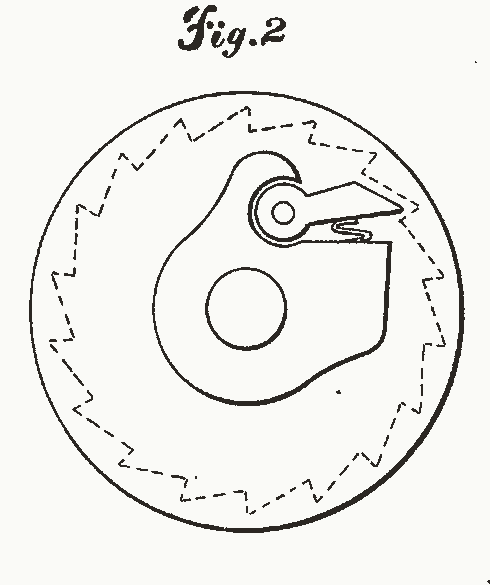
The pawls sit between the two bodies. Each is a small lever of hardened steel on a pivot in the inner body, and a spring pushes its tip outwards, into the teeth. The freewheel cut open in Fig. 2 has two pawls, on opposite sides, and the drawing shows one of them.
Fig. 2 holds the inner body still, as if the back brake were on. Before you drag the outer body, guess which way it will turn freely.
What the drawing shows
Backwards it turns. That is the way the outer body goes when you stop pedalling and the wheel runs on. The gentle slope of each tooth slides under the pawl and lifts it. The spring is squeezed as the tip rides up to the top of the tooth, and then the tip drops into the next gap. Forwards, the outer body stops after 2°. The steep face meets the tip of the pawl. The push runs along the pawl towards its pivot and swings the tip further into the tooth. So the push itself keeps the pawl in place, and on a bike the wheel would go round with it.
Why it clicks
Each click is a pawl landing in a gap after its spring throws it off the top of a tooth. Every pawl clicks once for each tooth that passes it, so the clicks come faster as the wheel gains on the sprocket. With the pedals still, a ring of 36 teeth whose pawls drop together clicks 36 times for each turn of the wheel. A road wheel with a 700 × 25C tyre rolls 2,105 mm a turn, so at 25 km/h such a hub clicks about 120 times a second. Riders often call the sound a buzz. One rider on Reddit, in a user report, asked for a louder freehub, so that other people on the trail would hear them stop pedalling.
Not everyone wants it. A rider on Bicycles Stack Exchange, in another user report, found the clicking of their single-speed so annoying that they flipped the back wheel round and rode it fixed for a few months. Pedalling all the time, even downhill, was worse. So they flipped it back and asked whether a freewheel that does not click exists. The accepted answer named Shimano’s Silent Clutch hub, which Shimano had stopped making.
How far before it bites
When you stop pedalling, each pawl comes to rest somewhere on a slope. When you start again, the sprocket has to turn until a pawl reaches the next steep face, and only then does the wheel feel the push. This wait is called the engagement angle. It is 360° divided by the number of places where the ratchet can catch, so 36 places give a wait of up to 10°.
Fig. 3 shows the ratchet of a freehub. Here the pawls ride on the freehub body, the part that carries the sprockets, and the teeth line the inside of the hub shell, the reverse of Fig. 2. Choose 2, 3 or 4 pawls, and before you turn the freehub body, guess whether more pawls make the wait shorter.
What the drawing shows
Pawls set evenly round the ring reach their teeth at the same moment, so adding pawls spreads the wear and leaves the wait as it was. To shorten the wait, a maker can cut more teeth, or set each pawl a fraction of a tooth behind the one before so that they take turns. A SRAM hub, described on Bicycles Stack Exchange in a user report, has four pawls in two pairs that take turns, which gives its 26 teeth 52 places to catch, about 7° apart. Wikipedia’s article adds that more than two pawls rarely bite at once, unless the parts are made more precisely than bicycle parts usually are.
The wait at the pedals is shorter than at the hub, because the chain turns the sprocket faster than the cranks. In a gear of 32 teeth at the front and 14 at the back, a 10° wait at the hub is 4.4° at the crank.
Kinds of freewheel
The thread-on freewheel is the older design. Its sprockets and ratchet come off the hub as one piece, and every push on the pedals screws it a little tighter on its thread. In a freehub the ratchet belongs to the hub, and a cassette of sprockets slides onto splines on the freehub body. The two are easy to mix up. A reader of Reddit’s Explain Like I’m Five forum, in a user report, asked for the difference, having tried to find it “for ages”.
Pawl counts vary. Sheldon Brown wrote that most freewheels have two or three, and freehubs usually have three or six. Some hubs have no pawls at all. DT Swiss presses two flat rings of teeth face to face with springs, a design called a star ratchet, so that all its teeth bite together. Common rings have 18, 24, 36 or 54 teeth, and DT Swiss’s 54-tooth ring catches every 6.7°.
Before the freewheel
On an ordinary velocipede of the 1860s the cranks were fixed to the axle of the front wheel, so the pedals turned whenever the wheel did. William Van Anden of Poughkeepsie, New York, described the rider’s trouble in his patent of 1869: “he is obliged to keep his feet in motion or remove them from the treadles, as long as the vehicle moves”. Choose “Locked” in Fig. 1 and roll the wheel to see it.
His US Patent 88,238, dated 23 March 1869, left the front wheel loose on its shaft. Disks fixed to the shaft carried a pawl, which caught on teeth in the hub (Fig. 4). Pedalling drove the wheel forwards, and when the rider rested, the wheel ran on, “the pawls offering no obstacle to the forward movement of the wheel”. He named a second gain as well: if the feet moved “unequally or irregularly, as is frequently the case with persons learning”, the wheel was not held back.
Van Anden also fitted a slide on the hub and a pin on one disk, so the wheel could be fixed to the shaft when the rider wanted. His own velocipede, given by Mrs William M. Van Anden, is in the National Museum of American History. Its record says a small plunger in the hub joins the cranks to the axle “as in the conventional velocipede”.
The idea took decades to spread. In 1881 a roller clutch, which grips with small rollers and has no pawls, was fitted to the Cheylesmore tricycle of the Coventry Machinists Company, and the Science Museum Group still has parts of it. Wikipedia’s history says the Whippet firm of Linley and Biggs fitted freewheels to safety bicycles from 1894. By 1899 they were widely fitted in Britain, usually with a back-pedal brake, and by about 1900 the ratchet had moved from the front hub to the rear sprocket.
Track bikes still have no freewheel. Their pedals turn whenever the back wheel turns, so the rider cannot coast at all.
What the drawings leave out
The sizes are the drawing’s own. So are the bike’s 36 and 18 teeth and the 16 spokes of its simplified wheel in Fig. 1, and the 24 teeth, the coil spring and the 2° of play in Fig. 2. Fig. 3 offers 24, 36 or 48 teeth and 2, 3 or 4 pawls.
Fig. 1 catches the moment you pedal, but a real freewheel waits for up to one tooth first, as Fig. 3 shows. Real pawl springs may be leaf springs, small coils or one wire ring round all the pawls. A thread-on freewheel also holds two rows of bearing balls between its core and its sprocket carrier, and neither ratchet drawing shows them or the screw thread.
On a full-suspension bike the chain can pull the cranks backwards as the suspension compresses, and more places to catch make it more likely. A coaster brake hub, which brakes when you pedal backwards, holds a freewheel too, and none of these drawings shows one. Hubs without pawls work another way again. A star ratchet catches with every tooth at once, and a sprag clutch, which Onyx puts in its hubs, grips with small cams between two rings and has almost no wait.
Sources
Read in November 2026.
- W. Van Anden, US Patent 88,238, “Improvement in velocipedes”, 23 March 1869: its words, and its Fig. 2 for Fig. 4.
- National Museum of American History, “Van Anden Dexter Velocipede, 1869”, TR.310206, read in the Internet Archive copy of 24 March 2023.
- Wikipedia, “Freewheel” and “Freehub”.
- Sheldon Brown, Bicycle Glossary, “Pawl” and “Fixed Gear”, “Freecoaster”, “Freehub” and “Freewheel”.
- DT Swiss, “Engagement angle technology” and “Ratchet Technology”.
- L. Branquinho, “Road bike hubs: Pawl vs ratchet”, Cyclingnews, 9 June 2021.
- R. O. Durham, US Patent 4,840,084, “Freewheel mechanism for bicycles”, 20 June 1989.
- Science Museum Group, “Roller clutch as fitted to Cheylesmore tricycle”, object number 1901-55.
- Bicycles Stack Exchange, “What freewheel mechanism designs are used in bicycles?”, January 2017, and its answers. User report.
- Bicycles Stack Exchange, “Is there such thing as a freewheel that doesn’t click?”, January 2013, and its accepted answer. User report.
- r/bikewrench, “Any way to tell, before buying, how loud a freehub body is?”, November 2025, via the Arctic Shift archive. User report.
- r/explainlikeimfive, “ELI5: What is the difference between a freewheel and a cassette on a bike”, February 2025, via the Arctic Shift archive. User report.
- Garmin, “Wheel Size and Circumference”, for the 700 × 25C wheel.
For the forces in the rest of a bicycle, read Bartosz Ciechanowski’s “Bicycle”.
The type is Playpen Sans by TypeTogether, under the SIL Open Font License 1.1.