Ratchet wrench
Back and forth with short swings, the handle of a ratchet wrench turns a nut, and the wrench never has to come off it. Inside its head, a spring holds a small catch called the pawl against a wheel of teeth.
A wrench that stays on the nut
A ratchet wrench is a kind of socket wrench, or socket spanner, often called just a ratchet. A square drive stands out of its head and takes a socket, which fits over the nut. Swing the handle one way and the nut turns with it. Swing it back and the head turns while the square stays still, so the socket never leaves the nut. A lever or knob on the head sets which way turns the nut.
A federal specification for the tool, GGG-W-641E, is dated 16 January 1975. It was approved for the use of all United States federal agencies. Its reversible ratchet handle has a handle, a head that houses the ratchet mechanism, the mechanism itself, and a drive tang. The ratcheting comes from an enclosed gear with hardened teeth and a hardened pawl or pawls, or else from an enclosed clutch. A shifting lever, button or knob reverses it, so the drive tang can ratchet either way.
A wheel, a pawl and a spring
Louis A. Hummel filed his patent for a reversible ratchet wrench on 29 March 1930. It was granted on 19 April 1932 and assigned to Snap-on Tools, Inc., of Kenosha, Wisconsin. Its drawings are newer than 1930 and cannot be shown, so Fig. 1 follows its words. In the head, a round chamber holds what Hummel calls a revoluble member. Its rim carries ratchet teeth, and his claims call it a ratchet wheel; here it is the wheel. A polygonal spindle through the wheel, drawn here as a square, takes the sockets.
Beside the chamber is a round recess, and in it the pawl turns on its hubs. The pawl is round too, but a notch interrupts its edge, and the two sides of that notch are the pawl’s two teeth. A wire spring lies on the pawl’s face. Hummel compares its shape to a question mark. One end is anchored in the head. The other is bent down into the notch, where it presses on the tooth that is not in use, and that keeps the other tooth in the wheel. Swing the handle to the right once. Then guess whether the square comes back with it when you swing the handle left.
What the drawing shows
The square stays where the swing to the right left it. On the way back, the head turns round the wheel, and a tooth of the wheel pushes against the notch side of the pawl’s tooth. Hummel marks that side (b). The push turns the pawl a little in its recess against the spring, until its tooth slides over the wheel’s tooth and falls into the next gap. In the drawing that happens once every 15° of swing, the angle from one of its 24 teeth to the next. A swing of 48° back gives three clicks.
Pushing one way, riding the other
On the swing to the right, a tooth of the wheel presses on the outer side of the pawl’s tooth, which Hummel marks (a). He wrote that the push there only presses the tooth harder into the wheel. The pawl has no room left to turn. So head and wheel turn as one, and the nut turns with them.
The pawl’s tooth does not fill its gap. In the drawing it has 0.7° of play before its outer side meets the wheel. After three clicks the handle went on 3° past the last one. The next swing to the right spends those 3° bringing the tooth back to its gap, so it turns the nut 45°, not 48°. This backward play is called backlash, and it is never more than the spacing of the teeth.
Clicks can also measure a turn. On the Stack Exchange site for motor vehicles, someone asked how to turn a bolt through a set angle with a ratchet. One answer counted 36 clicks while turning the drive square of a half-inch-drive ratchet half a turn by hand, which is 5° a click. Its author added that the count is no use if a swing gives fewer than two clicks.
The knob and its three settings
Hummel’s pawl turns with a knob fixed to its hub, outside the cover plate, marked “on” and “off”. Turned one way, it puts one tooth into the wheel, for tightening a right-hand thread, and turned the other way it puts in the other tooth, for taking one off. Between them is a neutral setting. Both teeth are then clear of the wheel, and the end of the spring sits halfway across the notch. One spring holds all three. When the knob moves the pawl, the end of the spring moves across the notch to the other tooth, which then stops it.
The pawl of Fig. 1 comes back larger in Fig. 2, where the knob is a choice of three. Set it to “off”, then guess which swing of the handle will turn the nut now.
What the drawing shows
At “off” the swing to the left turns the nut anticlockwise, loosening it, and the swing to the right clicks. The pawl’s left tooth does what the right one did, and the drawing becomes the mirror image of Fig. 1. The knob’s turn is the pawl’s turn. In the drawing it is 21.5° each way from neutral. At neutral the wheel stays still whichever way the handle goes.
By Alloy Artifacts’ account, a Snap-on F-70 ratchet date-stamped 1931 and marked “Patent Appl’d For” matches Hummel’s patent, and by 1934 Snap-on stamped “On” and “Off” below the shift lever. Its first ratchets of Hummel’s design used an S-shaped spring, which wore and broke. By 1935 a detent ball seated in the handle had taken its place, and the ball proved more reliable. A sheet of 2012 for an 84-tooth ratchet still calls the lever an on/off switch.
How much room the handle needs
Hummel wrote that a ratchet can work through any angle of swing, down to the pitch of its teeth, the smallest ratcheting angle there is. With less room than that, the pawl never reaches the next gap.
Makers print the arc next to the tooth count. One 84-tooth ratchet replaced a 60-tooth one and cut the return swing arc from 6° to 4.3°. A 72-tooth low-profile ratchet with a 3/8-inch drive is sold with a 5° arc swing, for confined spaces. Each figure is a full turn divided by the teeth. In Fig. 3 a handle has a stop below it and a post above. Guess how many strokes it takes to turn the nut once with 72 teeth and 7° of room.
What the drawing shows
A whole turn takes 72 strokes, one tooth a stroke. The pawl clicks once on each swing back, and the last 2° of the swing turn nothing. With 60 teeth and 12° of room it clicks twice, and 30 strokes make a turn. With less room than one tooth, the nut stops after the first stroke.
A dual-pawl ratchet clicks twice for each tooth on its gear. Snap-on’s F80 ratchet of 2013 has two pawls and an 80-tooth gear, with seven teeth in constant contact, though its maker does not say whether it clicks twice.
Two pawls in 1863
On 16 June 1863 J. J. Richardson of Woodstock, Vermont, received US Patent 38,914 for what he called an improved ratchet-wrench. He meant it for places where a restricted space made an ordinary wrench inconvenient or impossible to use, and for jobs where a wrench had to come off the nut and go back on for every turn. His was worked with an oscillating movement. The nut turned, and the wrench stayed on it.
Richardson’s ratchet had two pawls on one pin, one each side of it (Fig. 4). He called one a pulling pawl and the other a pushing or shoving one, and a spring between their inner ends kept both against the ratchet’s teeth. They caught the teeth when the wrench moved the way of the arrow marked 1 and slipped over them the other way, so it turned a nut one way only. Both pawls caught at once. The ratchet had a boss on each side, turning in eyes where the shank ends, and he wrote that the handle might be of wood.
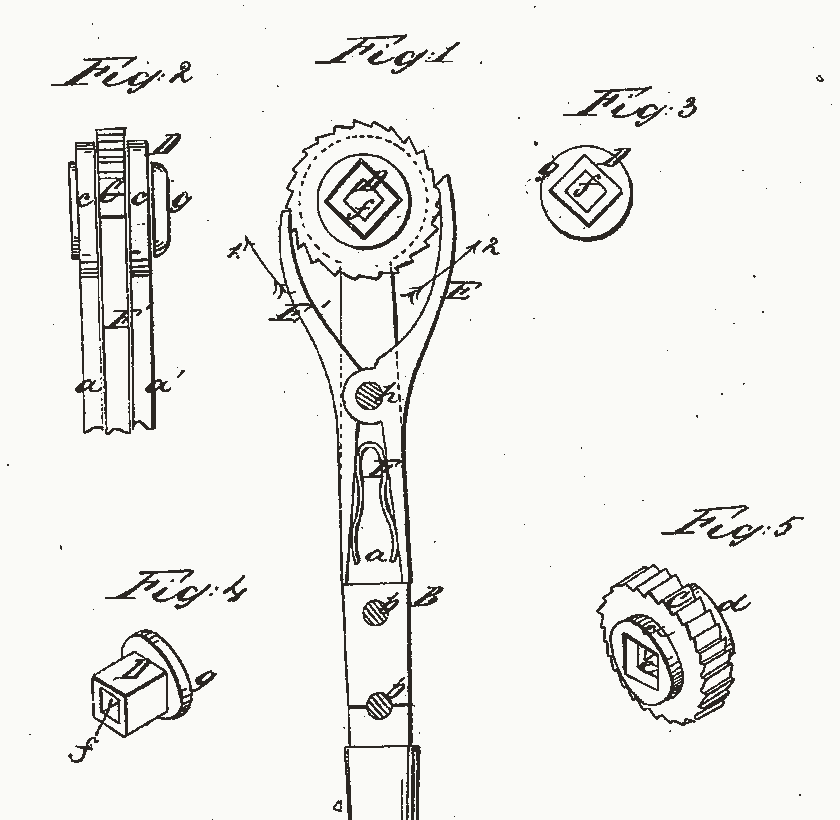
The sockets came off. Richardson made several for one wrench, all the same size outside, with square openings of different sizes for different nuts. One handle served them all. Wikipedia credits him with the ratcheting socket wrench with interchangeable sockets, and says the first picture of it was printed in Scientific American on 16 April 1864.
A pawl need not swing on a pin. In Walter I. Tuttle’s ratchet wrench, patented in 1922, a round pawl slides in a round hole in the handle, and a coiled spring presses it toward the ratchet. A flat on its side keeps it from turning in the hole. Swung one way, the sloping face of its end lets the teeth push it back into its hole. Swung the other way, it jams.
What the drawings leave out
The sizes are the drawing’s own. Hummel’s patent gives no sizes and no tooth count, so the wheel’s 24 teeth, the pawl’s turn of 21.5° between settings, the 48° swing and every length in the first two figures come from the model behind the figures. The wheel’s teeth are drawn as V-shaped gaps with flat tips. The question-mark spring is read from his words.
The drawn spring bends as its end moves, and it passes the hub next to the tooth it presses; how Hummel’s wire gets round from one side to the other is not drawn. The cover plate, the knob and the screws are left off. The nut is not drawn either, and it is taken to hold the wheel still while the handle swings back. No figure shows a socket, and no ratchet was measured or taken apart.
Fig. 3’s handle never moves; only the room changes. Its lengths are the model’s, and its tooth counts, 60, 72 and 84, are those of makers’ ratchets.
Sources
Read in November 2026.
- J. J. Richardson, US Patent 38,914, “Improvement in Wrenches”, 1863: an improved ratchet-wrench. Fig. 4 is from its drawing sheet.
- L. A. Hummel, US Patent 1,854,513, “Reversible ratchet wrench”, 1932, for Snap-on Tools. Its words are the basis of the first two figures.
- W. I. Tuttle, US Patent 1,426,127, “Ratchet wrench”, 1922: a sliding pawl.
- General Services Administration, Federal Specification GGG-W-641E, 16 January 1975, section 3.13.2, and its notice of cancellation, 1998.
- GEARWRENCH, a sheet on its 84-tooth ratchet, 2012.
- CRAFTSMAN, its 72-tooth low-profile ratchet, CMMT86722.
- Snap-on, a release on its F80 ratchet, 9 July 2013.
- Alloy Artifacts, Snap-on’s early reversible ratchets.
- Wikipedia, “Socket wrench” and “Ratchet (device)”.
- Stack Exchange, its site on motor vehicles, “How to measure angle when ratcheting a bolt?”, August 2015. User report.
The type is Playpen Sans by TypeTogether, under the SIL Open Font License 1.1.