Hole punch
Paper for filing goes into a narrow slit under the lever of a desk hole punch, over a plate with a hole beneath each punch. Pressing the lever drives the punches down through the sheets and into those holes. The round pieces they cut out fall through into a box underneath.
A lever over the punches
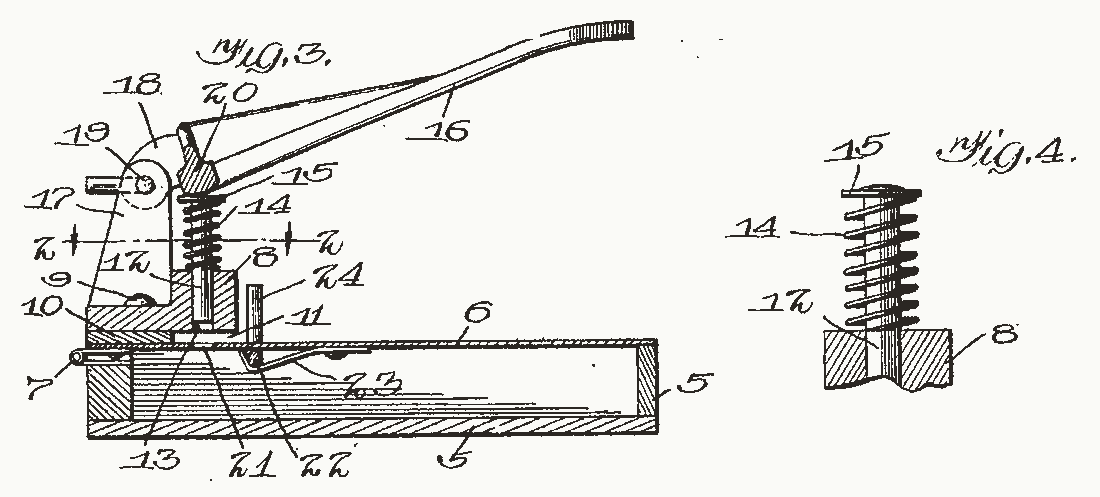
A desk punch stands on a hollow base, with its lever up. Along the back runs a slit just high enough for a stack of paper. Over the slit stands one punch for each hole. Each punch is a short rod. A coil spring under its head holds it up, with the lever resting on the heads. Under the slit lies a plate with a hole below each punch. The base below is a box. It catches what the punches cut out.
Swingline and the old patents also call it a paper punch. Makers give the size of the holes, their spacing and how many sheets go through at once. Leitz’s two-hole office punch makes holes 5.5 mm across and 80 mm apart, through up to 30 sheets of 80 gsm paper, which it also gives as 3 mm. Swingline’s punches make holes 9/32 inch (7.1 mm) across. Its SmartTouch takes 20 sheets, its Precision Pro 10 and its heavy duty punch 40.
Fig. 1 draws one punch in section, after Barrett’s patent, with twenty sheets in the slit. Guess how far the lever’s end comes down before the punch even reaches the top sheet.
What the drawing shows
Down through twenty sheets
The lever’s end comes down 19 mm before the punch touches the paper, since its travel is about eight times the punch’s. The lever’s pin is at the back. The bar under the lever bears on the punch’s head about 17 mm in front of the pin, and your hand pushes about 139 mm in front of it. Those proportions were measured on Barrett’s drawing. In his punch the bar is long, lying over every punch at once, so one press works them all.
The punch moves an eighth as far as your hand, so it pushes about eight times as hard. The ratio grows from 8.2 with the lever up to 9.1 at the bottom, because the lever’s end swings out level while the bar’s touch on the head moves back toward the pin. Suppose you push 30 N straight down on the end. The punch then pushes about 254 N as it starts to cut, less what the spring takes.
The cut starts when the punch’s end meets the top sheet and ends 2 mm lower, at the plate. In Fig. 1 the middle of the stack is pushed down into the hole as the punch goes in. Once the punch’s end reaches the plate, the twenty discs are free, and the punch pushes them out through the plate’s underside. Barrett’s plate has holes that line up with the punches, so that the punchings, as he calls them, drop into the box.
Two edges and a gap
A punch cuts against the edge of a hole. That hole is the die. Course notes on press tools, written for sheet metal, describe the cut in stages. The punch presses into the stock, then cuts a smooth band. Then cracks start at the punch’s edge and the die’s edge and meet, which frees the piece. The notes put punching next to shearing along a straight line between two blades, the cut the Scissors page follows.
The gap between the two edges is the clearance. For sheet metal it is typically 4 to 8% of the stock’s thickness. Too small, and the cracks miss each other and the force grows. Too large, and the stock is pinched between the edges and leaves a burr.
The force to cut is the stock’s shear strength times its thickness times the length of the cut edge. By that rule a hole twice as wide needs twice the force, and so does a stack twice as thick. For stapled packets of over 15 pages, one answer, a user report from Stack Exchange, was to punch five pages at a time. None of the sources gives a shear strength for paper, so the force for Fig. 1’s twenty sheets is not known.
Cutting a little at a time
A flat-ended punch over a flat die meets the whole edge of the hole at once. The press-tool notes say that a flat face makes the punch’s force build up quickly. Setting the punch’s face or the die at an angle controls how much is being cut at any moment.
Glaeser’s patent of 1928 offers two ways to do that in a paper punch. Its die plate may curve down to both sides of the line through the holes’ centres. A flat-ended punch then “will only cut at two points and will then progressively continue” round the hole. Or the punch’s end may have a groove cut through it, so that some points meet the paper before others. Fig. 2 puts one punch over a single sheet on either plate. Guess how much of the edge is being cut at the same moment on the curved plate.
What the drawing shows
On the curved plate, at most 39% of the edge is being cut at the same moment, and through the middle of the cut about a quarter. That share rests on a supposition, that each point of the edge is cut through while the punch moves one sheet’s thickness past it. The punch then travels 0.4 mm from first touch to a hole cut all round, where the flat plate takes 0.1 mm. By the notes’ rule the force goes with the length of edge being cut, so the curved plate asks for a smaller push over a longer stroke.
Up again, and where the discs go
Each of Barrett’s punches has its own coil spring, which holds it up with the lever’s bar resting on its head. Let go, and the springs lift the punches. The punches lift the lever. Glaeser wrote that punches before his had a helical spring on each. His own punch holds two punches on the ends of one leaf spring, which also brings them back up. A leaf spring bent one way, he added, can be turned over and used again.
For sheet metal, the notes on press tools say that once a punch has cut its way through, the stock closes round it, and it takes a real force to pull the punch back out. In Fig. 1 the punch-block’s underside lies just above the slit, as in Barrett’s, so the sheets cannot rise far with the punch. In the box the discs pack down, and one Reddit user found that a three-hole punch machine had compressed them “to look like geological strata” (a user report). Swingline calls the box a chip tray, and on its SmartTouch punch a pattern of holes in the base shows when the tray is full. Leitz’s punch has a hinged waste box.
Where the holes land
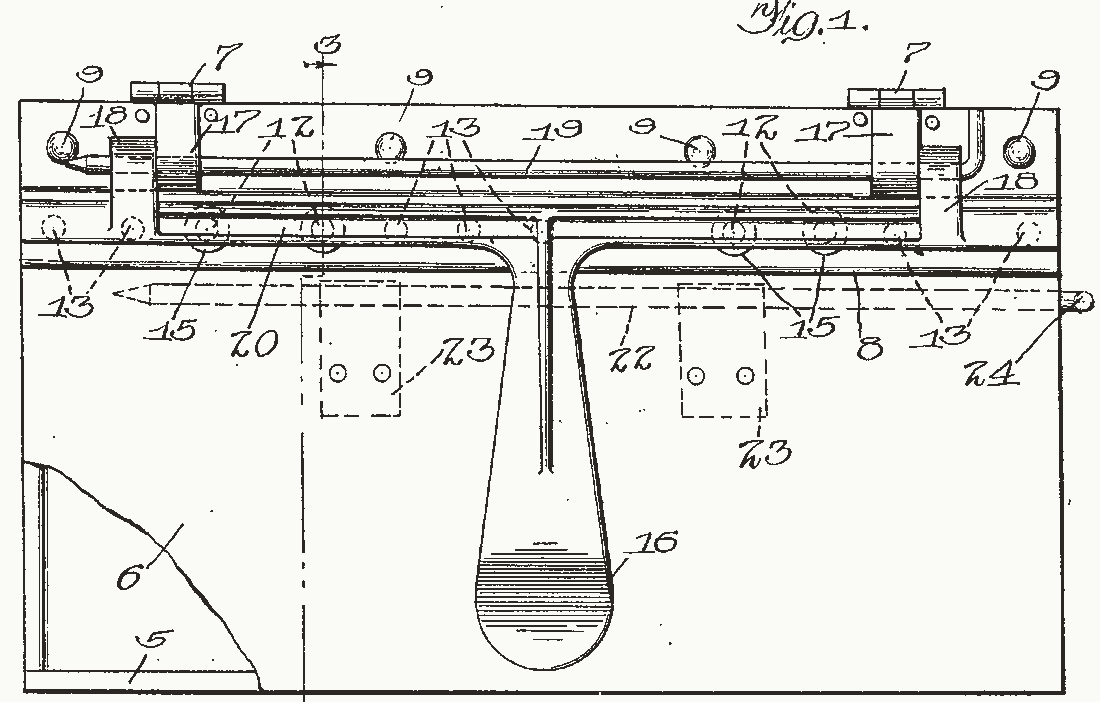
The punches fix how far apart the holes are, and the slit and the guide fix where the paper lies under them. In Barrett’s punch a strip fills the back of the slit under the punch-block, so the sheets go in only as far as the strip. A gage-rod runs along the underside of the cover-plate, held against it by two springy clips, and its up-turned end stands beside the sheets’ side edge. You slide the rod along to set the end for sheets of different sizes (Fig. 3). Glaeser’s punch has a gage at the back of its die plate’s opening that sets how far the sheet goes in.
One Reddit user, in a user report, could tell from a binder which part of the year an intern who could not use a three-hole punch properly had done the punching. Leitz marks paper sizes on its punch, and it also has a guide bar. Swingline’s SmartTouch has an edge guide and a paper guide that pulls out from 8.5 to 11 inches.
A punch for temporary binders
Arthur M. Barrett of Chicago filed his application on 25 September 1907 and received the patent on 12 January 1909, assigned to John R. Barrett. He wrote it for sheets that go into temporary binders. Their posts or prongs stand at different places in different makes, so a sheet punched for one binder would rarely fit another. So he made the punch adjustable.
His punch-block has a row of holes, and you put punches only in the holes a binder needs, after taking the lever off by pulling out its hinged pin. In his example, the first three holes at one end are 5/16 inch apart, centre to centre, and the rest 1/4 inch. In this way, he wrote, the holes can be set at any distance apart from 13/16 inch upward, by sixteenths. Fig. 4 is the section that Fig. 1 follows.
Ado Glaeser of Woodhaven, New York, applied on 31 July 1925 and was granted his patent on 16 October 1928. Glaeser wanted a compact punch. Earlier punches, he wrote, had a comparatively long lever. His handle is a round striking plate, pivoted on a T-shaped standard over the punches, that the hand presses straight down. Its centre lies behind the front edge of the base, so pressing it cannot tip the punch over, and a stop on the handle keeps the punches from falling out.
What the drawings leave out
The sizes are the drawing’s own. Fig. 1’s proportions come from Barrett’s Fig. 3, with the punch drawn 6 mm across, and each sheet is 0.1 mm thick, Leitz’s 3 mm for 30 sheets. Glaeser gives no curve for his plate, so the radius of 15 mm in Fig. 2 is a guess, and the gap between punch and die is 0.15 mm a side. The shares of the edge in Fig. 2 rest on the supposition above.
Fig. 1 shows one punch where Barrett’s has a row, and no gage-rod. Barrett gives no stop for the lever. So the stroke ends with the punch’s end 1 mm below the plate. The lever’s ratio leaves out the spring and friction. The twenty discs are cut and fall as one piece, which real sheets need not do. Fig. 2 has one sheet where a desk punch takes a stack, and no lever.
Sources
Read in November 2026.
- A. M. Barrett, US Patent 909,739, “Paper-punch”, 12 January 1909, with Figs. 1, 3 and 4 of its drawing sheet.
- A. Glaeser, US Patent 1,687,758, “Paper punch”, 16 October 1928: the striking plate, the leaf spring and the curved die plate.
- Leitz, “Leitz NeXXt WOW Metal Office Hole Punch”: its holes, capacity, guide bar and waste box.
- Swingline, SmartTouch 2-hole punch, Precision Pro desktop punch and heavy duty punch: hole size, sheets and chip tray.
- Bong-Kee Lee, Chonnam National University, “Sheet Metal Forming” and “Press Die Design (Blanking and Punching Dies)”, course notes in Mold Design (2013): the cut, the clearance, the force and the punch’s face.
- Stack Exchange, its site for life hacks, “Hole Punching Thick Packets”, February 2017, and its answers. User report.
- r/mildlyinteresting, “3 Hole punch machine compressed the holes to look like geological strata”, April 2019, via the Arctic Shift archive. User report.
- r/mildlyinteresting, “You can tell exactly what part of the year I had an intern who couldn’t properly use a three-hole-punch for my binder.”, October 2019, via the Arctic Shift archive. User report.
The type is Playpen Sans by TypeTogether, under the SIL Open Font License 1.1.