Stapler
One press of a desk stapler drives the front staple of a glued strip through the paper. Under the paper, a small grooved plate called the anvil folds its two legs. Turn the anvil round, and the legs fold the other way.
A strip of staples
A strip of desk staples is a row of steel wires, laid side by side, glued together and bent into a long channel. A stapler breaks them off its front end one at a time. A full strip holds 210. Swingline’s S.F. 4 staples, sold for full-size staplers such as its 747, come in full strips, with a crown 1/2 inch (12.7 mm) wide and legs 1/4 inch (6.35 mm) long. The crown is the flat top of a staple, and the legs are its two sides.
A patent filed in 1932 by Rudolph E. Zeruneith of Camden, New Jersey, describes one way of making such strips. Wire runs off 210 reels at once, the wires are drawn together into a flat band, and a roller wets one side of the band with a glue that sets fast. One stroke of a press then cuts the band and bends it into 210 staples stuck together, which the patent calls “frozen” staples. The glue goes on the side that ends up inside the strip.
One press
The front staple of the strip sits in a slot at the nose of the magazine, the channel that holds the strip, with a flat blade above it. When you press the stapler, the head and the anvil first pinch the papers between them. Then the blade goes on down the slot. It pushes on the crown of the front staple, breaks it off the strip and drives both legs through the paper.
Under the paper lies the anvil, a small metal plate with a groove under each leg. It folds the legs. Before you drag the blade down in Fig. 1, guess where on each leg the bend will start.
What the drawing shows
Each leg bends just below the paper. By then its tip has met the floor of the groove, which in the drawing is deepest under the leg and rises toward the middle. So the tip slides inward, and the rest of the leg follows it round. By the time the crown reaches the paper, both legs lie folded under the stack, and in the drawing their tips end 2.8 mm apart.
The stack in Fig. 1 is ten sheets of ordinary 20 lb copy paper, each 0.097 mm thick, so a little under 1 mm of each leg is spent getting through. A thicker stack uses up more of each leg. Twenty-five sheets, the most Swingline gives for its 747 Half Strip stapler, take 2.4 mm of a 6.35 mm leg.
Turning the anvil
On many desk staplers the anvil turns through 180°, and on others it slides to a second position. Swingline’s 747 has a knob on its underside for the turn, and Fellowes tells owners of its LX820 to rotate the anvil. Either way, a second pair of grooves comes under the blade.
The anvil in Fig. 2 can turn on its pivot. Turn it, and before you press, guess which way the legs will go.
What the drawing shows
The second grooves fold the legs outward, away from each other, so the staple ends up almost straight. Swingline and Fellowes both call this pinning, and they describe it as a temporary staple that is easier to remove.
At least seven posts on Reddit’s Explain Like I’m Five forum have asked what that other side of the anvil is for. The replies that collected the most votes are users’ reports. They say what the makers say. One compares a pinned staple to a paper clip, “but less likely for the pages to fall out”. Another writer’s office pins the forms that new staff fill in, so that the sheets can be taken apart and filed later. A pinned staple also holds the papers more weakly than one folded inward.
The next staple
Behind the strip, a spring keeps a pusher pressed against its last staple, so the whole strip leans forward on the blade. Elwood H. Michener described the same arrangement in a patent of 1923, for a machine that drives staples into packing boxes and crates. In his, a spring pulls a follower along the magazine and presses the row of staples against the driver. Before you press in Fig. 3, guess what moves when you let go.
What the drawing shows
Nothing in the strip moves on the way down. While the blade is in the slot, the next staple rests against its back. When the blade rises above the crowns, the spring moves the whole strip forward by one staple, and the next one slides in under the blade. In Michener’s words, when the driver is raised “the foremost staple of the row will be pressed into the channel”. After the last staple has gone, the blade comes down through an empty slot and nothing comes out.
Heyl’s press of 1877
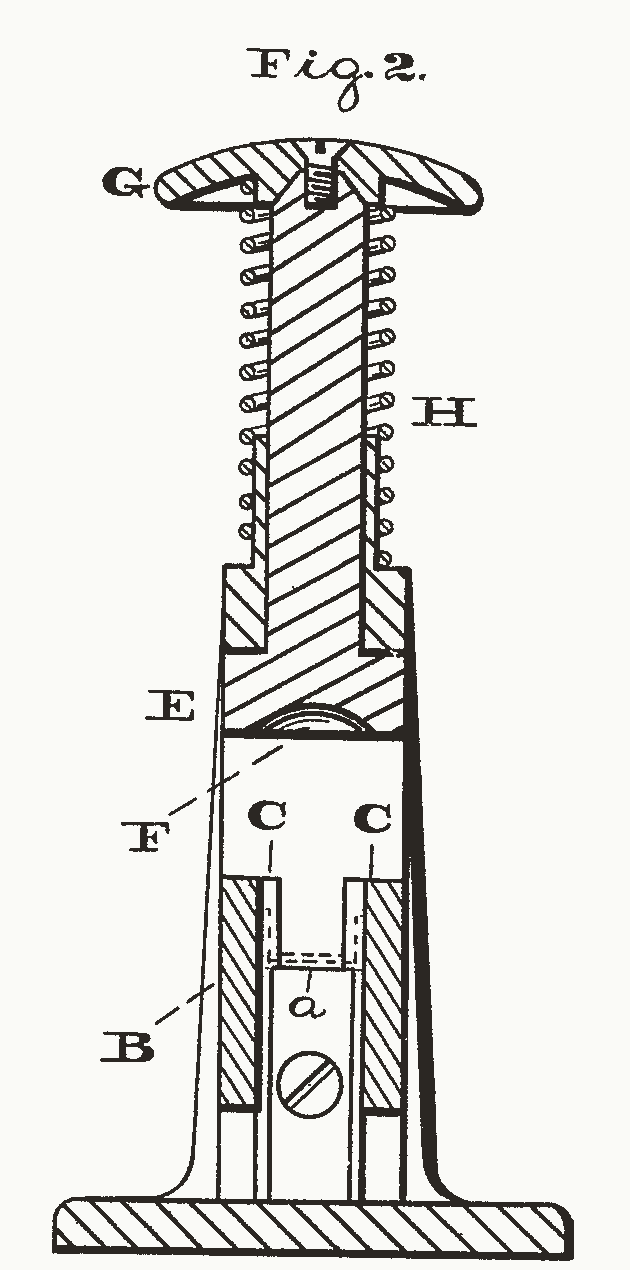
Who made the first stapler is argued over, and by Wikipedia’s account the claims go back to 1841. One of them is US Patent 195,603, granted on 25 September 1877 to Henry R. Heyl of Philadelphia. Wikipedia calls it the first machine to both insert and clinch a staple in one step, and says some count Heyl as the inventor of the modern stapler for that reason. The patent itself describes two blows.
Heyl’s press works upside down. The staple stands in two grooves with its crown on a fixed anvil and its points up, and the papers go on top. A sharp blow of the hand on the knob brings the driver down onto them, and the points come up through the papers into a hollow in the driver’s face, whose slanting walls bend them toward each other. Then you draw the papers a little forward, until the crown rests on the flat top of the guide, and a second blow flattens the legs.
Fig. 4 is his Fig. 2, a cut through the press. At the foot of the same drawing sheet, his Figs. 6 to 8 show a staple open, with its legs bent toward each other, and pressed flat.
What the drawings leave out
The sizes are the drawing’s own. In Figs. 1 and 2 the head already rests on the paper, and the grooves are a likely shape, not one measured from a real anvil. No figure shows the staplers that fold one leg in and one out. Fig. 3 has 6 staples where a full strip has 210, and its spring runs straight to a post at the front, where Michener’s runs forward round a small wheel and back to a lug.
Only the crown, the legs and the ten sheets keep true sizes. The wire is drawn thicker than the 0.405 mm wire of a 26/6 staple.
Many staplers also open for tacking. With the anvil out of the way, the legs go straight into a notice board and stay straight. Answers on Stack Exchange use the same trick to put a staple in the middle of a sheet, out of the stapler’s reach. They open the stapler, press the staple into a pencil eraser or a piece of foam, pull the paper free and fold the legs over by hand.
Sources
Read in November 2026.
- H. R. Heyl, US Patent 195,603, “Improvement in devices for inserting metallic staples”, 25 September 1877, with its drawing sheet. Fig. 4 is his Fig. 2, in the public domain.
- E. H. Michener, US Patent 1,457,446, “Stapling machine for driving wire staples”, 5 June 1923.
- R. E. Zeruneith, US Patent 2,085,780, “Method of making frozen strips of wire staples”, 6 July 1937.
- A. Jairam, US Patent 6,925,849, “Stapler anvil”, assigned to Acco Brands, 9 August 2005.
- Swingline, 747 Half Strip Business Stapler and S.F. 4 Premium Staples, product pages.
- LD Products, Swingline S.F. 4 staples, for the crown width.
- Staples, Swingline 747 Business Stapler, for the knob that turns the anvil.
- Fellowes, “What is tacking and pinning?”, support page.
- Wikipedia, “Stapler” and “Staple (fastener)”.
- Whitaker Brothers, “Paper Weights & Stock Cross Reference”, for the thickness of 20 lb paper.
- r/explainlikeimfive, “ELI5: when would I ever use the flip side of the strike plate on my stapler?”, March 2013, via the Arctic Shift archive. User report.
- r/explainlikeimfive, “ELI5: What is the point of the adjustable piece on the bottom of a stapler?”, December 2016, via the Arctic Shift archive. User report.
- r/explainlikeimfive, “ELI5: What is the practical use of the stapler setting that makes the staple prongs go outwards instead of inwards?”, March 2019, via the Arctic Shift archive. User report.
- Lifehacks Stack Exchange, “How do I staple a few sheets of paper in the middle using a normal stapler?”, July 2016, with the answers by BrettFromLA and Stan. User report.
The type is Playpen Sans by TypeTogether, under the SIL Open Font License 1.1.