Lock
A pin tumbler lock stops its plug from turning with a row of spring-loaded pins of different lengths. The right key lifts each pin to the right height, and the plug turns. The lock drawn here has five stacks of pins, and its key has five cuts.
The key in your hand
A Kwikset house key has five cuts along the top edge of its blade. Locksmiths read the cuts from the bow, the end you hold, toward the tip, and write each one as a number. The number is a depth. Depth 1 is the shallowest and leaves 0.329 inch of metal under the cut; each step deeper takes away another 0.023 inch, so a cut of depth 6 sits 0.115 inch below a cut of depth 1.
The key in Fig. 1 is cut 3-1-4-2-5. With six depths, five cuts allow 7,776 codes on paper, and not all of them are cut. A cut may be at most four steps deeper or shallower than the cut beside it, a limit locksmiths call the MACS, because a steep drop between neighbours would leave the blade too thin at that point. That rule alone leaves 6,306 codes. The key in the figure stays well inside it, with steps of 2, 3, 2 and 3 between neighbouring cuts.
Each cut matches one stack of pins inside the lock. The cuts are 0.150 inch apart, about 3.8 mm. The deepest cut on this key, a 5, leaves 0.237 inch of blade. When the key is all the way in, the cut nearest the bow sits under pin 1 and the cut nearest the tip sits under pin 5.
Inside the lock
If we cut the lock open along its length, as in Fig. 2, we find two main pieces. The outer one is the housing. It has a round hole through it, and in that hole sits the plug, a cylinder that has to turn for the lock to open. The front of the plug has a slot for the key, the keyway. At the back, past the broken edge of the drawing, a cam or lever on the plug pulls back the bolt.
Five holes are drilled through the top of the plug, and five more in the housing sit above them. Each pair of holes holds a stack of three parts: a key pin at the bottom, rounded at its lower end so the key can slide under it, then a driver pin, then a spring that pushes both pins down.
The thin gap between plug and housing is the shear line, the one place where the two pieces can slide past each other. Anything that crosses it holds the plug still.
Guess which part will catch the plug, then press “Try to turn” in Fig. 2.
What the drawing shows
With no key in the lock, the springs push each stack down as far as it will go, and the key pins hang in the empty keyway. That leaves every driver pin reaching across the shear line, partly in the housing and partly in the plug, so it is the five driver pins that catch the plug after the 2° of play the drawing allows.
The right key
The key lifts each stack until the gap between key pin and driver pin sits on the shear line. A shallow cut lifts its key pin high, so that stack gets a short key pin; a deep cut gets a long one. Kwikset key pins run from 0.172 inch for depth 1 to 0.287 inch for depth 6. Each is 0.023 inch longer than the last, the same amount each cut is deeper, so a cut and its key pin always add up to the same height.
Linus Yale Jr. put it this way in his patent of 1865: the key is “a thin slip of steel properly shaped to bring the lines of division between the tumblers into the same line and flush with the periphery of the cylinder”.
Before you push the key in, guess which pin will rise highest.
What the drawing shows
On the way in, every pin rides up over the uncut metal and drops into each cut that passes under it. Pin 1 meets the cuts for pins 5, 4, 3 and 2 before its own arrives. All five gaps line up only at the end of the stroke. The pin that ends highest is pin 2, whose cut is the shallowest; its key pin is also the shortest in the lock, so its top still lands on the shear line.
The wrong key
One step in one cut is enough to stop the lock, and the wrong key in Fig. 4 misses by four steps. It is cut 3-5-4-2-1, so it differs from the right key in two places, and the two mistakes go in opposite directions. Laid side by side, the keys differ by 2.34 mm at two points along the blade.
The wrong key is already all the way in. Work out which pins are out of line before you press “Turn”.
What the drawing shows
Cut 2 is four steps too deep, so its key pin sits 2.34 mm below the shear line and the driver pin above it reaches down into the plug. Cut 5 is four steps too shallow and pushes its key pin 2.34 mm up past the shear line, into the housing. Either mistake alone would hold the plug. Choose the right key and watch the same two pins: pin 2 rises four steps and pin 5 drops four.
So a pin lifted too far blocks the lock as surely as a pin not lifted far enough. In the oldest pin locks, lifting too far did no harm.
Why the key stays in while it is turned
Choose the right key in Fig. 4, turn it, and then try to pull it out. It will not come. Once the plug has turned, its holes no longer sit under the holes in the housing. The springs press the driver pins onto the curved surface of the plug, and each key pin is shut in under solid metal. To come out, the key would have to push its key pins up, and they have nowhere to go.
Yale wrote this into his 1865 patent: “the key in pin-locks cannot be removed, except when both parts of the pins or tumblers are in line.” He added stops so the plug always comes to rest where the pins line up, and the key can go in or out.
Older than Yale
The principle of the pin lock may go back to Egypt around 2000 BC, in locks made of wood. A bolt slid sideways into a post fixed to the door, pins dropped into holes in the bolt to hold it, and a wooden key lifted the pins so the bolt could move.
An early tumbler lock was also found in the ruins of the palace at Khorsabad, in northern Iraq, the capital built for the Assyrian king Sargon II. That lock is often called about 4,000 years old. The city was built in the decade before 706 BC, though, so a lock from its palace is about 2,700 years old; 4,000 years is the age of the Egyptian date.
The wooden locks had a weak point. Anyone who lifted every pin higher than needed could still slide the bolt. In 1805 an American physician, Abraham O. Stansbury, was granted an English patent for a double-acting pin tumbler lock, in which lifting the pins too much or too little kept it shut. A US patent followed two years later. Pin 5 in Fig. 4 shows his idea at work.
Stansbury drew on the Egyptian locks and on the lock of Joseph Bramah, who patented his design in 1784 and opened a shop at 124 Piccadilly, London, the same year. From 1790 a “challenge lock” in the shop window promised 200 guineas to anyone who could pick or open it. It held until 1851, the year of the Great Exhibition, when the American locksmith Alfred Charles Hobbs opened it after about 51 hours spread over 16 days. After some argument, he was paid. The lock is now in the Science Museum in London.
Linus Yale Jr. was born in 1821. As a young man he painted portraits, and about 1850 he turned to helping his father, Linus Yale Sr., whose shop in Newport, New York, made bank locks. On 27 June 1865 he was granted US Patent 48,475 for improvements “chiefly applicable in that class of tumbler-locks known as pin-locks” (Fig. 5). Its pins come in two pieces of different lengths, each stack with its own spring, and the key must bring every line of division into one line before the cylinder can turn. He also cut notches into the pins and their holes to make the lock harder to pick.
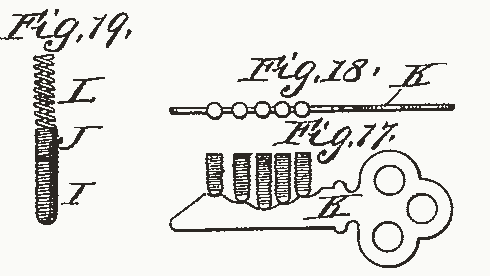
In 1868 Yale and Henry R. Towne founded the Yale Lock Manufacturing Company in Stamford, Connecticut. Yale died on 25 December that year, at 47.
What the drawings leave out
Some parts are drawn larger or simpler than they are. The gap at the shear line is far wider than in a real lock, so that you can see it. The cut spacing, cut depths and key pin lengths follow Kwikset sizes from suppliers and key-cutting tools, but the sizes of the plug, the driver pins, the springs and the bow are guesses. The cuts have flat floors and straight 45° sides, and the keyway leaves out the ledges that stop real key pins from dropping into it.
Real locks also hold parts the drawings omit. Spool pins have a narrow waist, like a cotton spool, and can make a lock picker think a pin is set when it still blocks the shear line. In a master-keyed lock some stacks hold a third pin, a spacer, between the driver pin and the key pin. Such a stack has two shear points, so two different keys open the lock.
Sources
Read in November 2026.
- Wikipedia, “Pin tumbler lock”.
- Wikipedia, “Linus Yale Jr.”.
- L. Yale Jr., US Patent 48,475, “Improvement in locks”, 27 June 1865, text and drawing sheet at Google Patents. Fig. 5 is cropped from its drawing sheet. Public domain.
- Wikipedia, “Dur-Sharrukin”.
- Wikipedia, “Bramah lock”.
- Encyclopedia.com, “Lock and Key”, and ScienceABC, “How Do Pin Tumbler Locks Work?”.
- Premium Hardware, Kwikset KW1 key-in cylinder, for pin lengths, depths, spacing and the MACS.
- CLK Supplies, “A Locksmith’s Guide” to space and depth keys, for the number of cuts, a seventh depth and what the MACS is for.
- B. Graydon, keyspace, “Common lock specs”, for Kwikset depths and the MACS.
- E. Van Albert, keygen, kwikset.scad, for cut spacing and depths.
The type is Playpen Sans by TypeTogether, under the SIL Open Font License 1.1.