Music box
Short steel pins stand out from the brass cylinder of a music box, and each one plucks a tooth of a steel comb as the cylinder turns. Every tooth sounds one note. Which tooth a pin plucks depends on where it sits along the cylinder, and when it plucks depends on where it sits around it.
Comb and cylinder
A music box movement is built on a brass bedplate, which holds everything and, because it carries sound, adds to the box’s resonance. On it sit the comb, a row of steel teeth tuned to a scale, and the cylinder, a brass drum fitted with steel pins. A spring inside a barrel, wound with a key, turns the cylinder. A governor sets how fast the spring may unwind. Reuge’s combs typically have 36, 72 or 144 teeth.
In December 2018 a parent put the question to r/explainlikeimfive, a Reddit forum, because their five-year-old had asked how a music box works and they found they had no idea. The reply with the most votes calls the comb a row of tiny tuning forks. That picture comes from a user, and the physics bears it out. Each prong of a tuning fork is a bar fixed at one end and free at the other, and a comb tooth is held the same way, fixed at its root and free at its tip.
A pin lifts a tooth
As the cylinder turns, a pin comes up under the tip of its tooth and lifts it, bending the whole tooth a little. The tip rides up until it slides off the end of the pin. Then the tooth springs back and swings up and down on its own. The earliest combs were played this way, the pins plucking the teeth directly, where musical clocks had used hammers on bells.
Fig. 1 cuts across one tooth and the cylinder under it. Before you turn the cylinder, guess when the tooth starts to sound: while the pin lifts it, or after the pin lets go.
What the drawing shows
It sounds after the pin lets go. While the pin holds the tip, the tooth is bent and cannot swing. Sound comes from that swinging. Touch a ringing string or bell with a finger, and the sound stops at the moment the vibration is damped. So the note starts when the tip slips free, and it fades as the swinging dies away.
Each pin plucks once. In the drawing the first pin touches the long tooth about 12° into the turn, and by the time it lets go, at 30°, it has lifted the tip 0.9 mm. The second pin in the same ring will pluck the same tooth again, later in the tune.
Long, short and thin teeth
One rule sets each tooth’s note. For a bar of one material fixed at one end, the frequency, how many times it swings in a second, rises with the bar’s thickness in the direction it bends and falls with the square of its length. An octave higher means twice the frequency, as a string stopped half way along shows. So a tooth half as long rings four times as fast, two octaves higher. A tooth half as thick rings an octave lower.
Pick the other teeth in Fig. 1 and turn the cylinder again. For steel, a plain tooth 20 mm long and 0.5 mm thick rings about 1,060 times a second. The short tooth, 10 mm long, rings about 4,230 times, and the short thin one about 2,110. The long tooth sounds lowest. Those numbers belong to the drawing’s plain bars. Real teeth carry weights and are ground to pitch.
Makers shift a tooth’s note after it is cut. A tuning fork’s pitch rises when the ends of its prongs are filed, and falls when metal is filed near the base or the ends are loaded with wax. Comb makers fix lead weights under the teeth, mostly in the bass, which make them vibrate more slowly. Reuge pours Zamak, an alloy of zinc, aluminium, magnesium and copper, under chosen teeth and saws the lump apart. Then a machine rings each tooth and compares it with the note wanted, and a grinding wheel takes metal off until the two match.
Pins for a tune
Each tooth has its own ring of pins round the cylinder. Reuge drills a small hole wherever the arranger’s score puts a note, pushes a fine steel wire into each hole, cuts it off, and trims all the pins to one height. A cylinder for a 72-note comb can carry more than 1,200 pins. Some of Reuge’s movements shift the cylinder sideways after each turn, so that another set of pins meets the teeth, and a 72-note comb can play up to three tunes.
Fig. 2 looks down on a comb of eight teeth, tuned from C up to the next C, over a cylinder pinned for the first two lines of “Twinkle, Twinkle, Little Star”. Its melody is French and was first published in 1761. Guess how many pins one turn needs for those two lines, before turning the crank.
What the drawing shows
It needs 14. The two lines last 16 beats, but the last note of each line is held for two beats, and the beat after it has no pin. On this cylinder the beats are 22.5° apart. These lines never use B or the top C. Those two teeth get no pins. A reply on Reddit adds that a music box can play chords, since every note has a tooth of its own. Two pins side by side pluck two teeth at once.
Dampers
A pin can arrive at a tooth that is still ringing from the pin before. Makers fit dampers for this. A damper is a fine quill or wire under the tip of a tooth, and Reuge glues damping feathers under its bass teeth, to stop unwanted vibration with too metallic a ring.
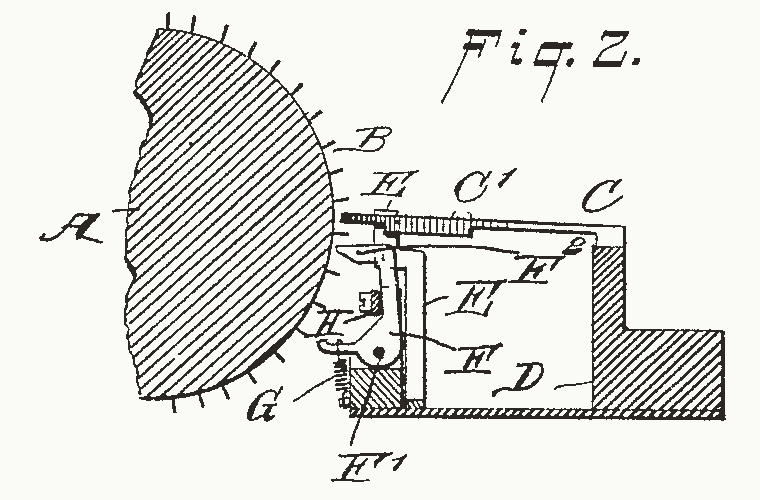
In 1894 William H. Hoschke of Brooklyn, New York, patented a damper worked by the pins themselves (Fig. 3). Each pin first pushes a small lever, and the lever lets a spring arm press on the side of the tooth. The tooth stops. Then the arm springs away again, before the same pin plucks the tooth. Every tooth gets its own arm and lever. Hoschke wanted each tooth to sound “to its full extent and without having any vibrations left from the action of the previous pin”. In his drawing the cylinder is on the left and the comb on the right, the other way round from Fig. 1.
A steady speed
In Fig. 2 your hand sets the pace. A spring left to itself would spin the cylinder far too fast. Emile Cuendet of Hoboken, New Jersey, described the usual answer in his patent of 1887. A gear on the cylinder’s shaft drives a train of gear wheels, and the last of them carries a fan that regulates the speed of the cylinder. It is called a fan-fly governor. Striking clocks use the same part, called the fly, a flat blade on the fastest shaft. It beats the air, and the air’s drag holds back the whole train.
Drag grows with speed. The fan settles at the speed where its drag balances the spring’s push, so a weaker push slows it only a little. If the drag goes with the square of the speed, a push weaker by a quarter slows the cylinder by about 13%. If it goes with the speed itself, by 25%.
Cuendet’s patent deals with failure. If a wheel of that train broke or came loose while the spring was wound, the spring would turn the cylinder fast enough to break or bend the pins and the teeth of the comb. His safety check is a weighted pawl that catches a ratchet on the cylinder when it speeds up. A second reply in the 2018 thread mentions another stop, which holds the drum while the lid is shut, so that lifting the lid lets it play.
Favre’s comb
Pinned barrels played tunes on bells long before there were combs. In 1598 Nicholas Vallin made a wall clock with such a barrel and a set of tuned bells. Museum Speelklok dates the history of the musical box from 1796, when Antoine Favre of Geneva registered his “carillon without hammers and bells”. Favre, also known as Favre-Salomon, replaced the stack of bells with a comb of tuned metal notes to save space, and built it into a pocket watch. Wikipedia, though, lists an earlier watch, made in 1772 by one Ransonet at Nancy, whose pinned drum played on tuned steel prongs standing upright.
Early movements went into clocks, watches, snuffboxes and sewing boxes. From about 1815 the cylinder box became more and more an instrument in its own right. Toward the end of the 19th century a tin disc could take the cylinder’s place. The success of disc boxes ended around 1910, with the gramophone and the radio.
What the drawings leave out
The sizes are the drawing’s own. So is the pin’s lift, and none was measured from a box. The teeth are plain bars, while real bass teeth carry weights. Fig. 1 gives its tooth two pins, where Reuge’s 1,200 pins for 72 teeth come to about 17 a tooth. Fig. 2 has eight teeth where Reuge’s combs typically have 36 or more. Its crank is fixed straight to the cylinder, and whether small crank boxes turn the cylinder through gears was not checked. The sound is one plain tone for each note, and “Play one turn” keeps a pace of two beats a second, which no source gives. Neither drawing shows the spring, the gears or the fan.
The drawings also leave out the box. In 2021 a Reddit user asked why a crank movement sounds faint held in the hand and louder set on a table or in a wooden box. The brass bedplate carries sound and adds to the box’s resonance, and tuning forks were once supplied with resonance cases, which greatly increase their volume.
Sources
Read in November 2026.
- Museum Speelklok, “Musical boxes”: Favre’s registration of 1796, the earliest combs, and disc boxes.
- Reuge, “Mechanical Music Movement”: the parts of a movement, pinning, tuning, Zamak and damping feathers.
- Musical Box Society International, glossary entries “tuning weights”, “damper”, “governor” and “comb”.
- J. W. Strutt, Baron Rayleigh, “The Theory of Sound”, volume 1 (Macmillan, 1877), sections 2, 57, 58, 124, 126, 171 and 182: the rule for a bar’s pitch, the figures for steel, and tuning forks.
- W. H. Hoschke, US Patent 531,036, “Damper attachment for Swiss music-boxes”, 18 December 1894: its words, and its Fig. 2 for Fig. 3.
- E. Cuendet, US Patent 363,451, “Safety-check for music-boxes”, 24 May 1887: the fan and the runaway cylinder.
- Wikipedia: “Music box”, “Antoine Favre-Salomon”, “Striking clock”, “Drag (physics)” and “Twinkle, Twinkle, Little Star”.
- r/explainlikeimfive, “ELI5: How does a music box work? (My 5 year old just asked me, and I realized I actually have no idea)”, December 2018, via the Arctic Shift archive. User report.
- r/explainlikeimfive, “ELI5: Why does a music box (the crank, cylinder, and teeth part) sound quiet when it is played while holding it in your hand …”, March 2021, via the Arctic Shift archive. User report.
- r/explainlikeimfive, “ELI5: How do music-box makers simplify tunes so effectively …”, February 2017, via the Arctic Shift archive. User report.
The type is Playpen Sans by TypeTogether, under the SIL Open Font License 1.1.