Locking pliers
Jaws of a pair of locking pliers, closed once on a bolt or a bar, keep their hold after your hand lets go. A link between the handles holds the jaws shut until you open them again.
A handle on each jaw
Locking pliers, also called Vise-Grips or Mole grips, look like plain pliers with a screw in the end of one handle. One handle runs straight back from the fixed jaw. The other jaw swings on a pin in the fixed one. The second handle is pinned to a short arm at the back of this movable jaw, so closing the handles turns the jaw shut. The parts here have the names Harold T. Jones gives them in his patent, whose words Figs. 1 and 2 follow.
Both handles are channels, U-shaped in section, facing each other. Inside them lies what Jones calls the toggle lever. This page calls it the link. One end of the link is pinned in the moving handle. The other is pinned to the tip of an adjusting screw, which runs lengthwise into the back of the fixed handle. A coiled spring, hooked to the fixed handle and to a lug on the movable jaw, pulls the jaws open. Jones also lays a release lever in the moving handle, and a foot on the link rests on it.
IRWIN sells these pliers as Vise-Grip. Its catalogue names the same screw a “hex key adjusting screw”, one that “tightens to draw material closer together for tighter grip”. Fig. 1 shows each of these parts from the side.
Squeezing past the line
Jones explains the lock with one straight line. It runs through the handle’s pin on the jaw and the link’s pin on the screw. Fig. 1 draws it dashed. The link’s other pin, in the handle, starts off to one side of that line. As the handles close, that pin swings toward it. The handle’s arm and the link then reach further between the two outer pins. So they push the jaw’s pin away from the screw, and the jaws close. Jones wrote that the lever “will straighten out through a line” through the three pins “to thereby develop an enormous pressure on the grip”.
The pliers in Fig. 1 hold a round bar 20 mm across. Their screw is set so the jaws would close to 19.5 mm if nothing gave. Before you drag the handle up, guess whether the jaws squeeze the bar hardest with the link on the line or past it.
What the drawing shows
The squeeze is greatest with the link on the line, where the bar must give 0.5 mm. Push on, and the link’s pin crosses the line until its foot comes down on the release lever, 3° past the line in this drawing. The bar then gives only 0.3 mm, since past the line the two arms reach a little less far. Now the bar’s push turns the link further over, onto its stop, so the pliers stay shut when you let go. Jones gave the foot a length that lets the pin “just pass the center line”. Let go short of the line and the spring opens the jaws.
How hard the jaws press depends on how near the link is to the line. With no part giving and no friction, a push at the handle’s end in Fig. 1 presses the jaws about 5 times as hard with the link 13° short of the line. At 5° it is about 14 times, and at 1° about 70.
Setting the screw
Petersen’s patent of 1924 gives the screw the same job. Moving it in or out, he wrote, shifts the end the link pushes against, so the jaws can be set “in accordance with the work”. The screw is set so the jaws would close a little smaller than the thing they grip. On DIY Stack Exchange, one answer, a user report, said to squeeze until you feel the “click” as the toggle goes over, and warned that with the screw too tight or too loose it “cannot latch”. Set too loose, the link crosses the line before the jaws reach the work.
Fig. 2 locks the same pliers on nothing and lets you turn the screw. No source gives the thread’s pitch. The readout gives instead how far the screw’s tip sits inside the handle’s end. Guess how far the locked jaws open for each millimetre the screw comes out.
What the drawing shows
Each millimetre the screw comes out opens the locked jaws by about 0.9 mm, a little more near the end of its travel. All the way along, the locked jaws stand 0.2 to 0.26 mm wider than when the link crossed the line. Petersen wrote that the screw could also be turned with the pliers locked, to force the jaw further onto the work.
Undoing the lock
Petersen’s patent has no release lever. Without one, the handles have to be pulled apart by hand to open the jaws, and a tight grip could be hard to undo, sometimes needing both hands. By 1957 Petersen’s pliers had a small release lever inside the lower handle, the one in Jones’s patent.
Jones’s lever lies in the moving handle, under the link’s foot. Pull up or press down on its outer end, he wrote, and it forces the handle away from the foot, carrying the pin “back over the center line”. The spring and the work’s push then open the jaws at once. In Fig. 1 the lever turns 2.9° to bring the link from its stop to 1° short of the line, and its end rises 7.3 mm. Channellock says the long release lever on its locking pliers “prevents finger pinch”. IRWIN’s Fast Release pliers have no trigger. Its catalogue calls theirs “a one handed, triggerless release”.
Petersen’s wrench
William Petersen of De Witt, Nebraska, applied for his patent on 5 January 1923. It was granted on 8 April 1924, with half of it assigned to Jules A. Sire of the same town. He called the tool a wrench. He wrote that it could be used “with equal facility as pliers”, and much as a ratchet wrench or a pipe wrench. Fig. 3 is his lengthwise section through it.
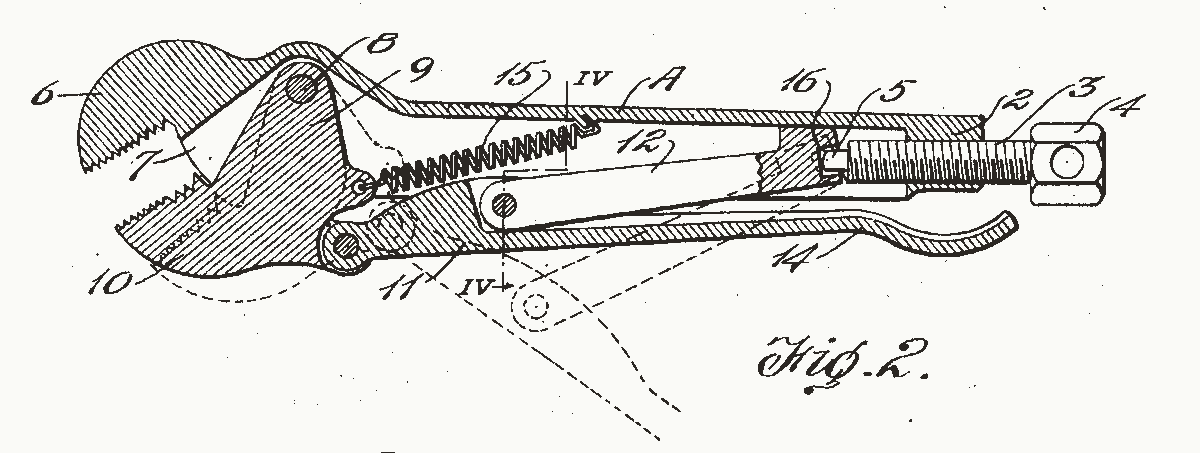
His parts are those of Fig. 1 under other names. Handle A is a channel with a closed end, and a shank 3 with a head 4 is threaded through it. A pocket 16 in the end of section 12 takes the shank’s point. Section 11 is pinned to the movable jaw 10 and drawn out into the operating handle 14, and spring 15 opens the jaw. Petersen wrote that it had been “fully demonstrated in practice” that the tool holds work “with the grip of a vise”, above all once it is “beyond center”.
IRWIN’s catalogue says the Vise-Grip was invented in 1924 by William Petersen, a Danish immigrant and blacksmith, who first sold them from the back of his car to farmers. Alloy Artifacts says his first patent, of 1921, lacked the strut that passes its centre. The firm, it says, began about 1923 as the Sire & Petersen Wrench Company. In 1944 Harold T. Jones of Vallejo, California, applied to patent a “locking wrench and pliers”, granted in 1950. Its general build, he wrote, follows a patent Petersen was granted in 1942. By Wikipedia’s account, M. K. Mole and Son began making nearly identical pliers in Britain in 1955.
What the drawings leave out
The sizes are the drawing’s own. Neither patent gives a single length, and IRWIN gives none for the parts inside its pliers. The drawn pliers are about 270 mm long, near IRWIN’s 10R at 250 mm. They lock no wider than 28 mm, though, where IRWIN gives the 10R’s capacity as 48 mm. Jones gives no angle for the stop either, and 3° is a guess at his “just pass”.
The bar and the steel share the give between them. At this scale it is too small to see, so the jaws are drawn just touching the bar. Friction is left out of the pushes. The handles are drawn flat, with their near sides cut away so the link and the spring show. Jones’s release lever sits on a pin in a slot, which the drawing leaves out, rocking the lever on its front end instead. The teeth are plain saw teeth. IRWIN’s catalogue also lists locking pliers with curved jaws and with long noses, as well as locking C-clamps, while both drawings here show only the plain straight jaw.
Sources
Read in November 2026.
- W. Petersen, US Patent 1,489,458, “Wrench”, 8 April 1924, the scan from the US Patent and Trademark Office. Its first sheet supplies Fig. 3.
- H. T. Jones, US Patent 2,514,130, “Locking wrench and pliers”, 4 July 1950. Figs. 1 and 2 follow its words, not its drawing.
- W. Petersen, US Patent 2,280,005, “Wrench”, 14 April 1942, the wrench Jones built on; and US Patent 1,392,443, “Wrench”, 4 October 1921, his first.
- IRWIN, catalogue of pliers and wrenches, 2012, pages 2 to 5; and the page for a set of Original pliers.
- Channellock, page for its five-inch curved-jaw locking pliers, for the release lever.
- Alloy Artifacts, “Petersen Manufacturing Company”, a collectors’ history, updated May 2026.
- Wikipedia, “Locking pliers”, as of August 2026.
- Home Improvement Stack Exchange, “Fully tighten adjustable wrench locking pliers”, April 2025, and the answer by DrMoishe Pippik. User report.
The type is Playpen Sans by TypeTogether, under the SIL Open Font License 1.1.