Moka pot
Coffee in a moka pot travels upward, from water sealed in the bottom, up a tube, through a bed of ground coffee and out of a column into the top. The air shut in over the water pushes it as it warms, and later the steam does.
Three pieces that screw together
A moka pot comes apart in your hands into three pieces. Bialetti’s leaflet for its pot calls the bottom one the heater. It holds the water and has a safety valve on its side. The funnel filter drops into it. It is a cup for ground coffee, with a tube hanging from its perforated floor almost to the bottom. The upper part screws on top. Under its floor a rubber gasket holds a filter plate, and a column rises up its middle (Fig. 1).
What the drawing shows
The leaflet says to fill the heater with cold water up to the level of the valve, and to fill the funnel without pressing the coffee down. On gas the flame should stay under the rim. Outside Italy the pot is also called a stove-top espresso. In Spain it is a cafetera de rosca or an italiana, and in Portugal a cafeteira italiana. One three-cup pot, measured for a study of how it brews, took 150 g of water. That left 20 mL of air in the heater, with 15 g of coffee in a funnel of 50 mL.
Water that leaves before it boils
Once the pot is shut, the water and the air above it have no way out but the tube. The air outside presses on the coffee from above with about 1.01 bar, counted from empty space. Water climbs the tube only while the air and steam in the heater press harder than that, by enough to lift it and push it through the coffee.
In Fig. 2 a model of the three-cup pot sits on a steady heat, counted in kilojoules (kJ) put into its water. Guess how hot the water in the heater will be when the first coffee spills out of the column.
What the drawing shows
In the model the first coffee spills at 89 °C, with 40 g gone from the heater. Water starts up the tube at once. By 61 °C, 10 g has left. In the measured pot the water was at 69 to 70 °C when the first 10 g had left. Both are far below boiling. Accounts of the pot disagree here. A 2001 article by A. Varlamov and G. Balestrino, and a 2022 page of Bialetti’s, have the water reach 100 °C before its steam drives it up. The study, by L. Navarini and four colleagues, calls that a long-held misbelief. A 1996 patent filed for Bialetti agrees with them, and says warm water passes into the coffee before it is hot enough for a proper brew. In the model the heater presses only 0.09 bar harder than the outside air when the first coffee spills.
Air first, steam later
Two things fill the space over the water. One is the air sealed in at the start. Warmed, it presses harder, as any gas held in a fixed room does. The other is steam, whose pressure grows steeply with the water’s temperature. At 100 °C steam on its own presses at 1.01 bar, no more than the outside air, so below boiling it needs help. The heater’s pressure is split between the two in Fig. 3. Before you try it, guess which of them presses harder at 70 °C.
What the drawing shows
At 70 °C the air gives 0.71 bar and the steam only 0.31 bar. The air’s share falls as the water leaves, because every gram gone hands the air more room. The steam passes it at 83 °C, after 29 g. By the end the air gives 0.19 bar of the 2.09. Worked out from readings in a real pot, the two parts add up to the pressure measured there. With 120 g of water there is 50 mL of air. Then the first 10 g leaves by 47 °C, and the brew ends at 106 °C after 90 g. The 150 g heater finishes 13 °C hotter, so it pushes up more. At one final temperature, the amount pushed up rises in proportion to the air sealed in, so a fuller heater gives less.
Through the bed of coffee
The coffee sits in the funnel as a bed about 21 mm deep. Water rising from the tube first fills the gaps between the grains, and in the measured pot about 40 g had flowed before the first drop reached the top. Until then the heater’s pressure hardly rose above the outside air. Once water runs through the bed, pushing it takes pressure. By Darcy’s law the push grows with the flow and with the depth of the bed. Twice the flow needs twice the push. The model uses the same law, over a bed of 23.8 square centimetres, the funnel’s volume over its depth.
The bed also tightens as it soaks. The grains swell and settle, and the bed’s permeability, its ease of letting water through, fell during each measured brew. Navarini’s team give 70 to 400 millidarcy, more than ten times lower than the 2,300 that Concetto Gianino worked out in 2007 from a simpler balance. With the flow quickening and the bed closing up, the heater’s pressure climbed to about 2 bar. The water under it reached 117 to 121 °C. The coffee coming out of the bed was cooler, from about 62 °C at first to 96 or 98 °C at the end.
Finer or pressed coffee makes the bed harder to pass, and the pressure has to rise further. On Coffee Stack Exchange, a top answer said never to tamp the coffee because of the pressure, while another said years of tamping had never set off the valve. Both are user reports. Bialetti’s leaflet says not to use coffee ground for espresso machines.
The valve on the side
The safety valve is a small body on the heater’s side, with a piston sticking out. It is for when water cannot get through the bed. Bialetti’s page on the valve gives three reasons this can happen: coffee ground too fine, coffee pressed into the filter, or a heat source that is too hot. The pressure in the heater then climbs quickly, and the valve has to open and let steam out. Used as the leaflet says, the valve should never open. Neither the leaflet nor the page says at what pressure it does.
The valve also marks how much water to pour in, and the page says its place on the heater was chosen for that. The page puts the water just below the valve, and the leaflet up to its level. If the water covers it, the page warns, the valve may not work. In Fig. 2 it sits just below the funnel’s floor, with the water up to its lower edge. Bialetti’s leaflet tells you to fill the heater only up to the valve and warns that lime scale can block its hole.
The gurgle at the end
The tube stops a few millimetres short of the heater’s floor. When the heater’s water has sunk to the tube’s lower end, the air and steam above it find the way out, and they rush up the tube with spurts of the last water. The pot then rattles and sputters, the usual sign that the brew is over. The heater is no longer sealed, so its gas stops pushing water up, and the water left behind boils hard. The researchers who measured the brew named this the strombolian phase, after the bursts of a volcano. In their pot it began once about 120 g of the 150 had flowed. In the model the heater reaches that point after 120 g too, at 119 °C.
About 30 g of water stays behind in the heater, below the tube’s end. Bialetti’s valve page calls that normal. A new owner asked on Coffee Stack Exchange why the top was only half full while water was left in the boiler. The answer pointed to the funnel’s tube, which ends short of the bottom on purpose. That is a user report. Steam and water this hot draw bitter, burnt flavours out of the coffee. The leaflet says to take the pot off the heat once the coffee is out.
A pressure pot from New York
Mario Bontempi of New York patented an “Express coffeepot” in 1924 and a second coffeepot in 1927. Both have a tightly closed boiler and a central tube reaching almost to its bottom. The vapour in the boiler forces hot water up the tube. In his pots, though, the water comes out of the top of the tube and falls onto the coffee, then soaks down through it. A moka pot sends the water up through the coffee from below (Fig. 4).
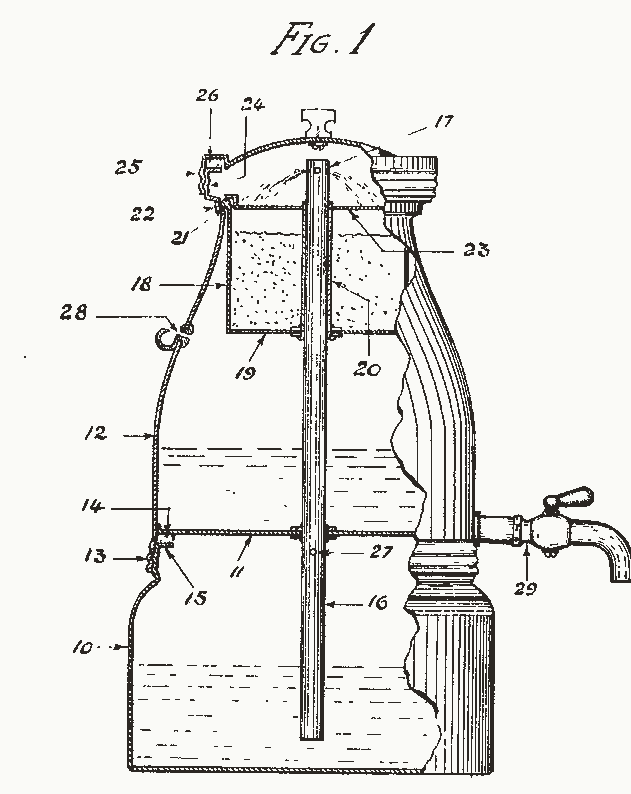
Bontempi writes that an ordinary percolator lets steam escape from under its lid, and the coffee’s aroma goes with it. In the 1927 pot, opening 27 lets some steam into the space above the coffee, to press the water through faster. Bontempi writes that steam cannot get out until the boiler’s water reaches the tube’s lower end, and that steam then passes through the coffee. The whistle at outlet 28 then tells you to turn off the heat. Bialetti dates its Moka Express and its valve to 1933. Navarini’s team write that the pot was inspired by an early washing machine, the lisciveuse.
What the drawings leave out
The sizes are the drawing’s own. The amounts of water, air and coffee are those of the measured pot. The model puts heat into the water at a steady 180 watts, so each 5 kJ on the scale takes about 28 seconds. None goes into the metal. At that pace its water warms about as fast as the measured water did. The model counts the air and steam at the water’s temperature, although the space above the water was found to be cooler. That may be why its first 10 g leave with the water 8 or 9 °C cooler than was measured. The bed’s permeability follows the measured curve, read by eye. Every gram is drawn as a millilitre, and the coffee leaves the bed as hot as the water that went in. The model stops at the gurgle, a phase too unruly to measure well. In the model no water or steam leaks past the gasket. User reports on Coffee Stack Exchange say a worn or wrong gasket lets steam out and makes the pot sputter. The valve stays shut throughout, as it should in use, and the funnel and plate have a few large holes for many small ones. Fig. 3 comes from the same run as Fig. 2. The flame is a sign for heat. The pot is round, with straight sides, and has no handle.
Sources
Read in November 2026.
- Mario Bontempi, US Patent 1,488,089, “Express coffeepot”, filed 25 October 1922, granted 25 March 1924.
- Mario Bontempi, US Patent 1,619,967, “Coffeepot”, filed 5 December 1924, granted 8 March 1927; Fig. 4 is cropped from its sheet.
- Ugo Moroni and Francesco Ranzoni, for S.P.A. Alfonso Bialetti & C., European Patent 0 932 355, “Pressure coffee maker for preparing coffee infusions”, filed 9 December 1996, granted 25 September 2002; read for what it says of the usual pot.
- Bialetti, Moka Express leaflet, for the parts’ names, the fill, the grind, the heat and the valve.
- Bialetti, “The Moka valve: a tiny component of remarkable importance”, 11 May 2022.
- L. Navarini, E. Nobile, F. Pinto, A. Scheri and F. Suggi-Liverani, “Experimental investigation of steam pressure coffee extraction in a stove-top coffee maker”, Applied Thermal Engineering 29 (2009), 998 to 1004, read in the authors’ accepted manuscript through the Internet Archive’s copy.
- W. D. King, “The physics of a stove-top espresso machine”, American Journal of Physics 76 (2008), 558 to 565; its abstract only.
- C. Gianino, “Experimental analysis of the Italian coffee pot moka”, American Journal of Physics 75 (2007), 43 to 47; its abstract only, and his permeability as the Navarini paper quotes it.
- A. Varlamov and G. Balestrino, “La fisica di un buon caffe”, Il Nuovo Saggiatore 17 (2001), 59 to 66, in Italian.
- NIST Chemistry WebBook, Thermophysical properties of fluid systems: water at saturation, 20 to 140 °C, for the model’s steam, density, heat and viscosity.
- NIST, CODATA value of the standard atmosphere, for the outside air.
- Coffee Stack Exchange, “Do I need to use a tamp if using a Moka pot stove top espresso maker?”, February 2015, with answers of 2015 and 2023. User report.
- Coffee Stack Exchange, “Why does my moka pot sputter?”, February 2017, with answers of 2018 to 2024. User report.
- Coffee Stack Exchange, “Why does water remain in the bottom chamber after brewing with a moka pot?”, April 2015, and its top answer. User report.
The type is Playpen Sans by TypeTogether, under the SIL Open Font License 1.1.