Water pistol
The water in a pump-up water pistol is shut in under a pocket of squeezed air, and the trigger only opens the way out to the nozzle. A hand pump squeezes that air first.
Room left for air
A pump-up water pistol has two controls: a handle that slides back and forth along the barrel, and the trigger. You pump the handle first, to build up pressure inside, and then pull the trigger. The same toy is also called a squirt gun or a water gun.
In one kind, the gun is filled only part of the way with water, leaving room for compressed air. The handle works a pump under the barrel, like the slide of a pump shotgun, and each squeezing stroke forces outside air in through a check valve, which lets air pass one way only. One design keeps an air reservoir shaped like a rifle scope above the highest level the filling port lets the water reach, so there is always room for that air.
The trigger opens a valve, and the water flows out as the squeezed air above it expands. Let the trigger go, and a spring shuts the valve again.
The most traditional water guns pump the water itself, through the trigger or by a battery motor, and are limited in how far the water goes, how much is shot and how long the pumping lasts. A toy that pumps water straight out needs a small piston to reach a good pressure, so each shot is small, and the speed of pumping sets how far it goes.
Two tanks and two valves
A design by Lonnie G. Johnson and Bruce M. D’Andrade, granted in 1992 and reissued in 1996 as RE35,412, pumps water against a cushion of air instead. It has two tanks. The storage tank holds water at the outside pressure, with a vent valve that lets air in as water is drawn off. The pressure tank is a cylinder with one opening and “generous radii” at its ends, which keep its walls strong. A piston between the two is driven by a rod from a handle that slides along the barrel.
Pulled one way, the piston draws water up a tube through the first one-way valve, a ball that a spring holds against a soft seal. Pushed back, it shuts that valve, and the water opens a second one. Beyond it is a T-shaped joint. The exit tube from the T is pinched shut by the trigger’s pinch bar, so the water’s only way on is into the pressure tank. Water-gun testers on iSoaker call this design the separate pressure chamber, and its two valves check valves #1 and #2.
Fig. 1 lays those parts out flat so that each can be seen. In the drawing each full stroke moves a tenth of the chamber’s space in water. Guess whether every stroke raises the chamber’s pressure by the same amount.
What the drawing shows
The first stroke lifts the chamber’s air from the outside pressure to 1.11 times it, and the seventh from 2.5 to 3.33. Water hardly squeezes, so every stroke takes the same tenth of the chamber’s space from the air. But each tenth is a larger share of the room the air has left. By Boyle’s law, for a gas kept at one temperature the pressure times the volume stays nearly the same. Air squeezed into half its room presses twice as hard. Five strokes do that here.
When the pump stops gaining
The pressure rises with each stroke until the pump can no longer overcome it, or until the trigger lets water out. The trigger can do that by itself. The bar is a safety valve. Its spring is calibrated so that above a set pressure the bar rises and lets water out until the pressure is safe again. No source gives that pressure as a number. In Fig. 1 the bar lifts at four times the outside pressure, the drawing’s own choice, when the chamber is three quarters water. That comes half way through the eighth stroke, and what is left of that stroke squirts out of the nozzle. Each stroke after it sends its water straight out.
A reader’s review of the Super Soaker 50 on iSoaker, a user report, says one to four pumps gave a long stream. It also says pumping that gun too much was bad, because it could not handle the pressure. iSoaker itself warns that without a working relief valve, too much pumping can make parts inside rupture, with leaks or even pieces thrown out.
Pumping air instead
Pumping water against an air cushion is more efficient than pumping air, because water hardly compresses, so fewer strokes reach a higher pressure. A pump of air comes to a stop of its own. The highest pressure it reaches is set by the ratio of the largest to the smallest space inside the pump’s cylinder. Air still in that smallest space when a stroke ends springs back as the piston returns. Once the chamber presses as hard as the pump’s squeezed air can, no more gets in. A pump whose space shrinks to a fifth stops at five times the outside pressure. A water pump has no such limit of its own, since water hardly springs back.
The double tank gun can pump air too. Held so that the air in the storage tank reaches the draw tube, it draws air and forms a cushion with it in the pressure tank.
Holding the trigger
Pressing the trigger lifts the pinch bar off the exit tube. The heavier water leaves first, from the bottom of the pressure tank, back through the T and out of the nozzle. It streams until the trigger is let go or the pressure inside equals the pressure outside. As the water goes, the air spreads into its room and presses less hard. Bernoulli’s equation, in its simplest form, makes the water’s speed out of the nozzle grow with the square root of the push above the outside air. A reply on r/explainlikeimfive, a user report, gave a squirt gun’s flow the same square root, through the orifice equation.
Fig. 2 starts from the chamber of Fig. 1 at four times the outside pressure. iSoaker advises pumping air into the chamber first, with the reservoir’s intake out of the water. It says that makes a better stream through the shot, but leaves room for less water before the relief valve opens. Fig. 2 lets you try both, the extra air to 1.5 times the outside pressure. Make a guess at which choice shoots for longer before you hold the trigger.
What the drawing shows
The water lasts 8 of the drawing’s seconds with no air pumped in first, and 3.2 with it. The second chamber holds less, 62.5% water against 75%, and spends it faster. With no extra air, half the water has gone after 1.82 seconds, and the second half takes the other 6.2, as the jet dies away to nothing. The last water leaves just as the air is back at the outside pressure. With the extra air, the jet still runs at 41% of its first speed when the water runs out. iSoaker writes that the squeezed air then escapes through the nozzle, and the chamber must be pumped up again.
A squeeze bulb in 1896
John Walter Wolff of Winston, North Carolina, patented a water-gun on 30 June 1896, a word his patent says takes in pistols. Fig. 3 is his drawing. A compressible ball or bulb E sits in a chamber D just in front of the trigger C. A tube G runs from it to the muzzle, where it narrows to a nozzle g. The trigger has an arm H, flattened into a broad bearing h, so that it presses the bulb without cutting into it. To fill it, you put the muzzle in a basin of water and pull the trigger once or twice. Every pull after that squeezes the bulb and sends out a jet. The bulb is the pump. The hammer A and its spring B stay, so that a cap can go off with each shot.
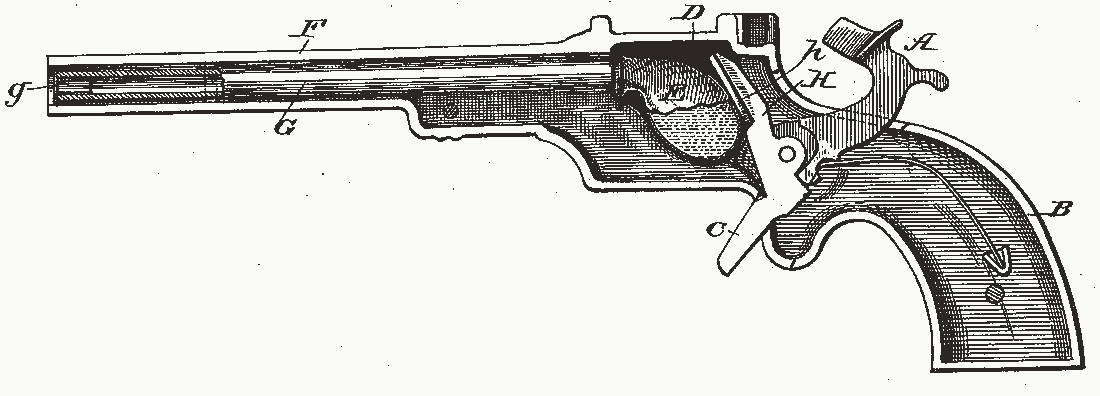
The bulb has no valve. Water goes in and out by the same nozzle, and no push is stored between shots. The trigger pumps iSoaker describes add two check valves, often with small ball bearings. A small spring-loaded pump then draws from a reservoir and pushes to the nozzle. iSoaker says such blasters are often called squirt pistols, and that their streams are thin and lack force, since each stroke moves so little water.
From a bathroom tap to Larami
The oldest water gun iSoaker knows of is a “USA Liquid Pistol” patented on 30 June 1896, the day Wolff’s patent was granted, and the site says it may not be the first. iSoaker names the Cosmic Liquidator, patented in 1977, as the oldest known stock blaster to use air pressure; its pressure tank was separate from the gun, joined to it by a flexible tube.
The Strong National Museum of Play put the Super Soaker in its National Toy Hall of Fame in 2015. In the early 1980s Johnson, an engineer working on NASA’s Galileo mission, hooked a nozzle from a heat pump he was building to his bathroom tap. The stream that shot across the room gave him the idea. His model of PVC pipe and an empty soda bottle, the Power Drencher, had an air pressure chamber and a water reservoir, and a trademark claim forced the new name. His patent for a squirt gun, filed in 1983, was granted on 27 May 1986; it even gave the toy a battery circuit and a small water wheel that works two reeds, for “futuristic space ray gun” sounds while it shoots. The Strong says Larami Corporation put the first Super Soaker on sale in 1990 and sold 27 million in three years. iSoaker gives the Super Soaker 50 a copyright date of 1989 and a release date of 1991, and names the Super Soaker 100 as the first stock blaster with a separate pressure chamber.
What the drawings leave out
The sizes are the drawing’s own. No patent gives a size or a pressure, and the only size Hasbro gives is the tank, 1.26 litres on its XP100, so the stroke, both pressures and the nozzle, with its seconds, are chosen for the drawings. A real gun folds its parts into its body, and Fig. 1 spreads them out. The air keeps one temperature, as Boyle’s law asks. A valve in Fig. 1 stays open until the handle reaches either end of its stroke or turns back, where a real one shuts as soon as the water stops. Fig. 1 also stops following once its tank runs dry, when the pump would draw air.
The tubes in Fig. 2 have no drag, though iSoaker counts it among the things that slow a stream. The water’s own weight over the chamber’s opening is left out too. Neither figure draws the tank’s vent valve. The XP100 comes with one caution: “Do not aim at eyes or face.”
Sources
Read in November 2026.
- Lonnie G. Johnson, US Patent 4,591,071, “Squirt gun”, 27 May 1986.
- Bruce M. D’Andrade and Lonnie G. Johnson, US Patent 5,074,437, “Pinch trigger pump water gun”, 24 December 1991.
- Lonnie G. Johnson and Bruce M. D’Andrade, US Patent RE35,412, “Double tank pinch trigger pump water gun”, 31 December 1996, a reissue of US Patent 5,150,819 (29 September 1992): the parts and workings of Figs. 1 and 2.
- John Walter Wolff, US Patent 563,114, “Water-gun”, 30 June 1896, and its drawing sheet, from which Fig. 3 is cropped.
- Hasbro, Super Soaker XP100 product page: the tank and the caution.
- NASA Glenn Research Center, “Boyle’s Law” and “Bernoulli’s Equation”.
- The Strong National Museum of Play, National Toy Hall of Fame, “Super Soaker”.
- iSoaker.com, testers’ pages on the separate pressure chamber, the trigger pump, the Super Soaker 50 and the oldest known water guns. User report.
- r/explainlikeimfive, “ELI5: Why does it take more force and time to unload a squirt gun with a smaller opening?”, August 2018, via the Arctic Shift archive. User report.
- Wikipedia, “Water gun”, for the other names and the 1896 date.
The type is Playpen Sans by TypeTogether, under the SIL Open Font License 1.1.