Sewing machine
Below the cloth on a sewing machine sits a second thread, wound on a small spool called the bobbin. The needle brings the top thread down through the cloth, and a hook under it carries a loop of that thread round the bobbin’s case. Pulled up, the loop holds the bobbin thread, and the two are linked inside the cloth.
Two threads in every stitch
This stitch is called a lockstitch. It takes two threads. The top thread comes off a spool on the machine, passes a tension mechanism and the take-up lever, and goes down to the needle, through an eye just above its point. The bobbin thread is wound on the bobbin, which sits in a bobbin case under the cloth. Ideally the two threads lock in the middle of the cloth’s thickness.
The parts here take their names from the manual of an industrial machine, Juki’s DDL-8700: needle, presser foot, throat plate, feed dog, bobbin, bobbin case, hook and handwheel. The throat plate is the plate the cloth slides over. It has a hole for the needle. The DDL-8700 sews up to 5,500 stitches a minute, and its longest stitch is 5 mm.
A later model, the DDL-8700B-7, has an automatic-lubricating full-rotary hook. Such a hook keeps turning round and round in place. The figures draw that kind. The two kinds in most use today are the rotary hook and the oscillating shuttle, which swings to and fro.
A loop beside the needle
A stitch begins with a loop of the top thread. The needle pushes the thread down through the cloth and the throat plate to the bottom of its stroke. As the needle is drawn back up, the thread tends to bulge away from it. Friction against the cloth holds it back, and so does its own inertia. That bulge is the loop that the hook’s point catches. For a good loop, the needle’s eye is set at right angles to the path of the hook’s point.
The cloth rides up with the needle if the presser foot does not hold it firmly where the needle passes. Then no loop forms, or it forms too late for the hook. Stitches are skipped or broken. The hook’s point also passes very close to the needle. On the DDL-8700 the gap is 0.04 to 0.1 mm, and a wider gap makes the machine skip stitches.
Round the bobbin case
Fig. 1 follows one loop through one turn of the handwheel, looking along the shaft of the hook. The turn starts with the take-up lever at the top of its stroke, holding the stitch before tight. It ends there too. The hook turns twice for every turn of the handwheel. Its point reaches the needle when the needle has climbed 2.2 mm from the bottom. Before you turn the handwheel past that moment, guess which side of the bobbin case the loop will go.
What the drawing shows
The loop passes both sides. The point slips between the needle and the loop and carries the loop’s far end round. One side of the loop crosses the front of the bobbin case, and the other goes behind it. Allen B. Wilson’s patent of 1852 says that as one side of the loop passes on one side of the bobbin and the other on the opposite side, the bobbin passes through it. In the drawing the loop’s far end has gone all the way round by 314° of the turn. The bobbin thread leaves the case near its top. Now it lies inside the loop.
Douglas A. Kerr, in an article on rotary hooks, explains how a thread gets behind a case that never turns. The case sits in a hook basket, which rides in a groove of the turning hook, the hook race, with room to spare. The thread slips through between them. A tab fixed to the machine stops the basket turning, but it sits loosely in a notch, and one side of the loop winds out past it. On the DDL-8700-7, too small a clearance between the hook and the inner hook presser is among the causes of loose stitches with loops.
The take-up lever
A loop that goes round a bobbin case takes a lot of thread, and the take-up lever lends it. In the model the tension discs hold the top thread, so the thread between them and the last stitch keeps its length unless something pulls harder than they hold. The lever comes down while the hook spreads the loop. Just past the bottom of the case the loop holds 63 mm of thread below the throat plate. The hook has pulled only 0.01 mm through the discs.
Then the loop slips off the hook. The lever climbs fast. In the 60° of the turn before the stitch pulls tight, the lever and the rising needle take back 68 mm of thread between them, which drags the loop round the case and up into the cloth. After that the lever draws 7.4 mm of new thread through the discs, as much as went into the stitch. The DDL-8700-7’s thread take-up is of the link type, and the drawing’s lever is moved by a crank and held by a link.
One stitch along
Between stitches the cloth has to move on. The feed dog moves it. It is a toothed bar under the throat plate. In Fig. 2 its teeth come up through slots in the plate, carry the cloth along one stitch length and drop away. On the DDL-8700 the feed dog’s teeth rise 0.75 to 0.85 mm above the plate at their highest. In the standard feed timing, the top of the feed dog and the top of the needle’s eye are level with the top of the plate as the dog goes down. The figure keeps that timing, with teeth that rise 0.8 mm. Before you turn Fig. 2 through, guess whether the cloth moves while the needle is in it.
What the drawing shows
The cloth waits for the needle. In the drawing the teeth come up through the plate halfway through the turn, 3° before the point leaves the cloth. They carry the cloth until the point comes down onto it again, and drop below the plate 16° later. The cloth moves only 0.004 mm while the point is in it. A longer stitch makes the teeth move faster over the same part of the turn. The DDL-8700-7’s feed dog has four rows of teeth, and the cut in Fig. 2 runs through one of them.
Wilson’s 1852 patent moved the cloth with a single sharp tooth on a springy bar. A cam pushed the tooth up through a hole in the plate and moved the bar along. A spring brought it back. An eccentric stop set how far the bar could go back, and so the length of the stitch.
Tension and loops
Where the two threads lock depends on how hard each one is pulled. Fig. 3 cuts along four stitches and lets you set the top thread’s pull against the bobbin thread’s. In the drawing the lock moves 1.1 mm toward the harder pull each time one pull doubles against the other, and goes no more than 1.8 mm off the cloth’s middle. Before you loosen the top thread, guess which side of the cloth will show the fault.
What the drawing shows
The back of the cloth shows it. In the drawing, with the top thread loose, the locks are pulled down out of the cloth, and the top thread hangs underneath in loops. On a real machine too, loops appear on the back of the fabric when the upper tension is too loose, and on the surface when it is too tight. A wrongly threaded upper thread may be too loose. Loose stitches with loops also come from a thread tension that is too low, and from a take-up lever stroke that is too long.
People who sew blame the top thread for a tangle under the cloth too. In a thread on Reddit’s r/sewing, the reply most liked said that bird’s nests on the bottom are usually a top thread problem. Under photographs of a nest in another thread there, one reply read, “That is top thread on the underside.”
Howe, Singer and Wilson
Elias Howe Jr., of Cambridge, Massachusetts, had US Patent 4,750, dated 10 September 1846, for a machine that sewed seams with two threads. His needle was curved and held on a swinging arm, with its eye about an eighth of an inch from the point. Once the needle had carried the thread through the cloth, the thread stood above it like a bow string. A small shuttle with a bobbin in it passed right through the gap. The cloth hung on pins. They stood out from a plate that moved along as the stitches were made. Howe noted that the thread on one side of the cloth all came from the needle, and on the other all from the shuttle.
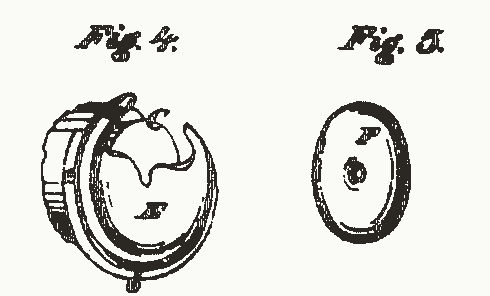
Isaac M. Singer, of New York, had US Patent 8,294, dated 12 August 1851, for improvements to a machine of his own. One was a driver that carried the shuttle with a little play. Another was a friction pad that held the thread as the needle went down. His earlier machine, he wrote, had a spring guide that could pull the loop back out before the shuttle passed through it. Allen B. Wilson, of Watertown, Connecticut, had US Patent 8,296 the same day. In it the loop of the needle thread was opened wide enough for a bobbin to travel through it, one way and then the other. His US Patent 9,041, dated 15 June 1852, kept the bobbin still. A rotating hook passed the loop right over it. The hook was cut from a disc, and the bobbin sat in the disc’s hollow face (Fig. 4). Wikipedia’s article on the rotary hook dates that patent 1 June 1852, but the patent itself says 15 June.
What the drawings leave out
The sizes are the drawing’s own. Two scales are used in Fig. 1. The take-up lever, its guides and the tension discs are drawn at two fifths of the scale of the needle and the hook, beside them and turned into view. The handwheel is only a sign of the turn. The basket, its tab and the hook race are left out, so the dashed side of the loop is drawn passing behind the case with nothing to show how.
Fig. 1 also leaves out the feed dog, which Fig. 2 draws, and the thread take-up spring. With no spring in the model, the slack the lever gives before the hook arrives hangs between two guides. It is never more than 8 mm. The lever’s sizes came from a search for one that gives the hook its loop without drawing thread through the discs and sets the stitch before the turn ends. In Fig. 2 the feed dog rises and moves along on sine curves.
No source gives Fig. 3’s rule for where the lock sits. The needle’s stroke of 30.7 mm, the 5 mm stitch and the feed dog’s rise of 0.8 mm are Juki’s.
Sources
Read in November 2026.
- E. Howe Jr., US Patent 4,750, “Improvement in sewing-machines”, 1846: the curved needle, the shuttle and the cloth on pins.
- I. M. Singer, US Patent 8,294, “Improvement in sewing-machines”, 1851: the shuttle driver and the friction pad.
- A. B. Wilson, US Patent 8,296, “Improvement in sewing-machines”, 1851: the travelling bobbin.
- A. B. Wilson, US Patent 9,041, “Improvement in sewing-machines”, 1852: the rotating hook, the still bobbin and the feed, and Fig. 4, its drawing.
- Juki, DDL-8700 instruction manual: part names, speed, stitch length, hook clearance, feed dog height and feed timing.
- Juki, DDL-8700-7 engineer’s manual (a dealer’s copy): needle stroke, the link take-up, the rows of teeth and the causes of balloon stitches.
- Juki, DDL-8700B-7 catalogue, the full-rotary hook.
- Brother, operation manual for the XM2701, upper tension and loops.
- D. A. Kerr, “Stitch Formation in Rotary Hook Sewing Machines”, October 2008: the hook basket, the race and the tab. User report.
- C. H. Holderby Co., “Stitch Formation”, quoting Groz-Beckert on the needle thread loop.
- Wikipedia, “Lockstitch” and “Rotary hook”.
- r/sewing, “Newbie sewer. Just inherited this beautiful Viking Husqvarna sewing machine. In great condition, but every tim[e] …”, September 2019, via the Arctic Shift archive. User report.
- r/sewing, “Tension problems, birds nest on the underside”, December 2024, via the Arctic Shift archive. User report.
The type is Playpen Sans by TypeTogether, under the SIL Open Font License 1.1.