Windscreen wiper
Each windscreen wiper is a rubber blade on an arm that swings to and fro across the glass. The motor in the designs drawn here turns only one way, and a crank and a rod between motor and arm turn that spin into a swing.
A handle for the motorman
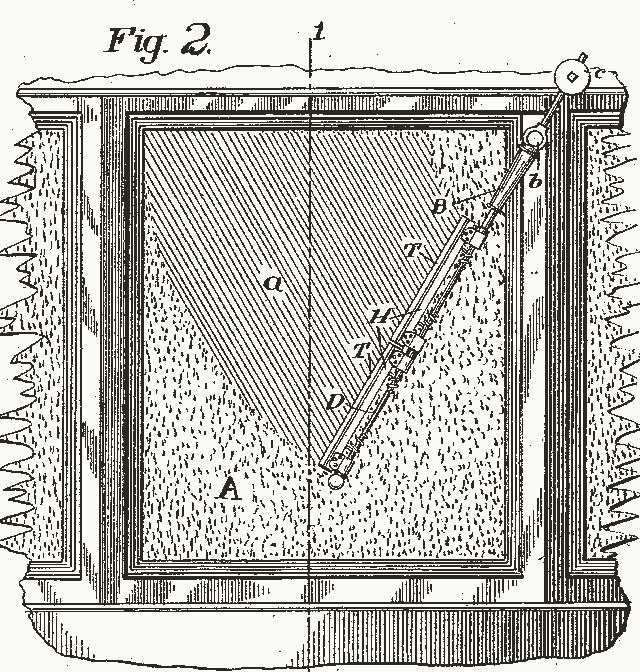
A wiper’s rubber is pressed on the glass at the end of an arm, and the arm swings to and fro about a pivot at its other end. In American English the whole thing is a windshield wiper. At each end of the sweep something has to stop the arm and send it back. In the cleaner of Fig. 1 that was the motorman, working from inside the vestibule. The arm was fixed on a spindle and swung from a support opposite one corner of the glass, and a handle on the spindle’s inner end turned it. The motorman had only to turn the handle “in one direction or the other” to clean the pane.
Mary Anderson, of Birmingham, Alabama, filed for her patent on 18 June 1903. On 10 November that year she was granted US Patent 743,801, for a “window-cleaning device” to clear snow, rain and sleet from the glass in front of the motorman. Its arm carried two cleaners, strips of wood that each held a rubber. Coiled springs pressed the rubbers on the glass, firmly enough to clean it, yet able to give if they struck something. A counterweight balanced the arm about its pivot, and in fair weather a thumb-screw let the whole arm come off.
Wikipedia says Anderson is popularly credited with the first working windscreen wiper. It names other inventors who patented window cleaners in the same year.
From a spin to a swing
Fritz R. Ryberg, of Cleveland, filed in January 1922 for the patent granted in May 1927, US Patent 1,629,740. His motor stands outside the car, beside the windscreen. A worm on the motor’s shaft turns a worm wheel, and a spur pinion on the wheel’s shaft turns a spur gear on a third shaft. Ryberg calls these “two reductions in speed”. On the third shaft sits a crank.
Each arm hangs from a stud on a plate fixed to the frame above the glass. The stud stands square to the glass, so the arm swings parallel to it. A short link swings on the stud, the arm hangs from the link’s lower end, and a spring presses the arm’s squeegee on the glass. Ryberg calls the rod from the crank to a pin low on the link a pitman. “The crank arm 11 through the pitman 29 serves to oscillate the link 21,” he wrote. The arm swings with the link.
The frame counts as a fourth link. A side link that turns all the way round is a crank, and one that does not is a rocker, this page’s name for Ryberg’s link. Fig. 2 draws his parts. Before you turn its crank, guess what the crank and the pitman look like at the moment the arm stops and starts back.
What the drawing shows
At each end of the sweep the crank and the pitman lie along one straight line, folded over each other at the left end and stretched out end to end at the right. Between the ends the pitman pushes the rocker or pulls it. At the ends the crank’s pin moves square across the pitman, so it does neither. The arm turns back. In the drawing its speed falls to nothing at each end and is highest near straight down, 0.57° of arm for each degree of crank. One turn of the crank takes the arm across and back once: 181° of crank from left to right, and 179° back.
The length of the crank
The ends of the sweep are fixed by lengths alone. At one end the rocker’s pin sits the pitman’s length plus the crank’s from the crank’s shaft, and at the other, the pitman’s length less the crank’s. A longer crank pushes both ends outward. The sweep grows with it. Fig. 3 lets you change the drawing’s crank.
By Grashof’s rule, a link can turn all the way round only if the shortest link and the longest together are no longer than the other two. In Fig. 3 the longest is the frame, 434 mm from the crank’s shaft to the stud. Before you lengthen the crank, guess how long it can get and still go round.
What the drawing shows
The drawing’s crank goes round only while it is no longer than 67.8 mm, the rocker’s 80 mm and the pitman’s 422 mm less the frame’s 434.2 mm. Until then the sweep grows faster than the crank does: 29° from a 20 mm crank, 69° from 45, 99° from 60 and 114° from 65. At 70 mm the crank, turning one way, stops after 329°. Its pin is then 502 mm from the stud, the pitman’s and rocker’s lengths together, so those two are pulled into one straight line and nothing can carry the crank on round.
Two arms on one rod
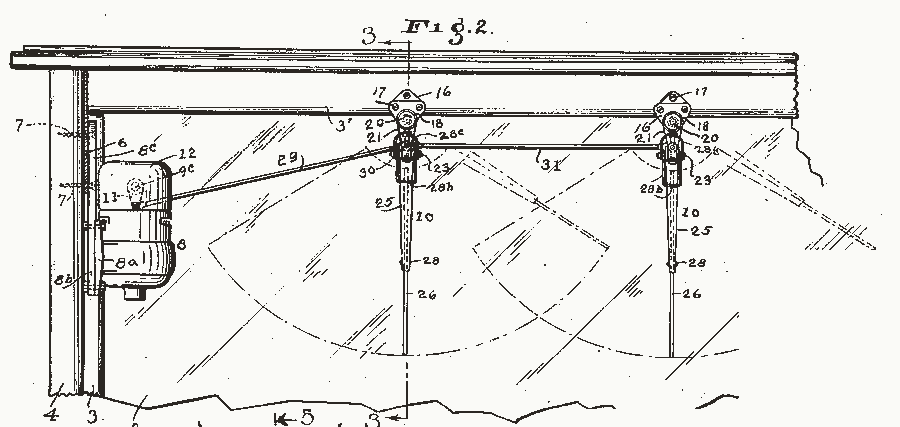
Fig. 4 is Ryberg’s own drawing, with the motor at the left and his pitman 29 running to the first link. A second rod, 31, joins the pins of neighbouring links. Both arms swing together, and the areas they wipe overlap. That keeps the glass clear from side edge to side edge, which Ryberg wanted for cars with front and rear driving seats, where in most cases the driver sat in the rear one.
Later patents drive two arms from one crank in other ways. In Kearns’s, filed in 1964, one link runs from the motor’s crank arm to a crank arm on the first pivot shaft. A second runs to a bell crank, a lever pivoted between its ends, and from it a third link reaches the second pivot shaft. A General Motors patent filed in 1958 drives its two blades through two connecting rods, a bellcrank and an idler link, over what it calls “asymmetrical paths”.
Speeds in the US standard
Federal Motor Vehicle Safety Standard 104, the US standard for wiping and washing, covers passenger cars, multipurpose passenger vehicles, trucks and buses. It asks each of them for “a power-driven windshield wiping system” with at least two frequencies or speeds. A lower speed may come down to 20 cycles a minute but no further, and the highest must run at least 15 cycles a minute faster than it. “One frequency or speed shall be at least 45 cycles per minute regardless of engine load and engine speed,” the standard reads. The other two limits hold whatever the engine is doing too.
These are US rules for vehicles as they are made, not a rule for every country, and each applies to a vehicle whose manufacture is completed on or after the day it takes effect. In S4.1.2 the standard also asks a passenger car to wipe at least 80, 94 and 99 percent of three areas of the windshield, tested wet. It lays the areas out with angles to the left, right, up and down, which its tables give for four widths of car, through the figures of an SAE practice from 1966.
A pause after each wipe
In light rain, or in spray from other cars, the glass is often wet-dry, and wiping on without a break may smear it. Robert W. Kearns, of Detroit, filed in December 1964 for a pause between wipes, patented in 1967 as US Patent 3,351,836. At full speed, he wrote, his motor took about a second for one wiping cycle.
His design stops the wipers near the end of each cycle for a pause the driver can set anywhere from one to twenty seconds. A capacitor charging through a variable resistor times it. Water gathers on the glass meanwhile and wets the blades for the next stroke. That, with a constant wiping speed, keeps them from chattering, he wrote. Rattle and flutter in an old blade come from ozone and UV rays, which break the rubber down until it cracks and tears.
Kearns was not the first. His own patent names an earlier one, US Patent 3,110,056, by John R. Oishei and others. In that design a cam worked a switch that made the wipers dwell at the end of each cycle. In 1925 Charles F. Laganke put the switch for his wiper on a spoke of the steering wheel. In light rain or snow, he wrote, it could be pressed now and then to swing the wiper across a time or two.
Coming to rest
Laganke drove his wiper through a worm and worm wheel, a crank pin on a disc, and a pitman pushing a rack to and fro. He wrote that it was “quite impossible to control the motor accurately enough” to bring the wiper to rest at the end of its stroke, out of the driver’s view, and fixed a small hand wheel on the motor’s shaft so the driver could set it by hand.
A General Motors patent filed in 1958 parks the blades with the crank. Its motor turns one way only. When the wipers are switched off, the crank is almost stopped and its throw, the reach of its pin from its axis, is increased. A longer reach moves the end of the sweep, as in Fig. 3, so the blades travel on past their usual inboard end and lie down against the lower rail. Then a parking switch, worked by a pawl, stops the motor.
A reader on Motor Vehicle Maintenance & Repair Stack Exchange asked why the wipers of a 2006 Honda Accord stopped straight up on the glass after a moment’s use. A reply said a pin or cam usually opens a pair of contacts that cut the current when the blades are in the right place. The owner of a 2002 Chevrolet Impala answered their own question about the same fault. A pawl in the wiper transmission, as owners and parts sellers call the box of links, swings out to catch a tab when the wipers should park. All three are user reports. A blade left long in the parked position in high temperatures can deform and leave a section of glass unwiped, as a bent tension strip can.
What the drawings leave out
The sizes are the drawing’s own. Ryberg’s patent gives none, and Figs. 2 and 3 show one arm where his Fig. 2 has two. The crank is drawn in front of the gear case. Ryberg put it on the side of the motor next to the windscreen, close to the glass and nearly in the plane the arms swing in. The gear case is drawn shut. Its worm and gears are hidden inside.
The arm hangs from above the glass, as in Ryberg’s patent. Each joint is drawn as a plain pin, and friction is left out. So are the drag of the blade on the glass and the spring that presses the squeegee down. The crank turns at whatever pace you give it, and the drawing counts degrees of crank, never seconds. Kearns’s and General Motors’ designs appear only in words. Ryberg’s own Fig. 2 marks each wiped area with a dash-dot line, as Figs. 2 and 3 do.
Sources
Read in November 2026.
- Mary Anderson, US Patent 743,801, “Window-cleaning device”, 1903: the hand-worked cleaner and Fig. 1, her drawing.
- Fritz R. Ryberg, US Patent 1,629,740, “Cleaning mechanism”, filed 1922, granted 1927: the design Figs. 2 and 3 follow, and Fig. 4, his drawing.
- Charles F. Laganke, US Patent 1,536,506, “Windshield cleaner”, 1925: the button on the steering wheel and the hand wheel for setting the wiper.
- Peter R. Contant and five others, for General Motors, US Patent 2,985,024, “Windshield cleaning mechanism”, filed 1958: the one-way motor, the two blades and the parking by a longer throw.
- Robert W. Kearns, US Patent 3,351,836, “Windshield wiper system with intermittent operation”, filed 1964: the two pivot shafts, the second a wiping cycle, the pause and the chatter.
- John R. Oishei and others, US Patent 3,110,056, “Windshield wiper system”, 1963, as Kearns names it.
- NHTSA, 49 CFR 571.104, FMVSS 104, windshield wiping and washing, in Cornell’s copy, checked against the eCFR; and 49 CFR 571.7, on which vehicles the standards cover.
- Yi Zhang with Susan Finger and Stephannie Behrens, Carnegie Mellon University, “Planar Linkages”: crank, rocker and Grashof’s rule.
- Wikipedia, “Windscreen wiper”, revision of 6 November 2026: who is credited with the first wiper.
- Robert Bosch (Australia), “Bosch Wiper Blades: Clear visibility for your safety”, 2019: rattle and flutter, and an unwiped section and its causes.
- Motor Vehicle Maintenance & Repair Stack Exchange, “Wipers stop in random position”, February 2019. User report.
- Motor Vehicle Maintenance & Repair Stack Exchange, “How to repair windshield wipers that get stuck in an upright/vertical position when turned off?”, October 2021, with the asker’s own answer. User report.
- Motor Vehicle Maintenance & Repair Stack Exchange, “Windshield Wiper Transmission Linkage Bushings for 2002 Civic EX (1.7L L4)”, April 2017: the name “wiper transmission”. User report.
The type is Playpen Sans by TypeTogether, under the SIL Open Font License 1.1.