Roller blind
Cloth hangs from a hollow roller with a long coiled spring inside it. Pulling the blind down turns the roller and winds the spring tighter. Ease it back gently and it stays put. Give it a short tug and let go, and the spring rolls it all the way up.
A rod that cannot turn
A spring roller blind’s spring lies inside its hollow roller. One end of the spring is fixed to the roller and the other to the rod that the roller turns on. So pulling the blind down turns the roller round the rod and winds the spring. Let go, and the spring unwinds and rolls the blind back up onto the roller.
The rod must not turn. Jacob David’s patent of 1867 squares or flattens its outer end to fit a slot in the bracket, and winds the spring round the rod. Draper’s spring rollers, made in Spiceland, Indiana, still end on the left in a flat spear that is lowered into a slot in the bracket. Their springs are tensioned at the factory, so a new blind arrives with turns already wound into it. At the roller’s other end, in David’s patent, a short journal turns freely in a second bracket.
How hard the spring pulls
Each turn wound into the spring makes it pull harder. Each length of blind let down adds weight for it to hold. Fig. 1 sets one against the other for a drawn blind. Its roller is 32 mm across and its drop is 1.5 m. The bottom bar weighs 150 g, and the cloth 200 g a metre. The spring lifts 25 g more for every turn, counting its lift as the weight that would pull as hard if it hung from the roller’s edge. A metre of blind turns the roller almost ten times.
Before you let go of the blind in Fig. 1 at the bottom with its spring wound too little, guess how far up it gets.
What the drawing shows
Not quite two thirds of the way. The weak spring stops it 55 cm below the top. Rising a metre unwinds almost ten turns, which takes 249 g off the lift, while the blind gets only 200 g lighter. So the lift falls behind. Over the top 103 cm of the drop this spring lifts less than the blind weighs, and the blind gets into that stretch only on the speed it picked up lower down. Let go of it there and it stays put.
Wound too much, the spring brings the blind up from its lowest at 2.9 metres a second, against 2.0 for the spring wound about right. And that lowest is only 101 cm down, because the drawing lets its spring take no more than 26 turns. A roller wound too tight will not let its shade unroll fully or freely.
A pawl that drops into a notch
Stewart Hartshorn of New York patented a way to make the blind stay put on 11 October 1864, US Patent 44,624. A hub with two notches, one on each side, is fixed to one end of the roller. Above it, a pawl hangs from a pivot on the bracket and rests on the hub by its own weight. A projection under the pawl is sloped on one side, so that pulling the blind down forces it out of a notch. Its other side is square. That side catches the front edge of a notch and stops the spring winding the blind up.
Whether it catches depends on speed. Hartshorn wrote that if the spring turns the roller briskly, the notches pass under the projection without catching, and that it catches a notch as soon as the roller is slowed. The blind rolls up as long as it moves fast enough to carry the notches past the pawl before the pawl can fall into them. Fig. 2 draws Hartshorn’s design with a hub 20 mm across with notches 4 mm wide and 2 mm deep, and a pawl that falls as freely as a dropped stone. Guess how far the pawl gets into the notch when you turn the hub briskly.
What the drawing shows
Hardly in at all. At five turns a second the notch passes under the pawl in 6.4 ms. In that time the pawl falls 0.2 mm, a tenth of the notch’s depth. At one turn a second the notch takes 32 ms to pass, and the pawl is down the whole 2 mm after 20 ms. The drawing counts a pawl that has fallen half the depth as caught, so its pawl misses above 2.3 turns a second. On the roller of Fig. 1, that is a blind rising at 23 cm a second.
Slowly, or with a tug
A blind left to its spring passes that speed almost at once. With the spring wound about right, a blind let go at the bottom of Fig. 1 is rising faster than 23 cm a second after only 1.4 cm, a seventh of a turn of the roller. Wound too much, it takes 0.6 cm. So unless a notch happens to be close, the spring carries the roller past it.
To leave the blind where it is, let it back up slowly under your hand until the pawl drops in. That takes half a turn at most. On Fig. 1’s roller, half a turn is about 5 cm of blind. To raise the blind, pull it down a little, so that the sloped side lifts the projection out of its notch, and let go at once. The spring has the roller turning briskly before the next notch comes round.
Someone asked on Reddit’s r/explainlikeimfive how “old-fashioned” blinds work, the kind you give a tug down before they roll up, also seen on projector screens. The one reply still in the archive said a lock holds the spring when the blind is pulled down and lets go when it is jarred the right way.
A blind that will not stay down is missing one of two things. The roller must be turning slowly when a notch reaches the pawl. The more the spring is wound, the sooner it is too fast. The pawl must also fall freely. Hartshorn’s drops by gravity, and he added that a pawl set under the hub or beside it would need a spring to press it in.
Two hands and a cord
Before Hartshorn, the pawl of a spring roller was lifted by a cord at the side of the window. With this “coach fixture”, one hand pulled the cord while the other held the shade. Otherwise it flew up its whole length. Hartshorn’s blind needed only the shade itself.
Fig. 3 shows two of the five figures on his drawing sheet. The first gives the pawl and the hub, seen from the end. In the second, a cut through one end of the roller shows the spring inside.
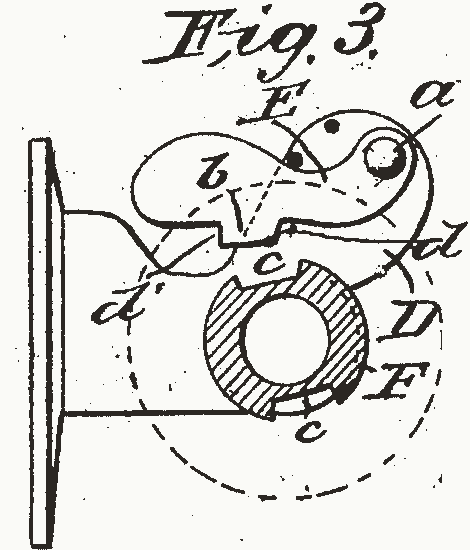
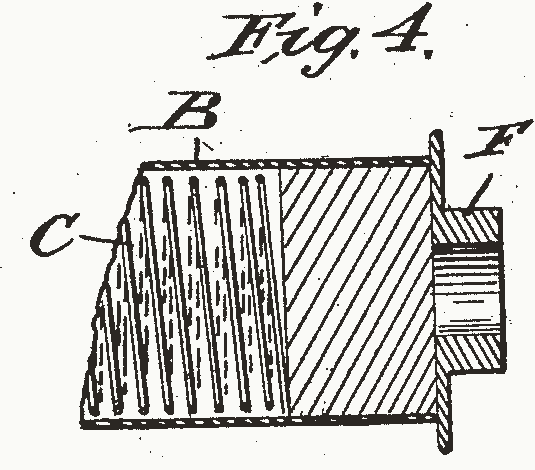
The design had one fault. With the pawl on the bracket and the hub on the roller, lifting the roller out of its brackets parted them. The spring ran down. It then had to be wound again before the roller went back in, a job Hartshorn’s next patent, of 3 September 1867, calls hard for anyone unskilled. A spring that has run down leaves the blind as Fig. 1 does with too little winding, unable to roll itself up.
Pawls on the roller
Three patents of September 1867 put the pawl on the roller. Hartshorn’s of 3 September fixed both the pawl and the notched hub to it. With both on the roller, the spring kept its winding out of the brackets. William Campbell’s, of 24 September, used loose pins in the roller’s end. Whenever the roller turned with a little speed, the spinning threw them outward, clear of a flattened shaft. When it slowed, the uppermost pin dropped onto the shaft and held it at the flat.
Jacob David, in a patent of the same day, hinged an arm in a slot in the end of a wooden roller. Spinning fast, the roller swung the arm out past a raised side of the box that held the rod. Slow or still, the arm fell toward the middle whenever it was uppermost. Then it caught. David said in evidence that he wanted to do away with the noise of Hartshorn’s roller, whose hub kept striking the pawl and throwing it up. In 1887, in a case over three of these patents, the US Supreme Court found that the roller made by the Saginaw Barrel Company had its pawl on the turning part and its ratchet on the fixed part.
On Engineering Stack Exchange, someone asked what the clutch in a roll-up window shade is called. Searching for a centrifugal clutch had brought up the kind that engages with speed. The answer they accepted called it a spring-loaded ratchet and pawl, unlocked as the user starts the shade rolling.
Bead chains and clutches
The ratchet and pawl is the most common way to hold a roller shade, by the account of a patent filed in 1994. The same patent calls it “notoriously unpopular”.
A clutch, worked by a loop of cord or bead chain, can hold the roller too. In the usual kind, a coil spring is wound tightly round a fixed stud. The shade’s weight makes it grip the stud harder still, so the roller cannot turn. The chain turns a pulley that pushes on one end of the spring. That opens the coil a little. It slips round the stud and lets the shade go up or down.
A chain or cord that hangs in a loop can strangle a young child, quickly and silently, and so can any window-covering cord within reach that is longer than 8 inches (20 cm). Cordless blinds are the safest choice where young children are. Since 15 December 2018 the US standard ANSI/WCMA A100.1 has required blinds sold ready-made to be cordless, or to have cords that are short or out of reach. A spring roller is worked by its bottom bar. It needs no loop at all.
What the drawings leave out
The sizes are the drawing’s own. The first drawing leaves out friction and treats the roller as equally thick all the time, though the cloth wound on it makes it fatter as the blind goes up. Its roller is drawn far thicker than its drop, and its spring looks the same however many turns it holds. Its two arrows give the spring’s pull as a weight hung from the roller’s edge, the way the text counts it.
In the second, the pawl falls like a stone. A real one swings on its pivot and may bounce. The second drawing also turns its hub at a steady speed, while a real roller let go keeps speeding up, and its rule that half the notch’s depth is enough to catch is its own. Its pawl and bracket are plainer shapes than Hartshorn’s, though its two notches sit opposite each other as his do. It leaves out the plate on the roller’s end that held his hub and adds a brass knob as a grip.
Sources
Read in November 2026.
- S. Hartshorn, US Patent 44,624, “Improved curtain-fixture”, 11 October 1864: the text and the drawing sheet.
- Supreme Court of the United States, Hartshorn v. Saginaw Barrel Co., 119 U.S. 664 (1887), for the coach fixture and the patents of 1864 and 1867.
- J. David, US Patent 69,189, “Improved curtain-fixture”, 24 September 1867.
- E. T. Rude, US Patent 5,482,105, “Clutch control for roller shades”, 9 January 1996.
- J. Berman, V. J. Brown and V. Erlikh, US Patent 6,164,428, “Wrap spring shade operator”, 26 December 2000.
- Draper, “Spring-Roller Window Shades by Draper”, installation instructions, 2015.
- US Consumer Product Safety Commission: “Window Covering Cords”; the release of 2 November 2022; the release of 2019 on the voluntary standard; the 15(j) rule guidance.
- Millburn-Short Hills Historical Society, “A Look at the Hartshorn Spring Shade”, a column on Patch, for the label and the name.
- r/explainlikeimfive, “ELI5: How do those old-fashioned blinds that you pull down to get them to roll up work?”, February 2017, via the Arctic Shift archive. User report.
- Engineering Stack Exchange, “What is name of clutch system in a roller shade?”, November 2019. User report.
The type is Playpen Sans by TypeTogether, under the SIL Open Font License 1.1.