Zipper
Two rows of small metal teeth on strips of cloth hold a zipper shut. Every tooth has a bump on one face and a hollow on the other. Pulled up, the slider sets each bump into a hollow. Pulled down, it lifts them out again, one tooth at a time.
Two tapes and the teeth on them
A zipper on a pair of jeans has two strips of cloth, the tapes, with a row of metal teeth clamped along the inner edge of each. Two small top stops keep the slider from running off the upper ends, and a bottom stop holds the rows together below. You move the slider by its pull, the flat tab that hangs from it. Fig. 1 names these parts on a short zipper that is half open.
Zippers are sold by a size number. It is close to the width of the closed teeth in millimetres, so a number 5 is 5 to 6 mm across. Number 5 is the usual size for jeans and jackets of middle weight, and the size is often stamped on the flat underside of the slider.
One row is set half a tooth lower than the other, so when the chain is closed the teeth take turns across it, from the bottom stop up to the slider.
One tooth
Each tooth in Sundback’s zipper is a small metal cup. His patent of 1917 makes every tooth the same shape, on both tapes, and has them stamped from flat metal. A tooth starts with two open jaws at one end. These are pushed over the corded edge of the tape, a cord sewn along it to make a bead, and pressed shut until the cord is squeezed tight between them.
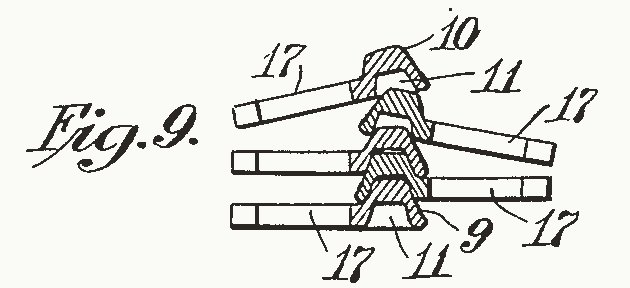
The free end of the tooth, its head, is the cup. On one face it has a rounded hollow, and on the other face the outside of that hollow stands up as a bump. In the closed chain every bump sits in the hollow of the tooth above it, which belongs to the other tape. Sundback put it as “the outside of one member nests within the recess of an adjoining member”. Paper cups in a stack nest the same way, the outside of each in the hollow of the next.
Sundback also designed the machine that made them. Each tooth is one piece. His machine cut it from a strip of Y-shaped wire, punched the hollow and the bump into it, and clamped it onto the tape, so a continuous chain came out of the machine.
Why the closed chain holds
Pull the two tapes of a closed zipper apart and the chain stays shut. YKK tests that pull: a closed length 2.5 cm long is clamped by its tapes and pulled crosswise at a constant speed.
Each bump sits inside a hollow. When the tapes pull, the bump presses on the side of its hollow, and the hollow cannot slide off sideways. It can leave the bump only by lifting off it, and a tooth clamped to the edge of a tape can lift its head only by turning about that edge.
Try turning tooth 2 in Fig. 2 first, then tooth 1, and find out which of them has to go before the other.
What the drawing shows
Tooth 1 has to go first. Tooth 2 turns a few degrees and stops, because its head rises into tooth 1, which still lies over it. Tooth 1 is the last tooth in the chain and has nothing above it, so it turns freely. Once its hollow has lifted clear of the bump on tooth 2, tooth 2 can turn as well and lift off tooth 3. So a closed chain comes apart only from its end, one tooth at a time, and on a real zipper that end is wherever the slider has stopped.
The rounded cups also let the chain bend. Sundback wrote that the teeth of one tape can “rock or oscillate freely” against the teeth of the other without coming apart. His fastener would “remain locked even while the fastener is almost doubled on itself”.
Inside the slider
The slider is two plates, one in front of the teeth and one behind, joined in the middle by a post called the diamond. The pull is fixed to the top of the diamond. Along each side the plates have lips, the side walls, which hold a tape edge and the tails of its teeth. Between them the side walls make a channel shaped like a Y, with two arms at the wide end, the shoulder, and a single passage at the narrow end, the rear mouth.
When you pull the slider up, each row comes in through one arm of the Y, leaning outward. Just above the rear mouth the side walls bend the row back upright. In that bend every tooth is turned, as you turned tooth 1 in Fig. 2, and as the row straightens, its hollow comes down over the bump of a tooth from the other row. Pull the slider down and the same bend works backwards. The walls lead each row outward, the teeth turn, and their hollows lift off. Higher up, the diamond keeps the two rows apart.
Pick a tooth just above the slider in Fig. 3 and guess how far into the slider it goes before it hooks onto the other row.
What the drawing shows
In the drawing a tooth hooks on in a short bend near the narrow end, a few millimetres above the rear mouth and well below the point of the diamond. Everything above that is the slider bringing the two rows in from the sides. In the drawing the diamond never touches a tooth, so the turning is all done by the bend. Each time the slider moves up by the spacing of one tooth, one more tooth hooks on, from each tape in turn.
Stops and locking sliders
Stops keep the slider on the chain. In Sundback’s patent the two top stops enter the slider and meet in the middle, and side by side they are too wide to pass out of its narrow end. So the slider goes no further.
Some sliders also stay where you leave them. YKK makes an auto lock slider with a small mechanism inside that holds it in place until you pull on the tab. On a pin lock slider, pins on the pull go down into the teeth. On some trousers the pin drops between the teeth through a hole in the slider when the pull is folded flat.
A common fault is a zipper that comes apart again just behind the slider. A guide on iFixit, written by a reader, calls this very common on tents, backpacks and luggage. Most often the slider is worn or bent and can no longer press the teeth together. The guide’s fix is to squeeze the top and bottom plates of the slider a little closer with locking pliers, clamping only the slider. You tighten the pliers’ screw a sixteenth or an eighth of a turn at a time and clamp both sides the same, until the zipper closes properly. Going too far makes it hard to close.
Clasps first, cups later
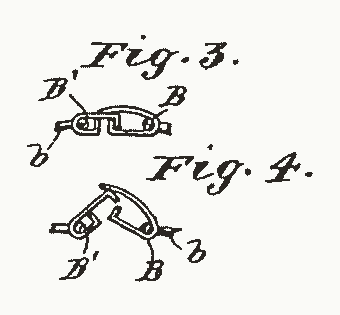
Whitcomb L. Judson of Chicago applied in November 1891 for a “clasp locker or unlocker for shoes”, and US Patent 504,038 was granted on 29 August 1893. Each clasp had two hooked halves that could “only engage with each other when at an angle to the line of strain”, and then only with the parts at about ninety degrees (Fig. 4, left). A locked clasp lies flat along that line, so pulling a boot tight keeps it shut. Closing the clasps one by one by hand was, he wrote, “a tedious operation”. He added a guide with two channels at its front end that ran together “over an angular center ridge” into one channel at the back. Fig. 3 has the same plan.
The fastener sold badly. Its clasps tended to pop open under stress and sometimes tore the cloth. In 1904 the firm, now the Automatic Hook and Eye Company, brought out the C-Curity under the slogan “A Pull and It’s Done”. In 1906 it hired a Swedish engineer, Gideon Sundback. Judson died in 1909.
A patent that Sundback filed in 1908 and was granted in 1913 still used hooks and eyes. It says of the older design that when the chains were bent, “the points of the hooks tend to disengage themselves”. In August 1914 he applied for a fastener with no hooks at all, the cups of Fig. 2. US Patent 1,219,881 was granted on 20 March 1917 to Sundback of Meadville, Pennsylvania, assigned to the Hookless Fastener Company. Its slider is made of two stamped sides, each with a Y-shaped channel, and a cap whose point fits between the arms.
Sundback was born in Sweden in 1880. He moved to the United States in 1905 and died in Meadville in 1954.
The name and the three letters
The first thing made in quantity with the new fastener was a money belt of 1917, popular with sailors in the First World War. The word came later, and Judson never heard it. In 1923 the B. F. Goodrich Company put the fastener on rubber galoshes, called it the zipper and registered the name as a trademark for its rubber footwear. It copies the slider’s sound.
Many sliders carry the letters YKK. They stand for Yoshida Kōgyō Kabushikigaisha, the firm Tadao Yoshida started in Tokyo in January 1934 as San-S Shokai. In 1937 the Hookless Fastener Company took the name Talon. By then Sundback’s main patent had run out, and Yoshida was one of its new rivals. Yoshida’s Komatsugawa plant burned down in the air raids on Tokyo in March 1945. That August the firm bought a works in Uozu and took the name Yoshida Kogyo, and in January 1946 it registered YKK as a trademark. In 2015 some 7 billion zippers a year were stamped with the letters.
What the drawings leave out
The sizes are the drawing’s own. Only the chain’s width follows a source: in Figs. 1 to 3 it is drawn 6 mm wide, like a number 5. The teeth, their spacing, the slider and the angle of its arms are by eye. The gaps between the teeth are wider than on a real zipper, so you can see where each tooth ends. The two plates of the slider and the lips that hold the tapes are drawn as one cut through the middle. The bumps and hollows have flat tops and straight sides where Sundback’s are rounded, and his bumps have sloping ends that guide the next tooth into place.
In Fig. 2 you turn the teeth by hand, one at a time. The slider in Fig. 3 does the same in its short bend near the narrow end, taking one tooth from each tape at a time.
Every tooth on this page is metal. Real metal teeth are brass, aluminium or nickel; in the drawings brass marks only the parts that move. Most zippers sold today have no separate teeth. Each tape carries a plastic coil, and the turns of the coil are the teeth that the slider joins.
Sources
Read in November 2026.
- G. Sundback, US Patent 1,219,881, “Separable fastener”, 20 March 1917, for the cups, their jaws, the slider and the stops; Fig. 4 shows its Fig. 9.
- W. L. Judson, US Patent 504,038, “Clasp locker or unlocker for shoes”, 29 August 1893, for the clasps and the guide; Fig. 4 shows its Figs. 3 and 4.
- G. Sundback, US Patent 1,060,378, “Separable fastener”, 1913, for the hooks and eyes.
- G. Takani and T. Ozawa (YKK), US Patent 8,225,466, 2012, a slider for a concealed zipper, for the names of the slider’s parts.
- YKK Americas, “The Structure of a Zipper”, for the parts and the tape.
- YKK Americas, “Product Testing Methods”, for the crosswise pull and the standards.
- YKK Americas, pin lock and auto lock sliders.
- YKK Corporation, corporate history, for San-S Shokai, the fire, Uozu and the trademark.
- Wikipedia, “Zipper”, for Sundback’s machine, the trouser pin, worn sliders and coil zippers.
- Wikipedia, “Gideon Sundback”, for his dates.
- Lemelson-MIT, “Whitcomb Judson”, for the word and Judson’s death.
- Scientific American blog, on Gideon Sundback (2012), quoting L. Weiner, “The slide fastener”, Scientific American, June 1983, for the firm’s early years, the money belt and Goodrich.
- New Scientist, “A fastening on history”, a review of R. Friedel, “Zipper: An Exploration in Novelty”, for the hookless fastener, Talon and the 1922 date.
- D. Lewis, Smithsonian Magazine, on YKK (2015), for its letters and its count.
- WAWAK, “Zipper Size Chart”, for size numbers.
- iFixit, “Repairing Zipper Slider”, a guide written by a reader, for the split behind the slider and the pliers. User report.
The type is Playpen Sans by TypeTogether, under the SIL Open Font License 1.1.